career · Article
CBTC Engineering Salary in the US: 2026 Benchmarks

CBTC engineering salaries in the United States in 2026 are higher than they were five years ago and still lower than the equivalent roles in software, semiconductors, or aerospace. That basic structure has been stable for a long time, even as the discipline has tightened up and the demand for working CBTC engineers has consistently outrun supply. This post pulls together the publicly available salary data from the US Bureau of Labor Statistics, Glassdoor, LinkedIn aggregates, and agency labor agreements, and adds the practitioner context that the published numbers do not. The framing is honest about ranges and hedged where the data is thin. None of this is investment advice, none of it is a guarantee, and any individual offer will land where it lands depending on the specifics.
What the public data actually says
The Bureau of Labor Statistics does not publish a “CBTC engineer” occupational code. The discipline sits inside three BLS categories, depending on which subsystem the engineer works on: Electrical Engineers (17-2071), Electronics Engineers (17-2072), and Industrial Engineers (17-2112). The 2024 BLS Occupational Outlook Handbook reports a median annual wage of approximately $111,000 for electrical engineers and a similar range for electronics engineers, with the 75th percentile near $140,000 and the 90th percentile above $170,000. The transportation industry sub-aggregate runs slightly above the cross-industry median, by roughly 5 to 8 percent depending on the year.
Those numbers are the right starting point. They are also too coarse to be useful for someone trying to evaluate a specific offer. Glassdoor, LinkedIn salary aggregates, and Built In tend to show higher numbers than the BLS figures because their samples are skewed toward higher-cost metropolitan areas (NYC, San Francisco, Boston, Washington DC) and toward larger employers, both of which pull the median up. The Glassdoor self-reported median for “CBTC engineer” or “rail signaling engineer” in 2025 was generally in the $115,000 to $135,000 range; LinkedIn aggregates were similar. These are noisier numbers than the BLS data but are closer to the actual offer landscape in the metros where most CBTC work happens.
The pattern across the public data is consistent enough to support some working ranges. The numbers below are the practitioner-recalibrated benchmarks I would use in 2026, with the caveat that any individual offer can easily land outside them. (For where CBTC engineering sits in the career arc that produces these numbers, see How to Become a CBTC Engineer: A 2026 Career Path.)
Working ranges by experience level
A junior CBTC engineer (zero to three years experience) at a major vendor in a major metro area typically lands between $80,000 and $110,000 base salary in 2026, with total compensation including benefits and any project-completion bonuses pushing the number 5 to 15 percent higher. The agency side runs lower, typically $75,000 to $95,000 base, with stronger benefits and pension contributions that partially close the gap on a total-compensation basis. Junior engineers in lower-cost metros (Atlanta, Phoenix, Honolulu, Denver) generally land 10 to 20 percent below the New York and San Francisco numbers.
A mid-career CBTC engineer (four to ten years experience, with one or more deployment cycles completed) typically lands between $115,000 and $160,000 base salary at a vendor in a major metro, with total compensation in the $130,000 to $185,000 range depending on bonus structure and any spot incentives for revenue-cutover commissioning periods. The agency side typically runs $105,000 to $140,000 base for an equivalent senior systems engineer or chief engineer role, with the same caveat about pension and benefits closing some of the gap.
A senior CBTC engineer (ten-plus years, with project leadership or principal-engineer responsibility) typically lands between $160,000 and $230,000 base salary at a vendor, with total compensation occasionally crossing $250,000 for principal engineers and chief architects on flagship deployments. The agency side runs $135,000 to $185,000 base for a senior systems engineer or director-level role; agency total comp can match the vendor side once benefits and pension are valued, particularly for engineers within ten years of vested retirement.
A program manager or director of engineering at a vendor running a major US deployment typically lands in the $200,000 to $300,000 base range with significant variable compensation tied to project milestones; comparable roles at the agency level run lower base ($165,000 to $230,000) with less variability. Executive roles (vice president of engineering, chief technology officer at a transit-rail business unit, agency chief signal engineer) sit above this range and are highly variable; the data is too thin and too individual to publish a useful number.
The metropolitan-area differential
CBTC work is metropolitan-concentrated. The major US deployments — NYC, BART, WMATA, SFMTA, MARTA, HART, Honolulu, BART again — drive the labor demand, and the salary differentials reflect the cost-of-living differentials in those metros plus a modest premium for the specialized labor pool.
New York and the surrounding region (Newark, Jersey City, Long Island) is the highest-pay metro for CBTC work in the US, with base salaries running 10 to 20 percent above the cross-metro average. The premium is partly cost-of-living (NYC is the most expensive major US metro) and partly demand: the MTA’s CBTC retrofit program is the single largest US deployment by volume, and the labor pool has not kept up with demand.
The San Francisco Bay Area is similar — high cost-of-living, high demand from BART’s TCMP and SFMTA’s TCUP — but with a smaller absolute labor demand than NYC. Base salaries run 5 to 15 percent above the cross-metro average.
Washington DC and the surrounding region (WMATA’s CBTC modernization, plus federal contractor presence) runs roughly at or slightly above the cross-metro average; the salary effect is modest because the DC region’s cost-of-living premium is offset by the proximity of lower-cost suburban Virginia and Maryland.
Boston, Philadelphia, and Atlanta run roughly at the cross-metro average. Honolulu is unusual: cost-of-living is high, the HART CBTC labor demand is concentrated, and the relocation friction (the 4,000-mile flight to anywhere) keeps the labor pool small enough to support compensation at or slightly above the cross-metro average.
Phoenix, Denver, Dallas, and Charlotte are lower-cost metros where CBTC presence is smaller but growing. Salaries typically run 10 to 15 percent below the cross-metro average. The career trade-off for an engineer in these metros is fewer projects per year of experience but lower cost-of-living and shorter commutes.
The vendor-versus-agency gap
The vendor-versus-agency gap is the structural feature most career decisions in this discipline have to engage with. Vendor base salaries run 10 to 25 percent above agency base salaries for equivalent technical responsibility. Vendor total compensation runs higher still on a current-year basis, particularly for senior and program-management roles where variable compensation is meaningful.
The agency side closes the gap on a lifetime-earnings basis through benefits and pension. A senior agency engineer with a vested pension worth 50 to 65 percent of final salary at retirement is in a different financial position than a vendor engineer with a 401(k) match. Whether the vested pension is more valuable than the higher current cash depends on the engineer’s age, tenure, family situation, geographic mobility, and risk tolerance. There is no universal answer.
The agency side also typically offers more job stability than the vendor side. Vendor staffing fluctuates with project pipelines; agency staffing is more linear. Engineers who have been through a vendor downsizing during a between-projects gap year — and most who have been at vendors for more than a decade have — value agency stability differently after the experience than before it.
A meaningful number of senior US CBTC engineers move from vendor to agency mid-career, often in their forties, trading current cash for stability and pension. A smaller number move the other direction, often early in their forties, trading stability for the upside of senior vendor roles. Both moves are legitimate; neither is the right answer for everyone.
What the published numbers do not show
A few important pieces of the compensation picture do not show up cleanly in the BLS, Glassdoor, or LinkedIn data.
Field commissioning premiums are common at vendors during revenue cutover periods. An engineer running a multi-month cutover often receives a project-completion bonus, an overtime allowance, or a per-diem that meaningfully exceeds the published base salary for the months in question. The published median misses this because the premium is event-driven.
Specialty premiums for hard-to-fill roles (cybersecurity for safety-critical systems, formal-methods verification, advanced ATO algorithms, high-density wireless DCS design) often add 10 to 20 percent above the median for an engineer with the right specific background. The data on these is thin because the population is small.
Geographic-mobility premiums occur for engineers willing to relocate to the project. A vendor offering a senior commissioning lead role in Honolulu or Phoenix often adds a meaningful relocation package and sometimes a recurring premium that does not appear in the salary aggregates because the published medians are metropolitan-specific.
Equity at vendors with publicly traded parent companies (Siemens, Alstom, Hitachi, the publicly listed engineering consultancies) is part of senior compensation but rarely appears in self-reported salary aggregates. For engineers at the principal or director level, equity grants over a multi-year vest can add 10 to 30 percent to total compensation depending on the company and the year.
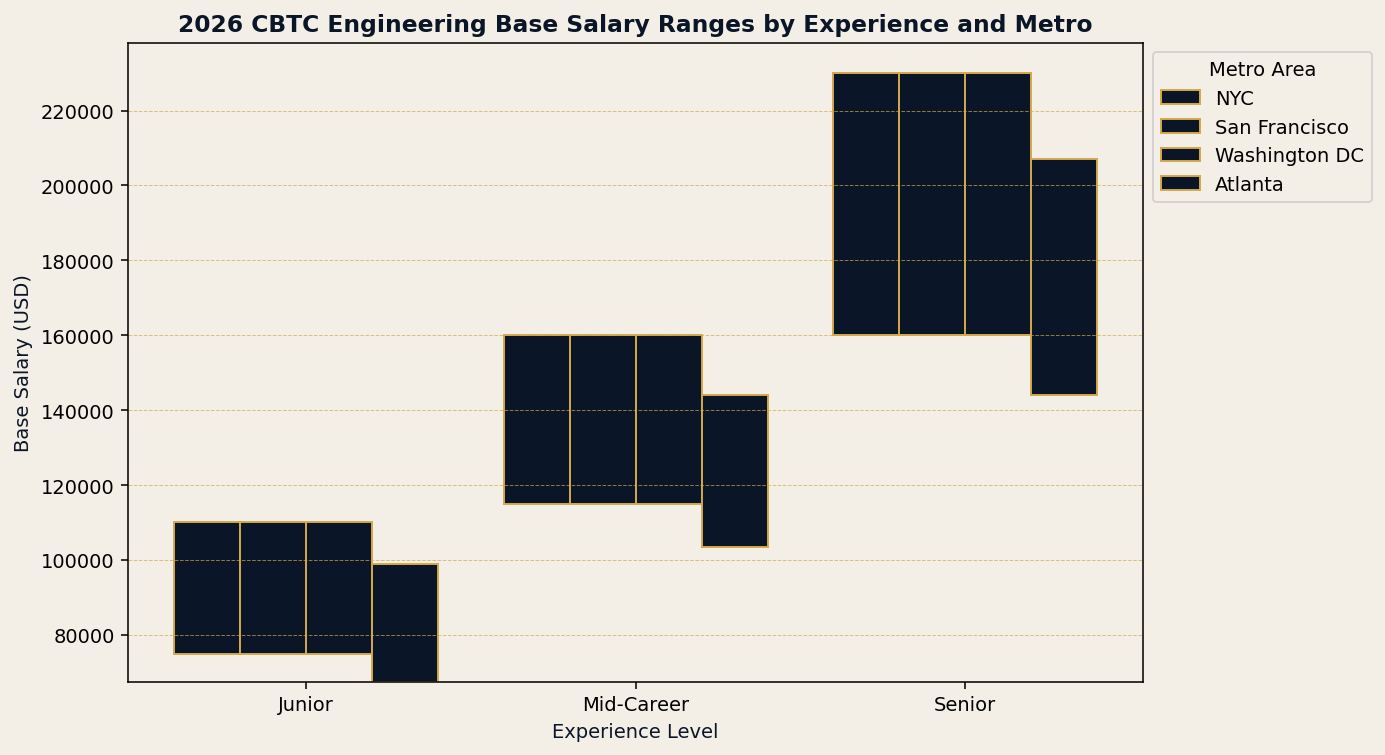 Working ranges for CBTC engineering compensation in 2026. Individual offers can land outside these ranges; the metro and.
What this means in practice
- The Bureau of Labor Statistics, Glassdoor, and LinkedIn aggregates produce different medians because the samples are different. The BLS is the most authoritative; the aggregates are closer to the offer landscape in major metros.
- Working 2026 ranges: junior $75,000 to $110,000, mid-career $105,000 to $185,000 total comp, senior $135,000 to $250,000-plus total comp. Agency runs lower on base, often comparable on total compensation once benefits and pension are valued.
- Metro differentials are real. NYC and Bay Area run 10 to 20 percent above the cross-metro average; lower-cost metros run 10 to 15 percent below.
- The vendor-versus-agency gap closes on a lifetime-earnings basis through pension and benefits at the agency. The right side of the gap depends on the engineer’s life situation, not on a universal answer.
- Field commissioning premiums, specialty premiums, and equity at major-vendor roles are not visible in the published medians but can add 10 to 30 percent at the senior level.
Where to go next
This post is a 9-minute orientation. The career-path context is in the companion piece: How to Become a CBTC Engineer: A 2026 Career Path. The author’s Communications-Based Train Control (Volumes 1 and 2) is the technical reference: Buy on Amazon.
Sources
- US Bureau of Labor Statistics. Occupational Outlook Handbook — Electrical Engineers, Electronics Engineers, Industrial Engineers (2024 edition with 2026 projections). bls.gov/ooh
- US Bureau of Labor Statistics. Occupational Employment and Wage Statistics — Transportation Industry. bls.gov/oes
- Glassdoor. Salary aggregates for “CBTC engineer,” “rail signaling engineer,” and related titles. glassdoor.com (consulted 2025).
- LinkedIn Salary. Aggregated self-reported compensation data for transit signaling engineering roles. linkedin.com/salary (consulted 2025).
- MTA New York City Transit. Labor Agreements with TWU Local 100 and ATU (publicly available portions). new.mta.info
- BART. Labor Agreement with Operating Engineers Local 3 and SEIU Local 1021 (publicly available portions). bart.gov
- American Public Transportation Association. Workforce Studies and Compensation Reports. apta.com
- Wang, C. (2026). Communications-Based Train Control (Volumes 1 and 2). Independent. ISBN 979-8-258-54295-3.
How this article was produced. Drafted with AI assistance, then reviewed and fact-checked by Chunjun (Francisco) Wang against Communications-Based Train Control (the author's two-volume reference) and primary sources — agency records, vendor documentation, and IEEE/IEC standards. Every date, vendor, and figure is traceable to a cited source. Spot a mistake? Corrections are welcome via the contact page.
Read the full treatment in the book
Chapter 12 of Communications-Based Train Control, Volume 2, covers this in depth.