Volume 02 of Two · Now Published

Operations, Deployment & Economics

Pages594
Words112,000
Chapters8
Format7 × 10 in

From architecture to practice. Operating modes, hard-won lessons of US deployments — New York MTA, San Francisco BART — benchmarked against London, Paris, and Asia. Project lifecycle, performance criteria, lifecycle cost analysis, and a clear-eyed map of the vendor landscape.

◉ Rail Signaling · Technical ReferenceEd. 2026
Volume 02 — of Two
Communications-
Based Train
Control
A Comprehensive Guide for US Transit Professionals
Operations, Deployment & Economics
Author
Chunjun (Francisco) Wang
594 pp · 112,000 words
7 × 10 in
About this VolumeVOL 02 / 02

From architecture to practice. Operating modes, hard-won lessons of US deployments — New York MTA, San Francisco BART — benchmarked against London, Paris, and Asia. Project lifecycle, performance criteria, lifecycle cost analysis, and a clear-eyed map of the vendor landscape.

Chunjun (Francisco) Wang · CBTC Engineer
Booth MBA · CFA
Published via Amazon KDP
Click to flip ↺
Selected figures from Volume 02 · 36 total
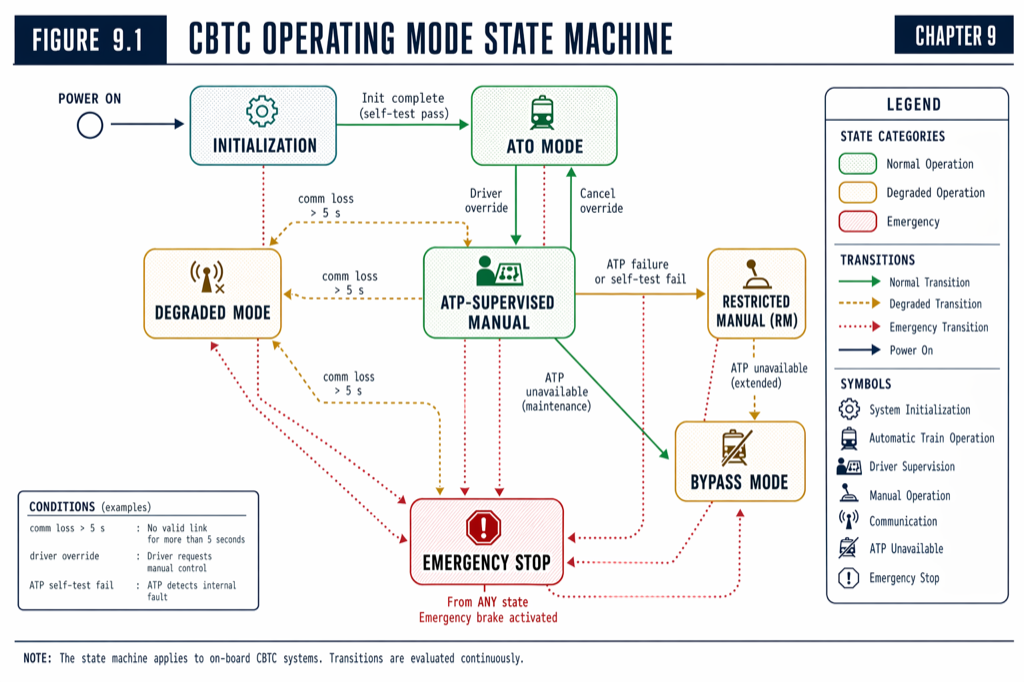
Mode State Machine
Fig 9.1Mode State Machine
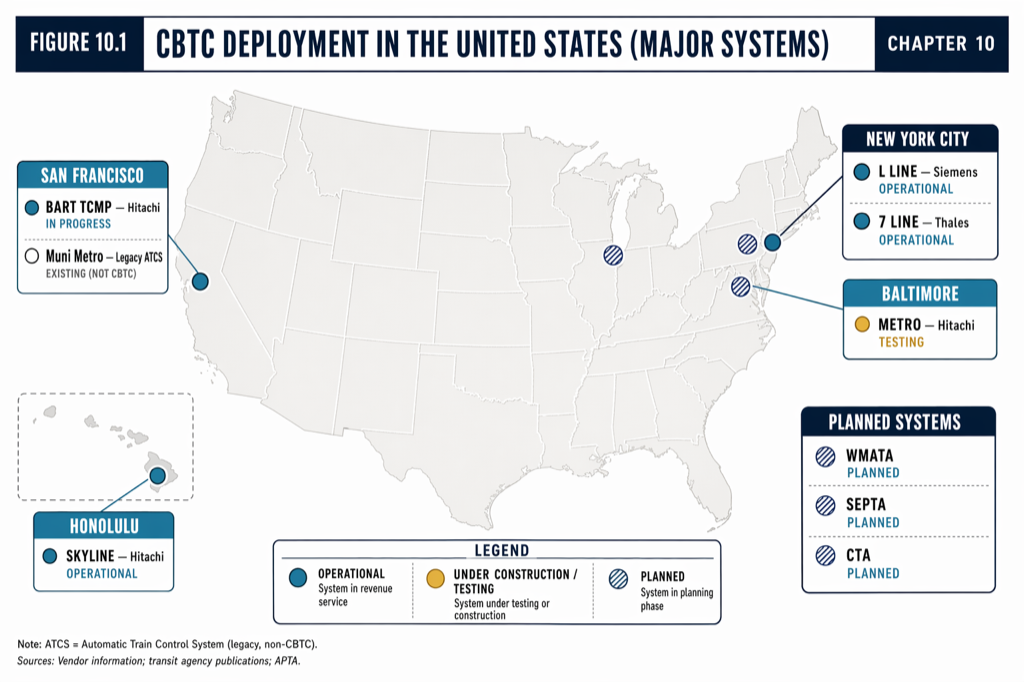
US CBTC Deployment Map
Fig 10.1US CBTC Deployment Map
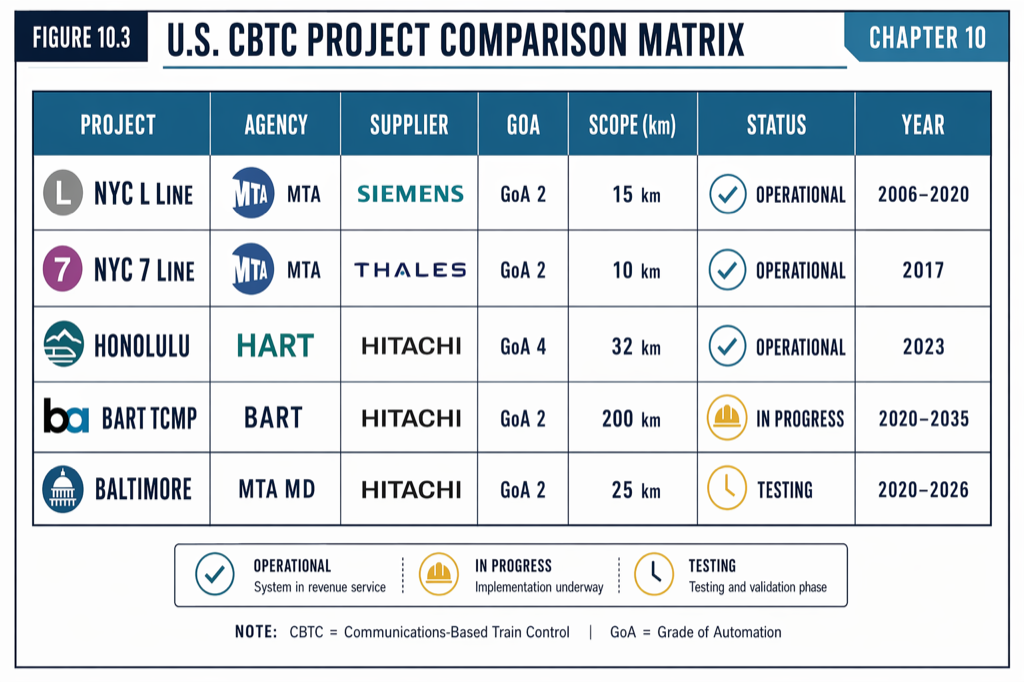
Project Comparison Matrix
Fig 10.3Project Comparison Matrix
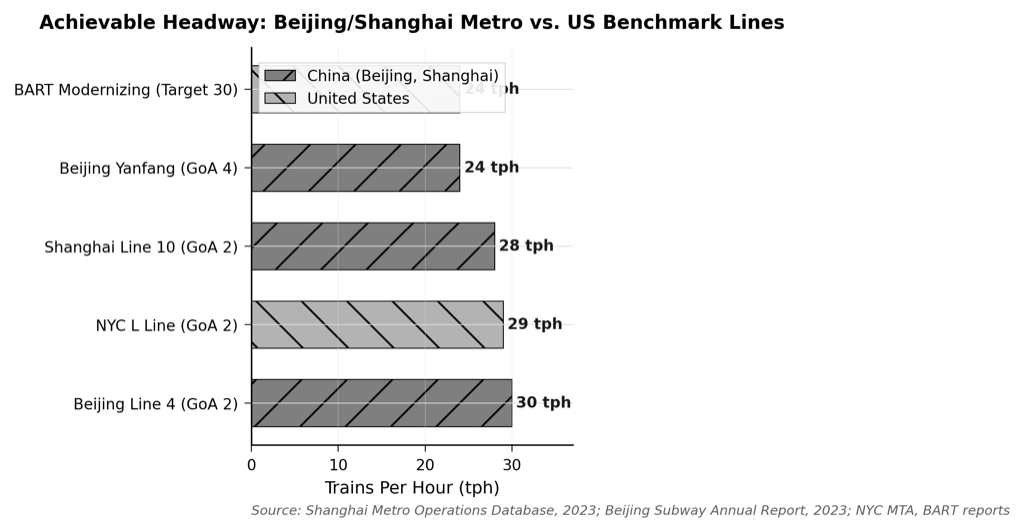
Headway — Major Networks
Fig 11.7Headway — Major Networks
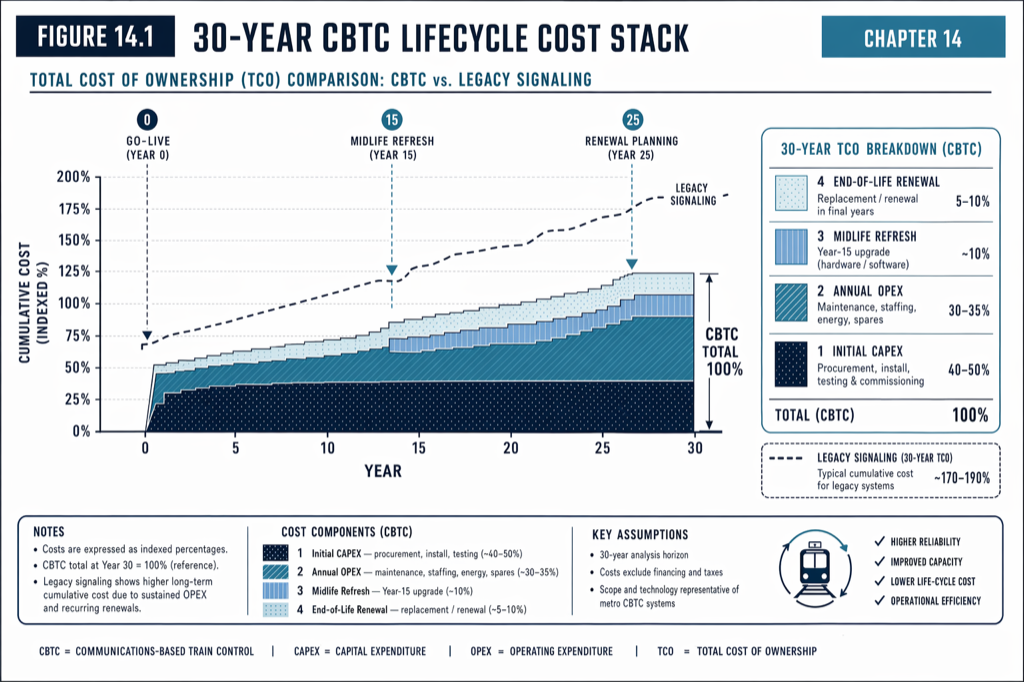
30-Year Lifecycle Cost Stack
Fig 14.130-Year Lifecycle Cost Stack
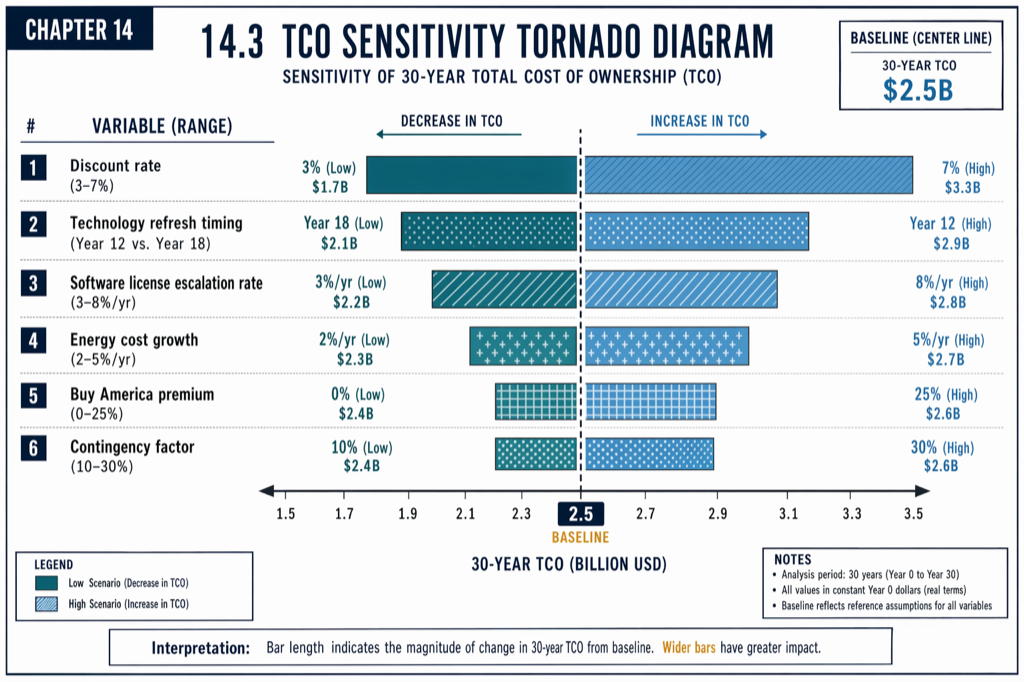
TCO Sensitivity Tornado
Fig 14.3TCO Sensitivity Tornado
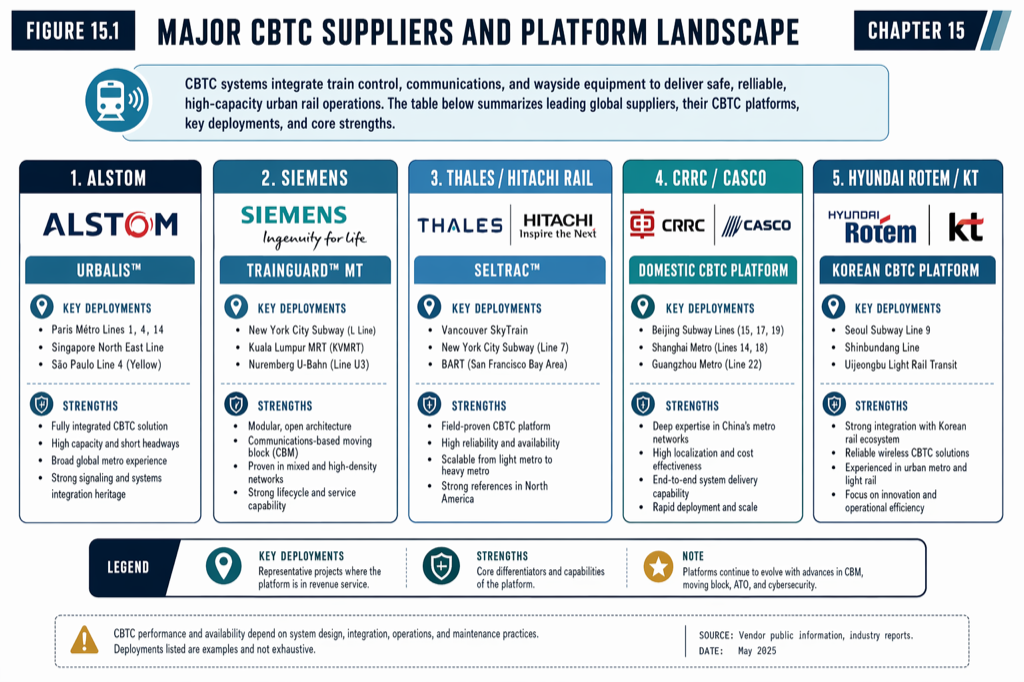
Global Supplier Landscape
Fig 15.1Global Supplier Landscape
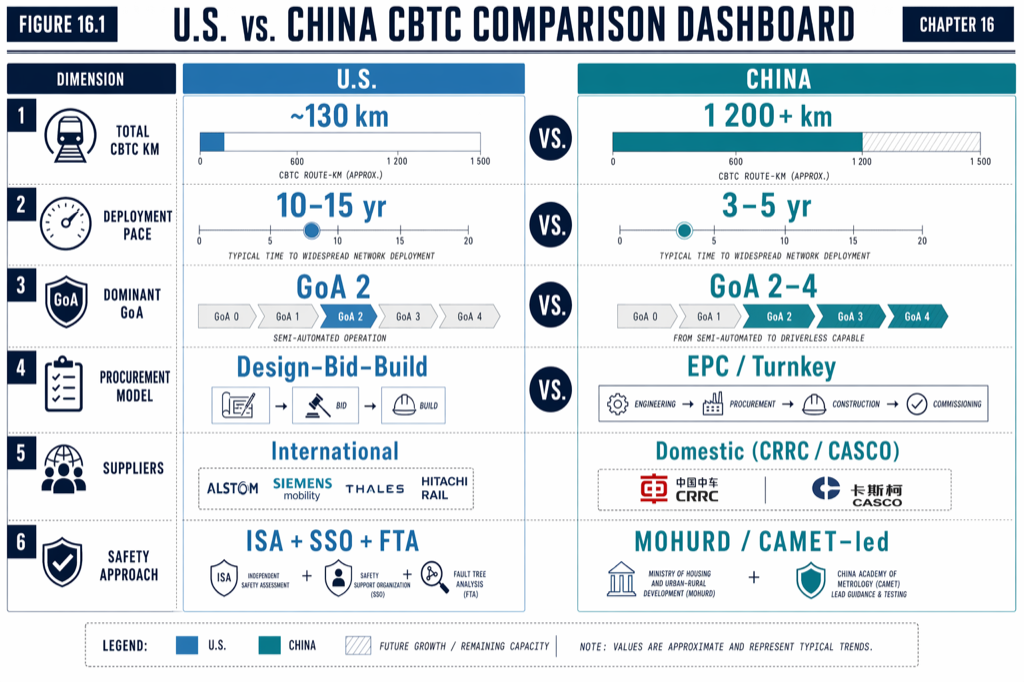
China vs. US Dashboard
Fig 16.1China vs. US Dashboard
Browse all 78 figures →
Full table of contents

8 chapters · grouped into five parts

09 Operating Modes 68 pp
10 CBTC in the United States 42 pp
11 International Benchmarks 31 pp
12 Project Lifecycle 42 pp
13 Performance Criteria 36 pp
14 Lifecycle Costs 42 pp
15 Vendor Landscape 41 pp
16 US–China Comparative Perspectives 41 pp
Sample reading

Excerpts from 3 chapters

Selected passages from across Volume 02. Each is presented as it appears in the manuscript, with editorial framing removed.

CH · 10 CBTC in the United States

The L Line — America's CBTC pioneer

The L Line of the New York City Metropolitan Transportation Authority holds a singular distinction in North American rapid transit: it is the first full CBTC system deployed on a revenue passenger subway line. Beginning limited revenue service in April 2006 and achieving full operational integration by 2009, the L Line has served as the critical proof-of-concept for CBTC in the United States.

The MTA selected Siemens Transportation Systems in 1999 for the design and deployment of the Trainguard MT CBTC system. The initial contract value was approximately $340 million, covering design, installation, integration, testing, and a five-year support and warranty period. This contract would ultimately expand due to scope changes, extended testing, and integration complexity — a pattern common to large infrastructure programs but noteworthy for establishing baseline cost expectations that subsequent CBTC projects would reference.

CH · 14 Lifecycle Costs and Economic Justification

What a single onboard controller actually costs

Onboard CBTC equipment — the Vehicle-Borne On-Board Controller (VOBC) — represents one of the largest per-unit costs in a resignaling project. A typical installation on a single train cab includes: VOBC hardware and real-time operating system ($80K–$120K per cab), radio antenna and modem ($15K–$25K), odometry and inertial sensors ($20K–$40K), the cab display and DMI ($25K–$50K), and vehicle integration engineering ($40K–$60K).

Multiplied across a fleet of 40–150 trains, total onboard CAPEX typically ranges from $250K to $450K per train cab. A 100-car fleet would incur $25M–$45M in onboard equipment alone. This cost is highly sensitive to fleet composition — retrofit of older rolling stock requires more extensive integration work — and to the choice of VOBC vendor, where proprietary versus open-standard deployments can differ by 10–20%.

CH · 16 US–China Comparative Perspectives

A 20:1 ratio in route-kilometers

As of 2025, China operates rapid-transit networks across more than 50 cities, encompassing approximately 11,200 route-kilometers of urban rail infrastructure. CBTC has become the default technology standard for the vast majority of lines opened since 2010, with nearly all new construction projects incorporating CBTC from the outset of detailed design.

The United States maintains CBTC on approximately six metro agencies covering fewer than 500 route-kilometers in aggregate. This roughly 20:1 ratio is neither a measure of engineering maturity nor a reflection of technology capability. It reflects distinct demographic, financing, institutional, and procurement frameworks that shape investment velocity and capital deployment patterns. Typical US CBTC project approval and environmental review takes 5–7 years; the Chinese equivalent is 2–3 years. Neither approach is universally optimal — both are reasonable responses to distinct governance structures and labor markets.

Pair it with
VOL · 01

Foundations & Technical Architecture

The technical foundation of CBTC — the wireless signaling architecture that has replaced fixed-block circuits across modern metro systems. From the hundred-year evolution of train control to onboard ATP/ATO, wayside zone controllers, the data-communication radio network, and the central ATS that supervises it all — closing with the GoA 0–4 framework that classifies every level of automation built on top.

See Volume 01 →
◉ Rail Signaling · Technical ReferenceEd. 2026
Volume 01 — of Two
Communications-
Based Train
Control
A Comprehensive Guide for US Transit Professionals
Foundations & Technical Architecture
Author
Chunjun (Francisco) Wang
533 pp · 108,000 words
7 × 10 in
About this VolumeVOL 01 / 02

The technical foundation of CBTC — the wireless signaling architecture that has replaced fixed-block circuits across modern metro systems. From the hundred-year evolution of train control to onboard ATP/ATO, wayside zone controllers, the data-communication radio network, and the central ATS that supervises it all — closing with the GoA 0–4 framework that classifies every level of automation built on top.

Chunjun (Francisco) Wang · CBTC Engineer
Booth MBA · CFA
Published via Amazon KDP