Volume 01 of Two · Now Published

Foundations & Technical Architecture

Pages533
Words108,000
Chapters8
Format7 × 10 in

The technical foundation of CBTC — the wireless signaling architecture that has replaced fixed-block circuits across modern metro systems. From the hundred-year evolution of train control to onboard ATP/ATO, wayside zone controllers, the data-communication radio network, and the central ATS that supervises it all — closing with the GoA 0–4 framework that classifies every level of automation built on top.

◉ Rail Signaling · Technical ReferenceEd. 2026
Volume 01 — of Two
Communications-
Based Train
Control
A Comprehensive Guide for US Transit Professionals
Foundations & Technical Architecture
Author
Chunjun (Francisco) Wang
533 pp · 108,000 words
7 × 10 in
About this VolumeVOL 01 / 02

The technical foundation of CBTC — the wireless signaling architecture that has replaced fixed-block circuits across modern metro systems. From the hundred-year evolution of train control to onboard ATP/ATO, wayside zone controllers, the data-communication radio network, and the central ATS that supervises it all — closing with the GoA 0–4 framework that classifies every level of automation built on top.

Chunjun (Francisco) Wang · CBTC Engineer
Booth MBA · CFA
Published via Amazon KDP
Click to flip ↺
Selected figures from Volume 01 · 42 total
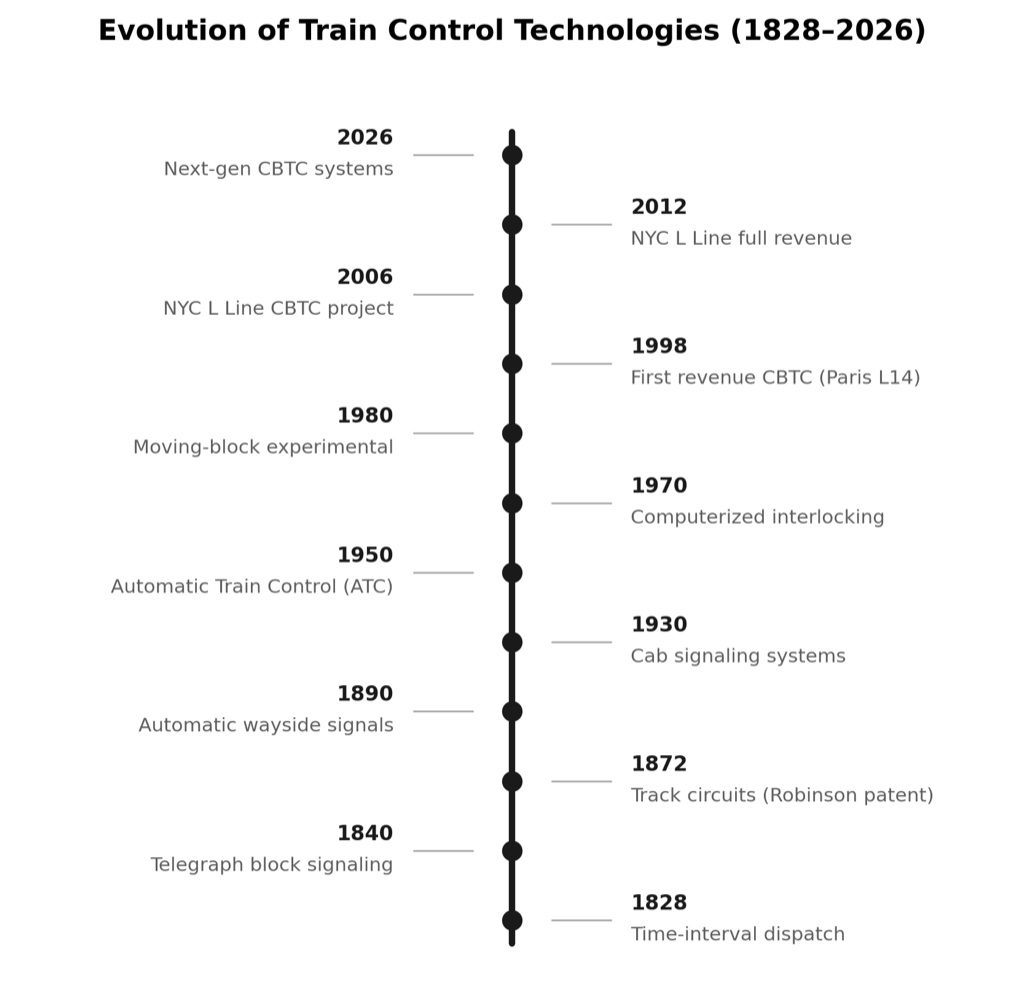
150-Year Evolution Timeline
Fig 1.1150-Year Evolution Timeline
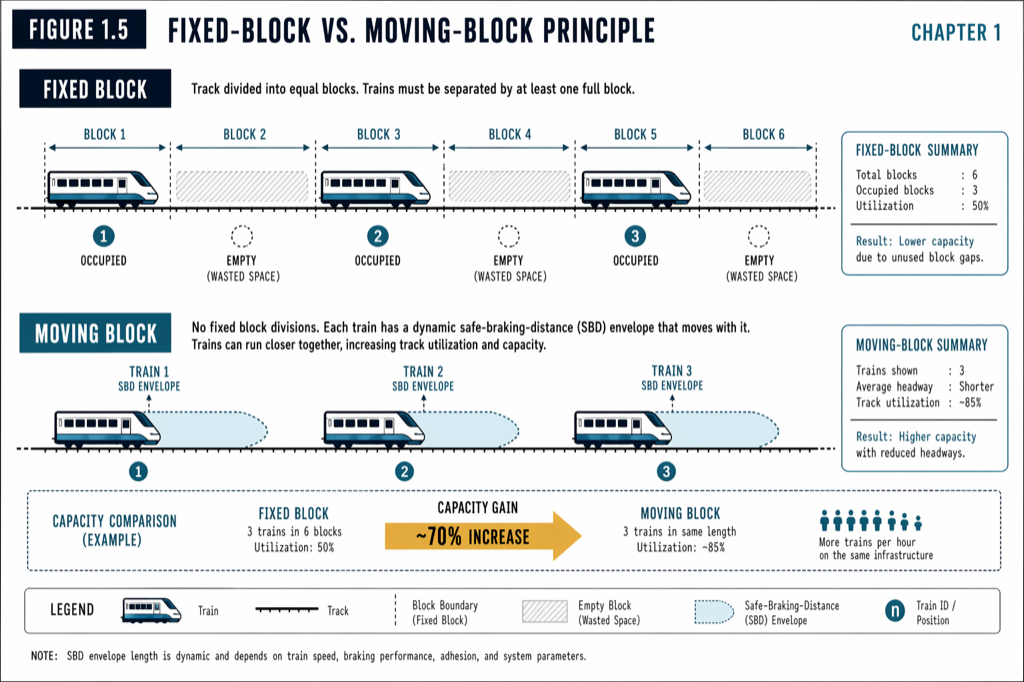
Fixed-Block vs. Moving-Block
Fig 1.5Fixed-Block vs. Moving-Block
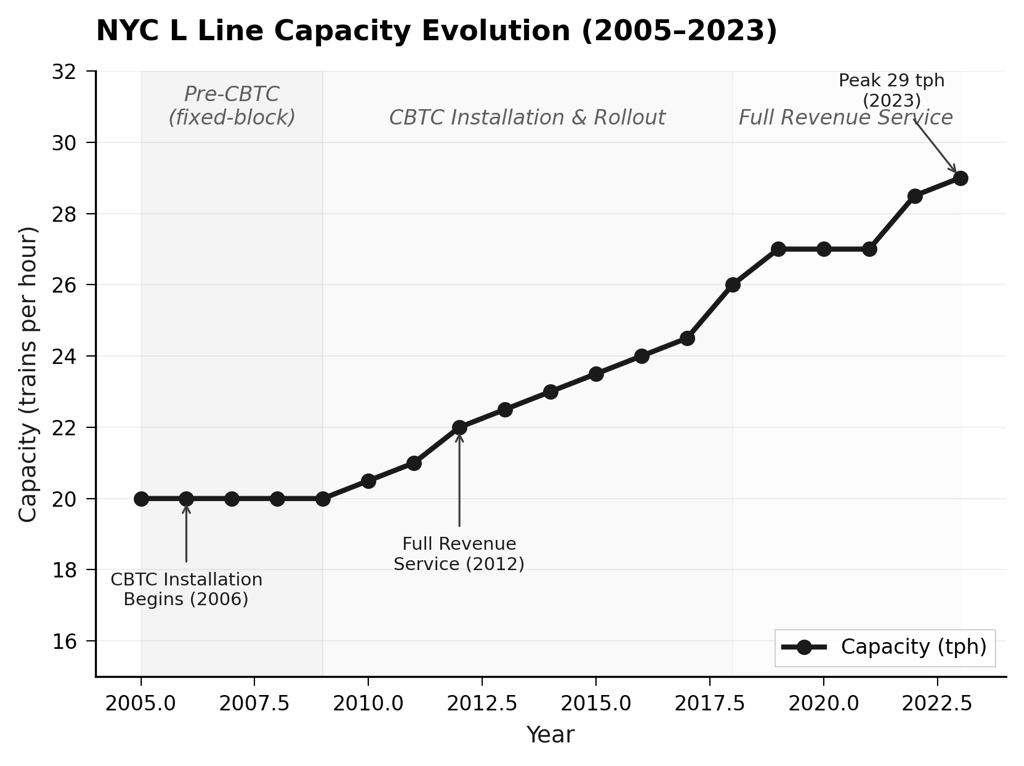
NYC L-Line Capacity Gain
Fig 1.8NYC L-Line Capacity Gain
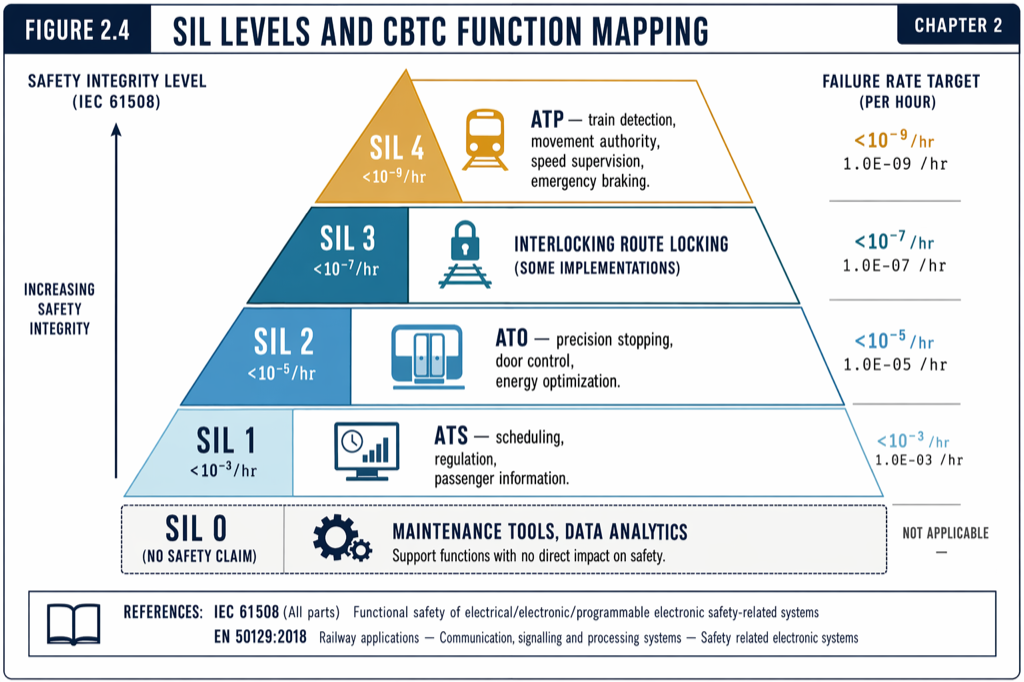
SIL Pyramid
Fig 2.4SIL Pyramid
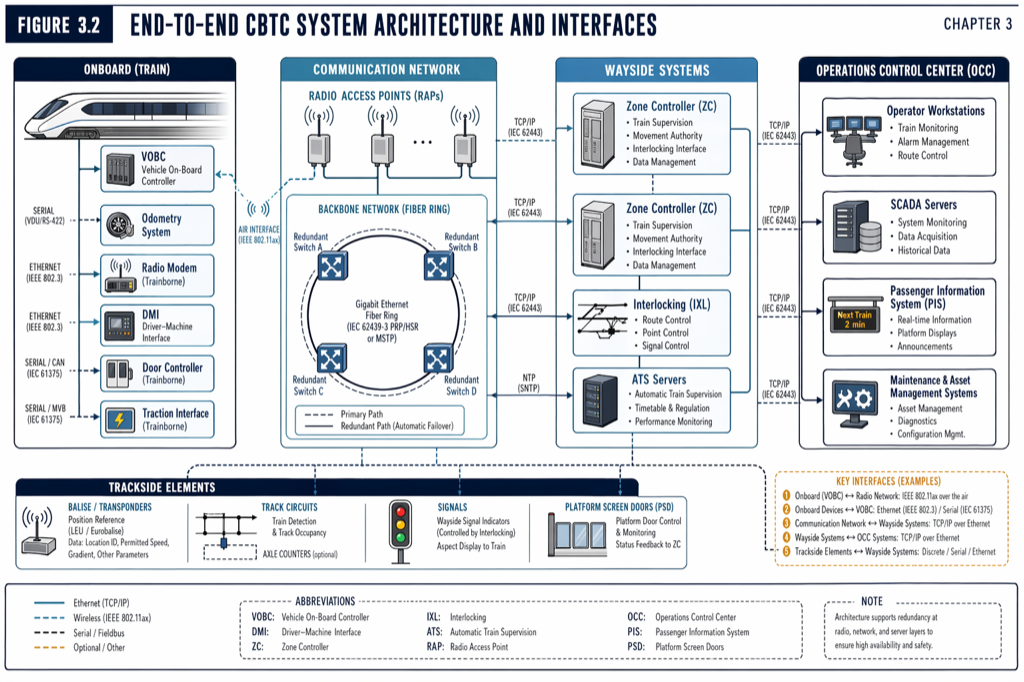
End-to-End Architecture
Fig 3.2End-to-End Architecture
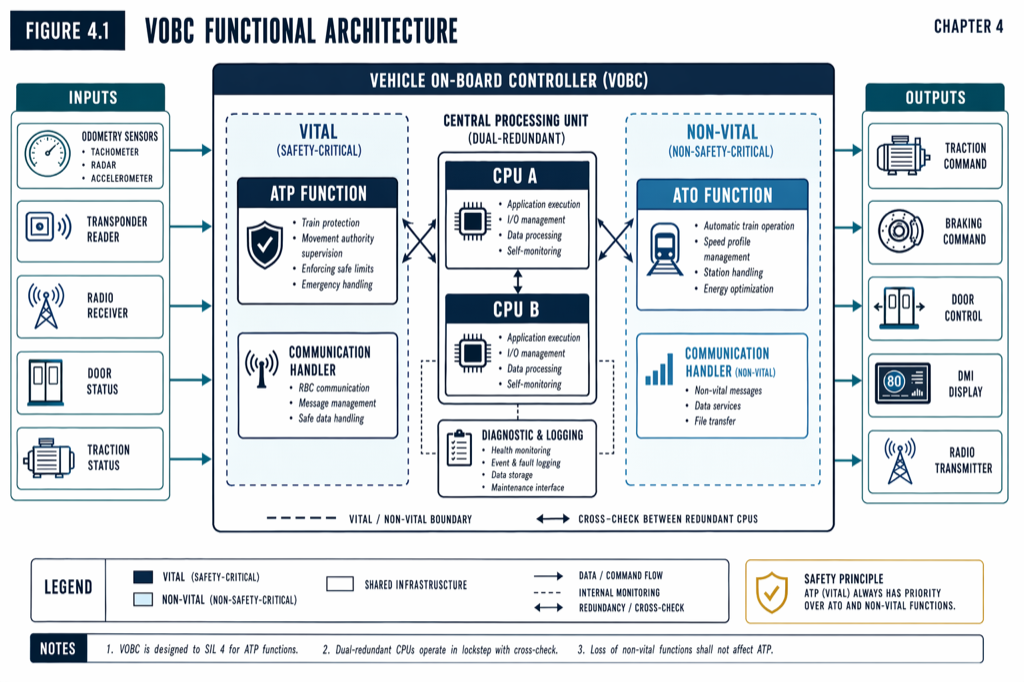
VOBC Functional Architecture
Fig 4.1VOBC Functional Architecture
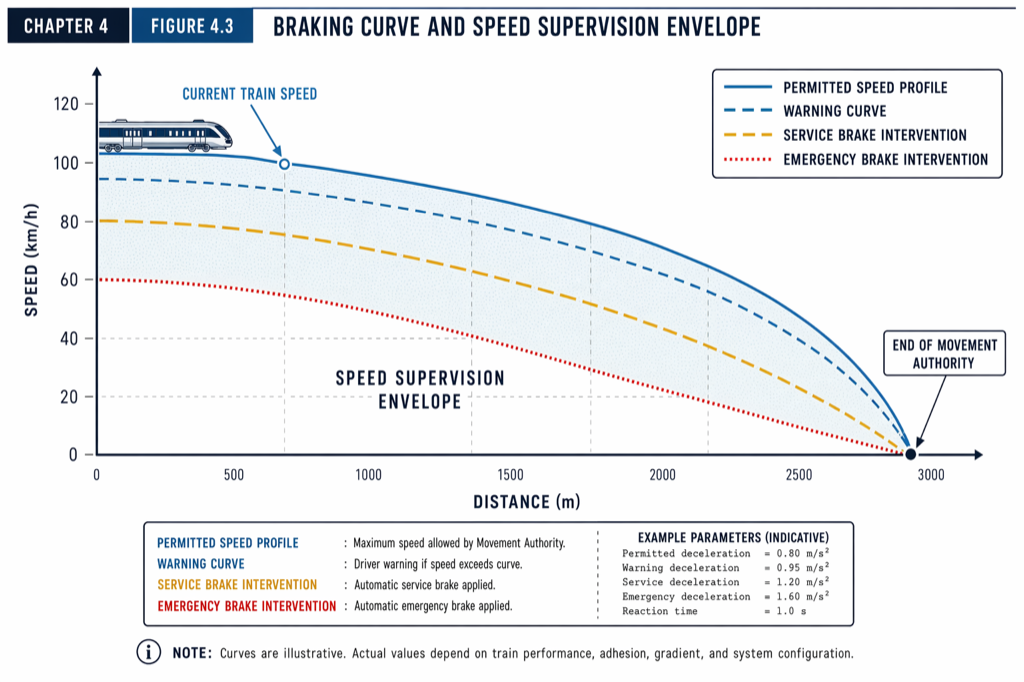
Braking Curve & Safe Stop
Fig 4.3Braking Curve & Safe Stop
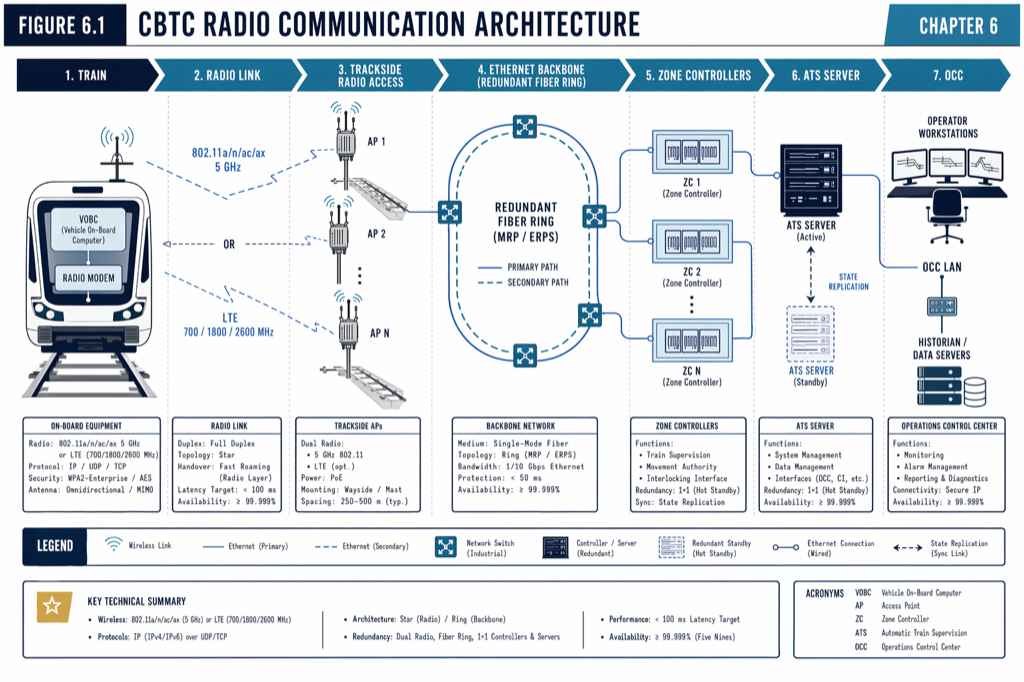
CBTC Radio Architecture
Fig 6.1CBTC Radio Architecture
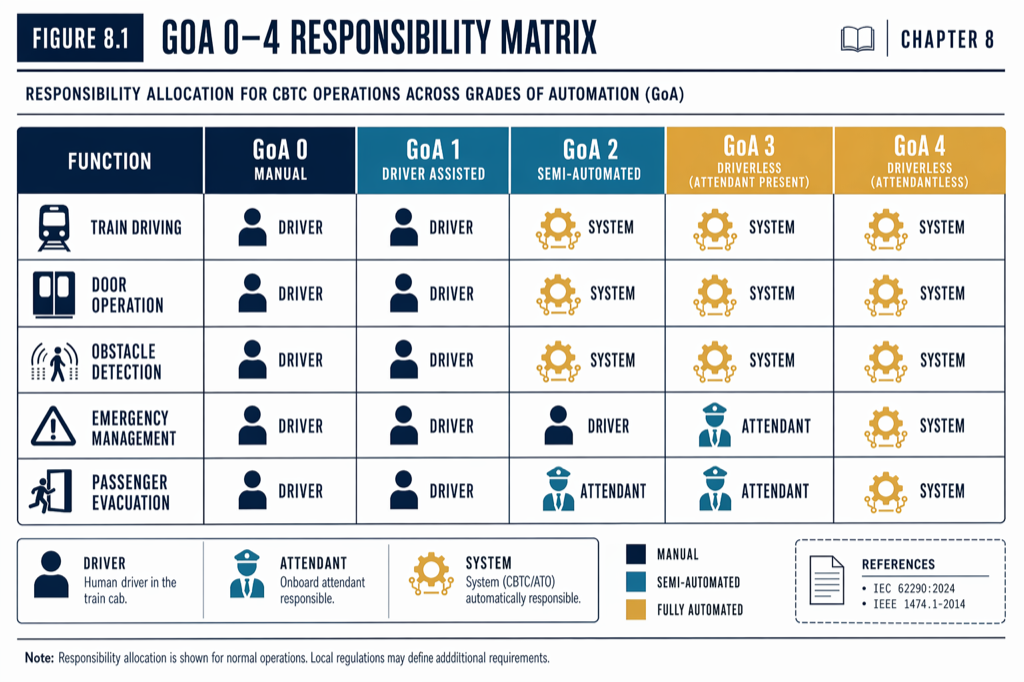
GoA 0–4 Responsibility Matrix
Fig 8.1GoA 0–4 Responsibility Matrix
Browse all 78 figures →
Full table of contents

8 chapters · grouped into four parts

01 The Evolution of Train Control 45 pp
02 Standards & Regulations: US Framework 60 pp
03 CBTC System Architecture Overview 46 pp
04 Onboard Equipment 77 pp
05 Wayside Equipment 61 pp
06 Communication Systems 61 pp
07 Central System / ATS 61 pp
08 Grades of Automation 99 pp
Sample reading

Excerpts from 4 chapters

Selected passages from across Volume 01. Each is presented as it appears in the manuscript, with editorial framing removed.

CH · 1 The Evolution of Train Control

From time-interval dispatch to the moving block

When the Baltimore & Ohio Railroad opened in 1828, America's first commercial rail line faced a novel problem: how should a dispatcher ensure that multiple trains traveling on the same track did not collide? The answer, born of necessity and crude experimentation, was the time-interval method — a dispatcher would record the time at which a train left a station and would not permit the next train to depart until a predetermined interval had elapsed.

This worked at 10–15 miles per hour with light traffic. It revealed its fatal flaw as locomotives became more powerful: the system offered no feedback about a train's actual location or condition. If a train broke down on the track, the dispatcher would remain blissfully unaware. The next train would arrive at the location of the disabled train at the calculated interval, and a collision would result.

The true watershed came in 1872, when William Robinson patented the use of the running rails themselves as electrical conductors to detect train presence. For the first time, the positions of trains and the spacing between them were regulated by physics and electrical engineering rather than by human judgment. CBTC inherits this hundred-year arc and inverts it: instead of the track reporting whether a block is occupied, the train reports where it is.

CH · 2 Standards, Regulations, and the US Framework

Why IEEE 1474 is performance-based, not prescriptive

The original IEEE 1474-1999 standard was framed as performance-based rather than prescriptive — it specified what a CBTC system must accomplish (maintain specific headway distances, respond to emergencies within defined timeframes) rather than dictating how a supplier must design the system to achieve those outcomes.

This was deliberate. The standard's architects recognized that CBTC technology was evolving rapidly, and locking requirements to specific technologies would stifle innovation. The performance-based structure also created ambiguity in early procurements, as agencies and suppliers sometimes interpreted the same requirement differently. Two decades on, the trade-off has held: IEEE 1474.1 remains the cornerstone document cited in virtually every US CBTC RFP, while the underlying radio, computing, and safety-assurance technologies have turned over twice.

CH · 3 CBTC System Architecture Overview

The IEC 62290 boundary — and why it matters in procurement

IEC 62290 establishes a clear system context diagram that delineates what is "inside" the CBTC system and what constitutes external systems. CBTC comprises three integrated functional layers: ATP (the safety-critical layer that enforces speed restrictions and calculates movement authorities), ATO (the automated driving layer, where implemented), and ATS (the fleet-level supervision layer that manages dispatching and dwell times).

During an RFP, a transit agency might specify that CBTC "must control platform screen doors" or "must manage traction power." But if those are specified as external systems, CBTC's role is limited to sending control signals via defined interfaces. The external system retains responsibility for executing the command safely. This division of labor is critical: if CBTC directly controlled power contactors, a CBTC software failure could result in uncontrolled power loss. Instead, CBTC issues a request; the power system's independent logic decides whether to honor it.

CH · 8 Grades of Automation (GoA 0–4)

GoA and CBTC are not synonymous

The Grade of Automation framework addresses a simple question: who does what in train operation? GoA codifies the allocation of responsibility across setting the train in motion, stopping the train, door operation, obstacle and collision detection, response to disruption, and passenger evacuation.

A persistent source of confusion in procurement documents is the conflation of automation level with control technology. GoA and CBTC are not synonymous. CBTC enables higher grades of automation, but it is fundamentally a signaling and control technology, not an automation level. A CBTC system can be deployed at GoA 2 (with a driver) or GoA 4 (fully unattended). Conversely, non-CBTC ATC systems with traditional fixed-block signaling can achieve GoA 1 or even GoA 2. Specifying "we want driverless" without separately specifying the underlying control technology — or vice versa — is a recurring source of scope ambiguity in US RFPs.

Pair it with
VOL · 02

Operations, Deployment & Economics

From architecture to practice. Operating modes, hard-won lessons of US deployments — New York MTA, San Francisco BART — benchmarked against London, Paris, and Asia. Project lifecycle, performance criteria, lifecycle cost analysis, and a clear-eyed map of the vendor landscape.

See Volume 02 →
◉ Rail Signaling · Technical ReferenceEd. 2026
Volume 02 — of Two
Communications-
Based Train
Control
A Comprehensive Guide for US Transit Professionals
Operations, Deployment & Economics
Author
Chunjun (Francisco) Wang
594 pp · 112,000 words
7 × 10 in
About this VolumeVOL 02 / 02

From architecture to practice. Operating modes, hard-won lessons of US deployments — New York MTA, San Francisco BART — benchmarked against London, Paris, and Asia. Project lifecycle, performance criteria, lifecycle cost analysis, and a clear-eyed map of the vendor landscape.

Chunjun (Francisco) Wang · CBTC Engineer
Booth MBA · CFA
Published via Amazon KDP