international-benchmarks · Article
CBTC in Latin America: São Paulo, Santiago, and the Quiet Pioneers
In May 2010, the São Paulo Metrô opened Line 4 (Yellow Line) — a fully automated metro line operating at Grade of Automation 4 (GoA 4) under a public-private partnership with ViaQuatro, using Siemens Communications-Based Train Control (CBTC) and full-height platform screen doors at every station. It was the first GoA 4 line in Latin America. In 2018, São Paulo opened Line 5 (Lilac Line) under ViaMobilidade with similar architecture. In November 2018, Santiago Metro opened Line 6 — a fully automated 15-kilometer line using Alstom CBTC. In 2019, Santiago opened Line 3 with the same architectural family. Mexico City Metro Line 12 (Línea Dorada) operates with modern CBTC. Lima Metro Line 2 — under construction across roughly 35 kilometers — has been specified for CBTC at Grade of Automation 4 by Alstom. The Latin American CBTC portfolio is smaller in route-kilometers than China, Europe, or the United States, but it includes some of the most operationally consequential GoA 4 deployments outside the canonical Paris–Singapore–Copenhagen reference set, and it has done so largely without making the international reporting circuit.
This post is a practitioner’s walk through the Latin American CBTC portfolio — what was built, how it was procured, and what the lessons are for US transit agencies.
What was built
The Latin American CBTC portfolio organizes around four city programs.
São Paulo, Brazil. Line 4 (Yellow Line, opened 2010) is the flagship: 12.8 kilometers, 11 stations, GoA 4 from inception, Siemens CBTC, full-height platform screen doors, operated by ViaQuatro under a public-private partnership concession with the State of São Paulo. Line 5 (Lilac Line, opened 2002 under conventional signaling, converted to CBTC across the 2014–2018 horizon under ViaMobilidade) operates at Grade of Automation 3 with on-board attendants, on a Siemens platform. Lines 6 (Orange Line, partially opened in 2025) and 17 (Gold Line, monorail) are on similar architectural baselines. The combined São Paulo CBTC portfolio is roughly 50 route-kilometers across multiple operators.
Santiago, Chile. Metro de Santiago opened Line 6 (Purple Line) in November 2018 with 15 kilometers, 10 stations, and Alstom CBTC at GoA 4. Line 3 (Brown Line) opened in January 2019 on the same architectural family. Both lines are fully automated, operate at GoA 4, and have been integrated into the broader Santiago Metro network of seven lines. The pre-existing Santiago lines (1, 2, 4, 4A, 5) operate on conventional cab signaling and are not CBTC.
Mexico City, Mexico. Mexico City Metro Line 12 (Golden Line, opened October 2012) is the most modern segment of the Sistema de Transporte Colectivo Metro and operates on a CBTC platform with Automatic Train Protection and Automatic Train Operation. The line has been the subject of substantial structural and operational scrutiny following the May 2021 elevated-section collapse near Olivos station; the underlying CBTC signaling architecture continued to operate after the partial line closure, but the broader Line 12 program has since received substantial capital remediation work.
Lima, Peru. Lima Metro Line 2 — a 35-kilometer fully underground heavy-rail metro, currently under phased construction with the first segment having entered limited revenue service in 2023 — has been specified by Alstom for GoA 4 operation under CBTC. When completed across the 2026–2028 horizon, Lima Line 2 will be the largest single GoA 4 metro line built from inception in the Western Hemisphere.
 Latin America’s CBTC portfolio is small by route-kilometers but includes consequential GoA 4 deployments.
What is striking about the Latin American pattern
Three things about the Latin American CBTC pattern are worth calling out for US readers.
First, the public-private partnership procurement model has worked. São Paulo Line 4 under ViaQuatro is the canonical case. The State of São Paulo procured the line under a 30-year concession with ViaQuatro responsible for design, procurement, construction supervision, integration, operation, and maintenance. Siemens supplied the CBTC. The line opened on schedule, has operated reliably for 15 years, and is now considered one of the world’s reference public-private partnership transit deployments. ViaMobilidade replicated the model on Lines 5 and 8/9 (the latter on commuter rail). The PPP procurement structure is not without controversy in Brazilian political discourse, but the operational outcomes have been defensible.
Second, GoA 4 was achieved without the institutional weight of Paris, Singapore, or Copenhagen. São Paulo Line 4 is a 12.8-kilometer urban metro line operated by a concessionaire in a city that, until 2010, had no GoA 4 experience. Santiago Lines 6 and 3 are operated by Metro de Santiago without prior GoA 4 history. The structural enablers — full-height platform screen doors at every station, operating concept locked before procurement, labor framework negotiated in advance, regulatory pathway agreed with the relevant transport authorities — were all replicated in contexts that lacked the multi-decade GoA 4 institutional depth of the canonical European and Asian reference systems. (For the canonical reference set, see Driverless Operations Worldwide: Who’s GoA 4, Who’s Faking It.)
Third, vendor relationships have been multi-vendor, not single-vendor lock-in. São Paulo’s portfolio is largely Siemens; Santiago’s GoA 4 lines are Alstom; Lima Line 2 is Alstom; Mexico City Line 12 has been a multi-vendor program. The Latin American operators have not committed to a single vendor across the network, and the resulting procurement bargaining power has helped contain unit costs even on smaller programs.
What is honest to acknowledge
Three caveats are useful before drawing US-relevant lessons from the Latin American pattern.
First, operational metrics from Latin American GoA 4 lines are less internationally cited than European and Asian equivalents. UITP and IRJ reporting includes São Paulo Line 4 and Santiago Lines 3 and 6, but the operational performance data — Mean Kilometers Between Failures (MKBF), system availability, incident rates — is reported less consistently than for the Paris, Singapore, Copenhagen, and Dubai reference set. The GoA 4 operating record on these lines is genuine, but the quantitative comparison should be made with the reporting consistency caveat in mind.
Second, the broader Latin American metro network operates on conventional cab signaling, not CBTC. The major São Paulo lines outside the ViaQuatro and ViaMobilidade concessions, the Santiago lines outside Lines 3 and 6, the bulk of the Mexico City Metro, the Buenos Aires Subte, the Rio de Janeiro Metro, and most of the Bogotá TransMilenio rail-related infrastructure operate without CBTC. The CBTC density in Latin America is concentrated in specific lines under specific procurement structures. (See Tokyo Metro vs Beijing Metro: Two Approaches to High-Density Operation for a related observation about ATC-anchored modernization paths.)
Third, the political and economic context shaped procurement structure in ways the US does not face. Public-private partnerships in transit at the scale of the São Paulo Line 4 model are politically and legally constrained in the United States by federal grant rules, state procurement law, and labor agreement frameworks. The Latin American PPP procurement structure is not directly transferable to US heavy-rail metro CBTC.
What is genuinely transferable
Two things from the Latin American pattern transfer directly to US transit agencies, regardless of procurement structure differences.
First, GoA 4 on a 12-to-15-kilometer urban metro line, opened from inception, is operationally tractable in the absence of multi-decade institutional GoA 4 experience. São Paulo Line 4 in 2010 and Santiago Line 6 in 2018 are the existence proofs. The structural preconditions — full-height platform screen doors, operating concept locked before procurement, labor framework negotiated in advance, regulatory pathway agreed upfront — are achievable on a single-line program. The Honolulu Skyline (HART) opening in June 2023 is the closest US analog: a single-line greenfield GoA 4 deployment delivered without prior US heavy-metro GoA 4 institutional depth. (See Paris Métro Line 14: The Original Driverless Showcase for the canonical GoA 4 greenfield reference.)
Second, multi-vendor procurement on a multi-line program preserves bargaining power even on portfolios smaller than China’s or Europe’s. São Paulo’s Siemens-anchored portfolio with Alstom on adjacent procurements, Santiago’s Alstom anchor with potential vendor diversification on later lines, and Mexico City’s multi-vendor history all support the proposition that operators with relatively small CBTC portfolios can preserve competition. US agencies with multi-line CBTC ambitions — NYC MTA, BART, Washington Metropolitan Area Transit Authority (WMATA), Massachusetts Bay Transportation Authority (MBTA) — can replicate this with explicit two-vendor procurement strategy at the program level. (See How to Write a CBTC RFP That Doesn’t Lock You Into One Vendor for the procurement implication.)
What this means for US transit agencies
Five points follow from the Latin American pattern that US transit agencies considering CBTC modernization should think about explicitly.
First, GoA 4 greenfield is achievable as a single-program deliverable. The São Paulo Line 4, Santiago Line 6, and Honolulu Skyline experiences all support the proposition that a single agency can deliver a GoA 4 line from inception without prior multi-decade GoA 4 institutional depth, given the right structural preconditions. US agencies considering greenfield heavy-metro deployment (planned extensions, new lines in mid-tier markets) should anchor their planning on this reference set.
Second, public-private partnership procurement structures, where US law and politics permit, can deliver operational outcomes consistent with the international GoA 4 reference set. The structural conditions for a successful PPP-procured CBTC deployment are operating concept lock-in, performance-based contractual structure, long-horizon concession framework, and effective owner oversight. Some of these are achievable in the US under the right procurement law and agency capability.
Third, multi-vendor procurement at the portfolio level is achievable on programs of any size. The São Paulo and Santiago portfolios are smaller than the comparable European and Asian portfolios, but the multi-vendor pattern still holds. US agencies should not commit to single-vendor architecture across the network on the assumption that scale economics require it.
Fourth, the operational record from Latin American GoA 4 lines deserves more US transit-industry attention than it currently receives. The 14-plus year São Paulo Line 4 record and the multi-year Santiago Lines 3 and 6 records are directly relevant to any US agency considering GoA 4 retrofit or greenfield, particularly in mid-tier markets where the institutional depth and political environment are closer to the Latin American context than to Paris or Singapore.
Fifth, the Lima Line 2 program is worth tracking through the 2026–2028 horizon. When completed, Lima Line 2 will be the largest single GoA 4 metro line built from inception in the Western Hemisphere. The procurement, construction, and commissioning record on a 35-kilometer fully underground GoA 4 metro line is directly relevant to US agencies contemplating greenfield projects of similar scale.
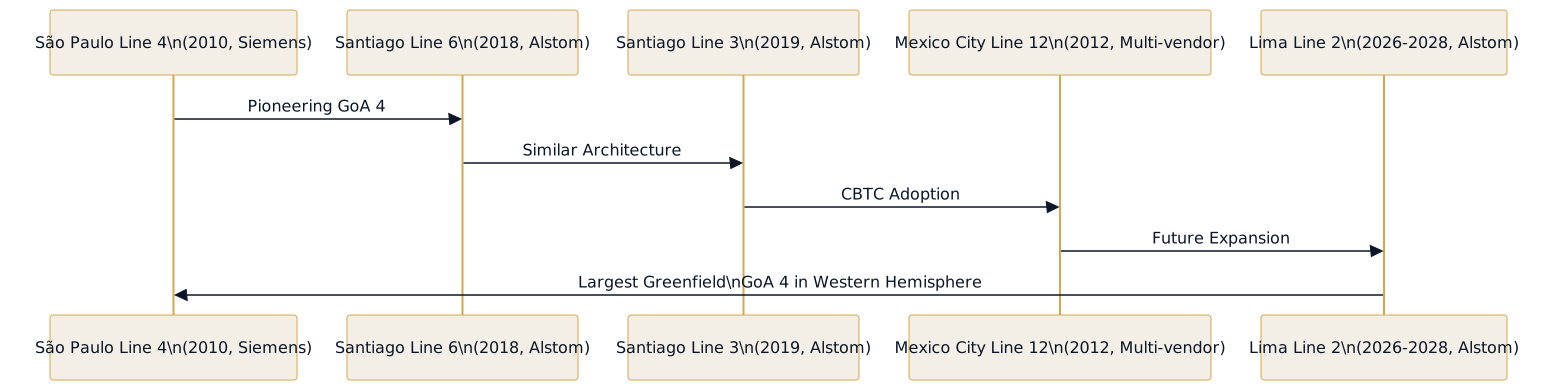 Latin America has been a quiet GoA 4 pioneer. Lima Line 2 will be the largest greenfield GoA 4 in the Western Hemisphere.
Practical takeaways for US transit agencies
- Use the São Paulo Line 4 (2010) and Santiago Line 6 (2018) records as international references for single-line GoA 4 greenfield deployment. Both are operational existence proofs in mid-tier markets without prior GoA 4 institutional depth.
- Where state and federal procurement law permits, evaluate public-private partnership structures for greenfield CBTC delivery. The ViaQuatro / São Paulo Line 4 model is the canonical reference.
- Preserve multi-vendor competition on portfolios of any size. Even a two-line CBTC program can support a two-vendor procurement strategy.
- Track Lima Line 2 through 2026–2028 as the largest greenfield GoA 4 metro under construction in the Western Hemisphere. The procurement and commissioning record will inform US agency planning.
- Anchor public acceptance work on the Latin American precedent, which is closer to many US mid-tier markets than the Paris or Singapore precedents in political and labor context.
Where to go next
This post is a 10-minute summary. The full treatment of international CBTC benchmarks, including Latin American deployments and the broader GoA 4 reference set, lives in Chapter 11 (“International Benchmarks with US Relevance”) of Communications-Based Train Control (Volume 2). Buy on Amazon. Download Chapter 11 slides (free PDF).
Sources
- Wang, C. (2026). Communications-Based Train Control, Volume 2: US Deployment, Procurement & Future Directions. Independent. ISBN 979-8-258-54295-3. — Chapter 11, “International Benchmarks with US Relevance”; Chapter 8, “Grades of Automation.”
- ViaQuatro. Linha 4-Amarela do Metrô de São Paulo. viaquatro.com.br
- ViaMobilidade. Linha 5-Lilás and Linha 8/9 Operations. viamobilidade.com.br
- Metro de Santiago. Líneas 3 y 6. metro.cl
- Sistema de Transporte Colectivo Metro (Mexico City). Línea 12. metro.cdmx.gob.mx
- Lima Metro Line 2 / Concesionaria Metro de Lima Línea 2. Project Information. metrodelima.gob.pe
- UITP (International Association of Public Transport). Observatory of Automated Metros. uitp.org
- Railway Gazette International. Latin American Metro Reporting. railwaygazette.com
- International Railway Journal (IRJ). Latin American Metro Coverage. railjournal.com
- IEEE Standards Association. IEEE Std 1474.1: Standard for Communications-Based Train Control (CBTC) Performance and Functional Requirements.
How this article was produced. Drafted with AI assistance, then reviewed and fact-checked by Chunjun (Francisco) Wang against Communications-Based Train Control (the author's two-volume reference) and primary sources — agency records, vendor documentation, and IEEE/IEC standards. Every date, vendor, and figure is traceable to a cited source. Spot a mistake? Corrections are welcome via the contact page.
Read the full treatment in the book
Chapter 8 of Communications-Based Train Control, Volume 1, covers this in depth.