trends · Article
The CBTC Market in 2026: Size, Growth, and the Vendor Landscape

On 31 May 2024, Hitachi Rail closed its acquisition of Thales’ Ground Transportation Systems business for roughly 1.66 billion euros, folding some 9,000 engineers and the SelTrac signaling family — the product that runs Vancouver, Dubai, and much of the London Underground — into a rail unit that now spans 51 countries and reports about 7.3 billion euros in pro-forma annual revenue (Hitachi Rail, 2024). For anyone tracking the CBTC market, that single close did more to reshape the competitive field than any technology release of the past decade. It reduced the population of full-line Communications-Based Train Control (CBTC) integrators, moved one of the most widely deployed product lines under a new owner, and confirmed a direction the industry had been drifting toward for years: fewer, larger prime suppliers, each carrying more than one CBTC product under its roof.
What the CBTC market actually counts
Before quoting a single dollar figure, a buyer needs to know what is being measured. “CBTC” is sometimes reported as a standalone urban-signaling category and sometimes folded into a broader “railway signaling” or “train control market” that also includes mainline systems such as the European Train Control System (ETCS) and North American Positive Train Control (PTC). The two framings produce numbers that differ by an order of magnitude, and research firms do not always state which one they used.
CBTC itself is a specific thing: continuous, radio-based, moving-block train control for metros and dense urban rail, defined functionally by the IEEE 1474 family of standards. The market for it consists of new greenfield lines, brownfield resignaling of legacy metros, extensions of existing automated lines, and the long-tail maintenance and obsolescence-renewal contracts that follow every deployment for 20 to 30 years. That services tail matters, because it is where a supplier’s installed base converts into recurring revenue — and it is one reason the vendor that wins a line tends to hold it for a generation.
How big is the CBTC market? A range, not a number
Here caution is not optional. Published estimates of the CBTC market size diverge so widely that citing any one of them as fact would be misleading. A few examples, each attributed to the specific firm that produced it:
- One market-research estimate, from Fortune Business Insights, valued the communications-based train control market at roughly USD 9.5 billion in 2025, projecting growth to about USD 20 billion by 2034 at a compound annual growth rate near 8.7% (Fortune Business Insights, 2025).
- Global Market Insights sized the same category far lower — around USD 2.4 billion in 2024 — while estimating a comparable growth rate of roughly 8.1% through 2034 (Global Market Insights, 2025).
- Market Research Future put 2025 nearer USD 5.7 billion and forecast a steeper trajectory to about USD 16.9 billion by 2035 at roughly 11.5% (Market Research Future, 2025).
- Several smaller reports cluster lower still, in the USD 2.4 billion to USD 3.8 billion range for 2025, with growth rates from about 5.5% to 11.5%.
Read together, these estimates span roughly a factor of four for the same base year. The disagreement comes from scope (metro-only versus all urban rail), geography (whether China’s enormous domestic volume is fully counted), and whether rolling-stock and civil integration are bundled in. The honest takeaway for a US agency or investor is directional, not precise: independent research firms agree the CBTC market is growing at a mid-to-high single-digit to low-double-digit annual rate, and they do not agree on its absolute size. The broader railway signaling market that contains CBTC is larger and better characterized, commonly reported in the mid-USD-20-billion range for the mid-2020s across firms such as SkyQuest and Global Market Insights.
The vendor landscape: a handful of primes and a long tail
The CBTC vendors that can deliver a complete metro line worldwide number only a few, and this article describes their positioning rather than ranking them. Each occupies the field differently.
Siemens Mobility markets its Trainguard MT CBTC across greenfield and brownfield work, from the fully automated Paris Métro Line 14 to a semi-automated upgrade of Berlin’s U5 and U8 and installations in Mexico City and São Paulo. Siemens has also begun packaging its metro offer under a “Signalling X” banner aimed at more software-defined, standards-based deployment.
Alstom sells the Urbalis family, including the Urbalis Fluence generation that moves more intelligence onto the train. Alstom’s 2021 absorption of Bombardier Transportation brought the CITYFLO product line under the same roof, and the company has been active across India, Switzerland, and Brazil. The architectural contrast between the two European primes is examined in Trainguard MT vs. Urbalis: Two CBTC Architectures Compared.
Hitachi Rail now carries two CBTC heritages at once: the former Ansaldo STS portfolio it acquired between 2015 and 2019, and the SelTrac line it gained with the Thales GTS close in 2024. That gives it one of the largest automated-metro installed bases in the world and a continued investment path — Hitachi has announced a SelTrac G9 development program integrating artificial intelligence, 5G, and cloud and edge computing.
CRSC (China Railway Signal and Communication) dominates the domestic Chinese market, which is by volume the largest single CBTC market on earth, and has begun exporting — including a 2025 contract to supply a fully automatic operation signaling system for the King Abdullah Financial District monorail in Riyadh, described as its first overseas fully automatic deployment. Alongside these primes sit specialists and national suppliers such as Nippon Signal, Kyosan, Toshiba, Mermec, and China’s Traffic Control Technology, which compete on specific lines, regions, or subsystems.
Regional demand: where the growth actually is
The CBTC market is not one market; it is a set of regional demand pools with different drivers.
China remains the largest by installed volume, driven by metro construction across dozens of cities and served predominantly by domestic suppliers — a scale-and-standardization story told in Why Chinese Metros Went CBTC in 50 Cities. The Gulf has been a high-visibility greenfield market: Dubai, Doha, and Riyadh built automated metros in single, integrated procurements, which is why the region attracts CBTC vendors far larger than its population would suggest. India has become one of the most active contract sources, with driverless CBTC awards across Mumbai, Bengaluru, and other cities as new lines open at pace. Europe is largely a retrofit market — dense legacy metros in London, Paris, Madrid, and Berlin resignaling for capacity — and its structural advantage over the United States in doing so is the subject of Why Madrid Has More CBTC Lines Than the Entire US.
The United States is the hardest of these pools. It is overwhelmingly a brownfield market: a small number of large agencies replacing Depression-era fixed-block signaling on lines that must keep carrying passengers throughout construction. The MTA’s 2025-2029 capital plan continues CBTC deployment across additional New York City Transit lines, and one North American report from Cognitive Market Research put the regional CBTC growth rate near 7.4%. The demand is real, but it is concentrated in a handful of agencies and paced by funding cycles rather than by technology availability.
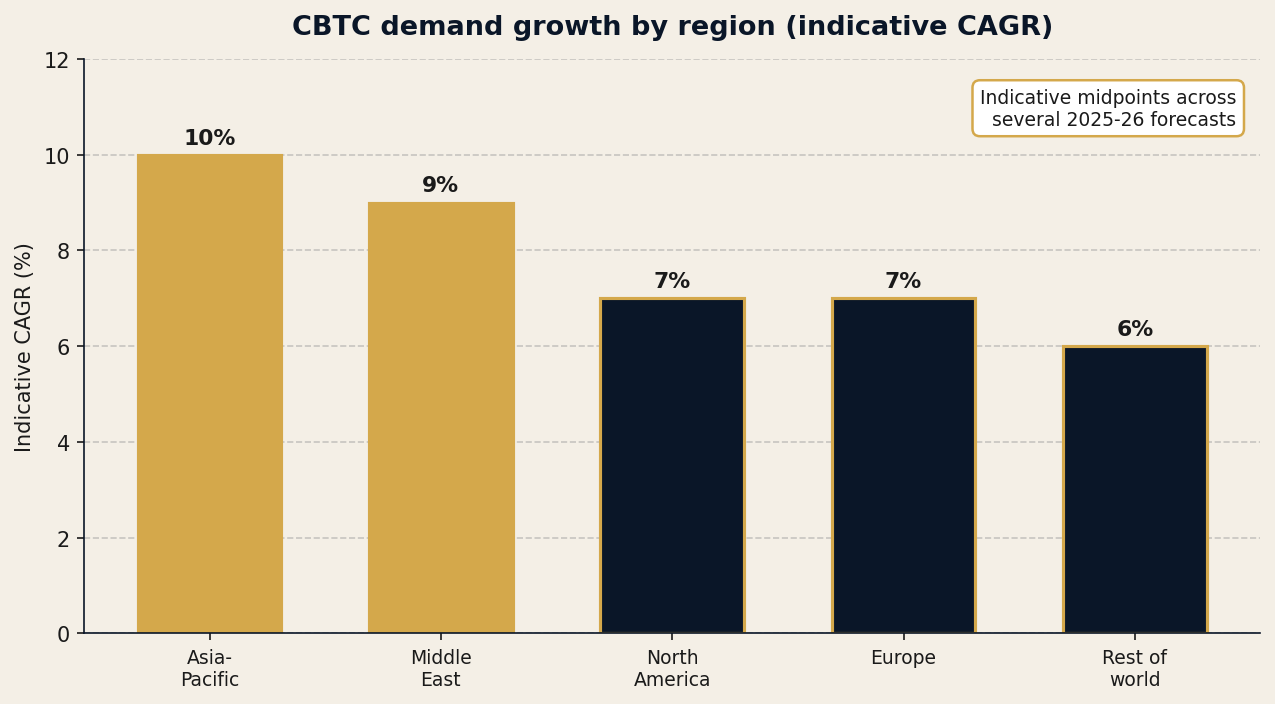 Indicative regional growth-rate midpoints synthesized across several 2025-2026 market forecasts; directional, not precise shares. Asia-Pacific and the Gulf lead; US demand is real but funding-paced.
Consolidation: what the Hitachi–Thales close changed
The GTS acquisition was the third major consolidation to reshape the CBTC supplier set in a decade, following Ansaldo STS into Hitachi and Bombardier Transportation into Alstom. Its effect on buyers cuts two ways. On one hand, a stronger Hitachi with two CBTC product lines and 51-country reach is a more capable single-source integrator. On the other, every consolidation thins the field of independent bidders, and a thinner field is exactly what a procurement officer trying to preserve price competition does not want.
There is also a practical continuity question. When a product line such as SelTrac changes owners, agencies with that system installed inherit a new obsolescence-management and spares relationship, and agencies writing new specifications must decide how much to weight a supplier’s ownership stability over a 30-year life. Consolidation does not erase a product; SelTrac, Urbalis, and Trainguard MT all continue under active development. But it does concentrate the roadmaps for those products in fewer hands, which raises the stakes on the interoperability question below.
Open and interoperable CBTC: the slow unbundling
Historically, CBTC has been proprietary end to end: the onboard controller, the radio, the zone controller, and the central supervision came from one vendor and did not interoperate with another’s. That single fact is the root of most vendor lock-in in urban rail, and it is the reason a resignaling contract effectively chooses a supplier for a generation.
Two threads are slowly loosening it. The first is agency-driven interoperability. New York City Transit pioneered interoperability interface specifications on the Canarsie line and has since brought interoperable CBTC into service where equipment from different suppliers must coexist on the same line — a direct attempt to keep more than one vendor in the game. The second is the broader move toward reference architectures and standards-based, software-defined signaling, visible in Europe’s Reference CCS Architecture work and in vendors’ own repackaging of their metro products around open interfaces. None of this has produced plug-and-play CBTC yet, and a buyer should treat “open” claims skeptically and test them against contract language. But the direction of travel — toward specifying interfaces rather than whole systems — is the single most consequential trend for anyone who will own a CBTC line into the 2050s.
What this means in practice
For a transit agency or an investor reading the CBTC market in 2026:
- Do not anchor a business case to a single market-size figure. Independent research firms disagree by roughly a factor of four on the CBTC market’s absolute size; cite a range and the firms behind it, and treat the growth direction — not the dollar total — as the reliable signal.
- Map the vendors to your line type, not to a ranking. Greenfield, brownfield retrofit, and extension work reward different supplier strengths; the right CBTC vendor for a from-scratch Gulf metro is not necessarily the right one for a live brownfield resignaling in a US city.
- Price the consolidation into your risk model. With the field of independent primes thinner after the Hitachi–Thales close, preserving competition in procurement takes deliberate effort — multi-vendor qualification, interoperability requirements, and staged awards.
- Weight the 30-year services tail, not just the capital price. The supplier you choose owns your obsolescence, spares, and upgrade path for decades; ownership stability and product roadmap continuity belong in the evaluation.
- Test every “open” or interoperable claim against the contract. Interoperability is advancing but is not yet plug-and-play; specify the interfaces you need explicitly rather than trusting a marketing label.
Where to go next
This post is a 10-minute market overview. The full treatment of the CBTC vendor landscape — how the primes are positioned, how consolidation has reshaped competition, and how to evaluate suppliers without locking into one — lives in Chapter 15 (“Vendor Landscape”) of Communications-Based Train Control, Volume 2: Operations, Deployment & Economics (Buy on Amazon). Download Chapter 15 slides (free PDF) for the supplier-comparison framework.
Sources
- Wang, C. (2026). Communications-Based Train Control, Volume 2: Operations, Deployment & Economics. Independent. ISBN 979-8-258-54528-2. — [Chapter 15, “Vendor Landscape”]
- Hitachi Rail. (2024). Hitachi Rail acquires Thales’ Ground Transportation Systems. hitachi.com
- GlobeNewswire / Hitachi Rail. (2024). Hitachi Rail acquires Thales’ Ground Transportation Systems for €1,660m. globenewswire.com
- Fortune Business Insights. (2025). Communication-Based Train Control Market Size, Share [2034]. fortunebusinessinsights.com
- Global Market Insights. (2025). Communication-Based Train Control Market Report, 2025-2034. gminsights.com
- Market Research Future. (2025). Communication Based Train Control Market Size Report 2035. marketresearchfuture.com
- Cognitive Market Research. (2026). North America Communication Based Train Control (CBTC) System Industry Report. cognitivemarketresearch.com
- Siemens Mobility / Trackopedia. (2025). Siemens Mobility completes CBTC implementation on Paris metro line 14. trackopedia.com
- Alstom. (2025). Alstom to supply trains, signalling solutions and maintenance for Mumbai Metro Line 4. alstom.com
- China Railway Signal and Communication (CRSC). About CRSC — urban rail transit control technology and overseas contracting. crsc.cn
- MTA New York City Transit. (2025). Proposed 2025-2029 Capital Plan (CBTC modernization). mta.info
How this article was produced. Drafted with AI assistance, then reviewed and fact-checked by Chunjun (Francisco) Wang against Communications-Based Train Control (the author's two-volume reference) and primary sources — agency records, vendor documentation, and IEEE/IEC standards. Every date, vendor, and figure is traceable to a cited source. Spot a mistake? Corrections are welcome via the contact page.
Read the full treatment in the book
Chapter 15 of Communications-Based Train Control, Volume 2, covers this in depth.