procurement · Article
CBTC Procurement: Cost Drivers Beyond the Sticker Price

A CBTC procurement that the contractor prices at $200 million arrives at the Federal Transit Administration (FTA) Capital Investment Grant application as a $260 to $320 million project. The difference is not contingency — it is the set of cost categories that sit outside the supplier’s bid: domestic-content premiums, prevailing-wage labor escalation, owner’s engineer and Independent Safety Assessor fees, parallel-operations OPEX during cutover, training, spares, and the inflation-indexed lifecycle of software support contracts. None of these are surprises individually. Together, they are the difference between a procurement budget that survives board approval and one that returns three years later asking for a reauthorization. This post walks through each of the cost drivers that experienced US transit procurement teams build into their early budget — before the supplier’s number arrives.
Why the sticker price is a starting point, not the answer
The Communications-Based Train Control (CBTC) supplier’s bid quotes the technical scope: hardware, software, integration engineering, factory acceptance testing, and a defined warranty period. It does not quote the cost of getting that scope through US transit procurement. It does not include the agency’s program management, the owner’s engineer’s design review, the Independent Safety Assessor’s safety case oversight, the agency’s testing and commissioning labor, the dual-system parallel operations during cutover, the training of every operator and maintainer, or the lifecycle support contract that follows revenue service ready. It also does not adjust for the federal procurement constraints — Build America, Buy America (BABA), Davis-Bacon prevailing wage, FTA Project Management Oversight Contractor (PMOC) review fees, NEPA environmental review — that move the all-in number 30 to 60 percent above the supplier’s contracted price. This piece is for the program manager, the chief financial officer, and the FTA grants officer building the all-in budget that the board will approve. The depth lives in Chapter 14 of Communications-Based Train Control, Volume 2.
Driver 1: the six canonical CAPEX categories
A CBTC resignaling project decomposes into six capital cost categories. Industry-standard ranges for a US brownfield project, drawn from manuscript Chapter 14 and recent agency capital plans:
Onboard and vehicle equipment typically accounts for 12 to 18 percent of CAPEX. A single Vehicle On-Board Controller (VOBC) installation on one train cab — including the safety-certified processor, radio antenna and modem, odometry and inertial sensors, cab display, and integration engineering — runs roughly $250K to $450K per cab. A 100-car fleet incurs $25M to $45M in onboard equipment alone. Retrofit of older rolling stock costs more than equipping new cars; the per-cab figure is sensitive to fleet age and prior modification history.
Wayside infrastructure is the largest single category for brownfield retrofits, typically 25 to 35 percent of CAPEX. Zone Controllers run $150K to $250K each, deployed every 3 to 5 route-miles. Modern microprocessor interlockings run $300K to over $1M per location. Balise networks, axle counters, and wayside radio access points add tens of thousands per route-mile. Total wayside CAPEX for a 20 to 30 mile US heavy-rail system typically runs $30M to $80M, or roughly $1.5M to $3M per route-mile.
Communication systems account for 12 to 18 percent of CAPEX. A 2.4 or 5 GHz WLAN mesh adds $40K to $80K per route-mile in material and installation; fiber-optic backbone in a brownfield environment can run $200K to $600K per route-mile because of civil-work complexity. Cybersecurity appliances, network operations center build-out, and ongoing licensing add another six- to seven-figure line item.
Central operations and control systems typically run 10 to 15 percent of CAPEX. The ATS server pair, OCC video walls and consoles, SCADA integration, and dispatcher training simulator together run $15M to $22M for a $150M project.
Engineering, systems integration, and program management — the soft costs — typically run 20 to 30 percent of CAPEX. This includes preliminary and detailed design (3 to 8 percent each), configuration management (2 to 4 percent), Independent Safety Assessment and Verification & Validation (3 to 6 percent), integration engineering and factory support (4 to 8 percent), and program management and owner’s engineer (3 to 6 percent).
Testing, commissioning, and revenue service demonstration typically run 8 to 12 percent of CAPEX, higher (15 to 18 percent) for brownfield projects with extended Shadow Running and parallel operations.
The honest aggregate: budget $15M to $30M per route-mile for US brownfield CBTC, with the lower bound for greenfield and the upper bound for dense urban brownfield with extensive legacy integration.
Driver 2: BABA, Davis-Bacon, and other US procurement premiums
These premiums are the most reliable underestimates in CBTC budgets.
Build America, Buy America (BABA) mandates 70 percent domestic content for manufactured products and 90 percent for steel and iron on FTA-funded projects. CBTC suppliers comply by establishing US assembly footprints — Siemens in Sacramento and New Jersey, Hitachi Rail in Coppell and Pittsburgh, Alstom in Rochester, Hornell, and Plattsburgh — but compliance carries a 5 to 15 percent premium over international market prices. On $30M to $50M of equipment CAPEX, BABA adds $1.5M to $7.5M.
Davis-Bacon prevailing wage requirements add 30 to 50 percent to installation and commissioning labor on federally funded projects. Major-metro prevailing wages run $45 to $85 per hour versus $30 to $50 elsewhere. On $5M to $10M of installation labor, Davis-Bacon adds $1.5M to $5M.
Project Labor Agreements (PLAs) add another 10 to 20 percent to installation and commissioning costs. On $8M to $15M of labor, a PLA adds $800K to $3M.
FTA and FRA oversight adds 2 to 5 percent to project cost, depending on the agency’s regulatory profile.
Insurance and bonding typically run 2 to 5 percent of CAPEX.
NEPA environmental review can add $500K to $3M for projects requiring an Environmental Assessment or Environmental Impact Statement. Pure CBTC signaling replacements often qualify as a categorical exclusion, but station accessibility improvements, new substations, or communication tower construction can trigger more rigorous review.
The honest planning rule: line-item BABA and Davis-Bacon into each subcomponent’s budget rather than treating them as a single contingency reserve. A 12 percent premium on each of 50 line items compounds differently from a single 12 percent reserve at the bottom.
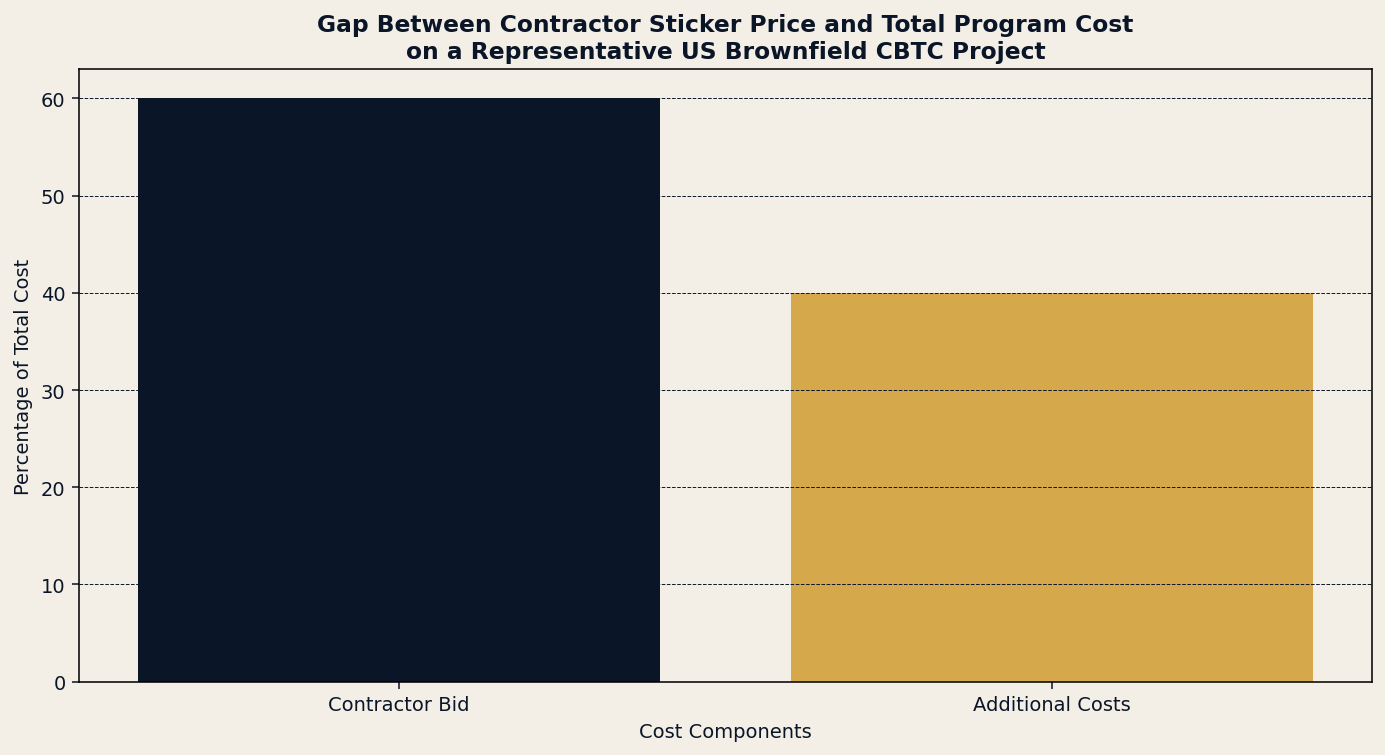 The contractor’s bid is typically 60 to 75 percent of the all-in program cost on a US brownfield CBTC project.
Driver 3: owner’s engineer and program management
US transit agencies typically lack in-house CBTC depth and engage a Program Management Consultant (PMC) from firms such as WSP, AECOM, HNTB, STV, or Jacobs. The PMC handles requirements development, vendor oversight, interface management, acceptance test planning, safety coordination with the ISA, and FTA reporting. On a major brownfield project, the PMC team is typically 3 to 8 senior engineers supported by a larger embedded team during peak phases. The total PMC fee typically runs 3 to 6 percent of CAPEX, with higher percentages for smaller agencies that lack any internal CBTC capability.
The owner’s engineer is not optional. An agency that issues a Design-Build CBTC RFP without a credible internal or contracted program management team is an agency that has handed all engineering judgment to the contractor. The change-order economics that result are predictable and unfavorable.
Driver 4: testing, commissioning, and parallel operations
Testing typically consumes 25 to 35 percent of project schedule and 8 to 12 percent of CAPEX (15 to 18 percent for brownfield). The cost is concentrated in three categories.
Non-revenue track access is the largest. A mid-size US brownfield CBTC project requires 12 to 20 weekends of Site Integration Testing, 4 to 8 weeks of Dynamic Testing with non-revenue trains, and 6 to 12 months of Shadow Running. NYC’s MTA could only access track Friday night through Monday morning during cutover phases, offering roughly 5 to 7 hours of uninterrupted access per night. The labor and operational cost of providing that access — track allocation, work zone protection, dispatcher overtime, Operations Control Center coverage — is rarely captured in the supplier’s bid.
Parallel operations during cutover require dual maintenance organizations, dual training programs, dual spare parts inventories, and active inter-system coordination. Brownfield transitions require 2 to 4 years of dual legacy/CBTC operation, increasing OPEX by 10 to 20 percent during the transition.
Revenue Service Demonstration (RSD) runs 2 to 4 weeks at full operational schedule with paying passengers and is operationally expensive: dispatcher training, operator familiarization, maintenance team readiness, communications protocols, and contingency response all need to be exercised at full scale before the cutover is declared complete.
Driver 5: 30-year lifecycle costs
The CAPEX that closes a procurement is roughly half the all-in 30-year cost. A $1B CBTC CAPEX deployment generates approximately $1.2B to $1.8B in O&M over 25 to 30 years.
Annual OPEX runs 2 to 4 percent of original CAPEX during stable years (5 through 15), higher in the first 5 years of dual-system operation. Software support and OEM contracts run 8 to 15 percent of original software CAPEX annually, declining over time. Cybersecurity monitoring under TSA Security Directive 1580 adds $500K to $1.5M annually for a 100 to 300 mile system.
Technology refresh cycles vary by component. VOBCs and Zone Controllers refresh every 15 to 20 years, costing 15 to 20 percent of original CAPEX. Wayside radio access points refresh every 10 to 12 years at 2 to 5 percent of original CAPEX per cycle. OCC servers and workstations refresh every 5 to 7 years at 5 to 10 percent of original OCC CAPEX. Major software platform versions release every 4 to 6 years at 1 to 3 percent of original software CAPEX per version.
The honest budget includes Phase 2 (years 5 to 15) and Phase 3 (years 15 to 25) refresh costs in the financial plan, even when the FTA Capital Investment Grant only funds Phase 1.
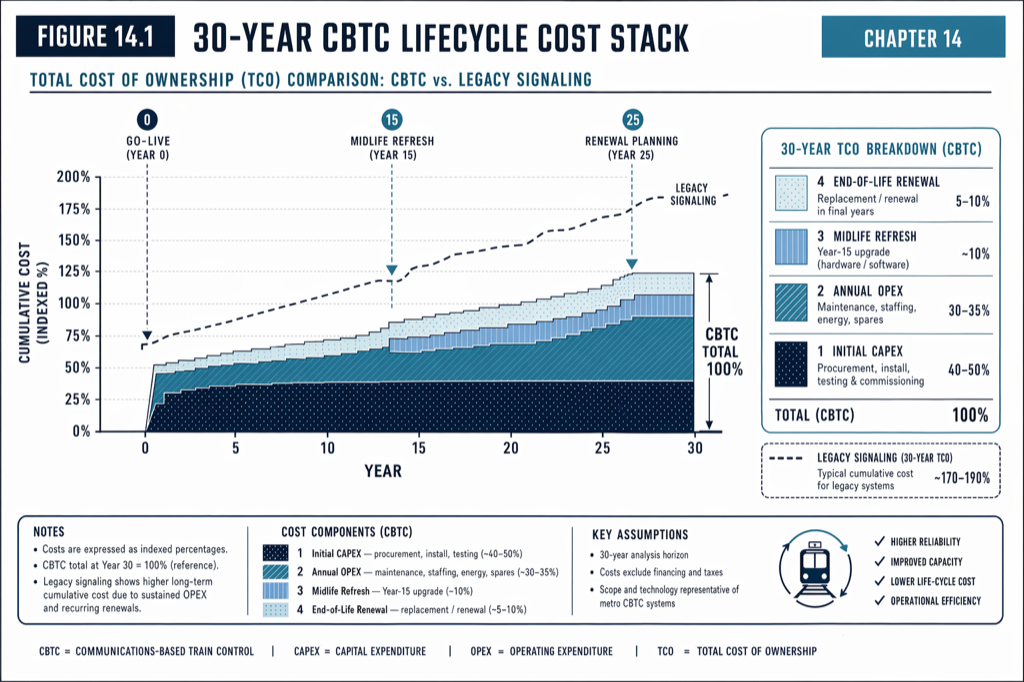 Initial CAPEX is roughly 35 to 42 percent of 30-year discounted lifecycle cost. The remainder is OPEX and refresh.
Driver 6: vendor consolidation and competitive leverage
The US CBTC vendor base has consolidated. Alstom acquired Bombardier Transportation in 2021, merging the Urbalis and CITYFLO platforms. Hitachi Rail acquired Thales Ground Transportation Systems in 2024, consolidating SelTrac under Hitachi Rail. The number of genuinely independent tier-1 suppliers capable of delivering a complete US CBTC system has shrunk from approximately six to approximately five (Siemens Mobility, Hitachi Rail, Alstom, with Wabtec on the PTC-bridging fringe and CRSC limited by US regulatory and supply-chain security policy).
Fewer bidders translates directly into less negotiating leverage on price, schedule, and performance guarantees. Procurement timelines extend to 18 to 24 months of evaluation and negotiation. Incumbent vendor advantage compounds — an agency that selected Siemens for its first CBTC line will pay a premium to switch suppliers on its second line because of training, spares, and integration costs.
The mitigation is the multi-vendor strategy that NYC’s MTA has pursued across the L Line (Siemens), the 7 Line (originally Thales SelTrac, now Hitachi Rail), and Queens Boulevard (Siemens). The cost of multi-vendor operation — dual training, dual spares, dual diagnostic tooling — is real (estimated at a 10 to 25 percent lifetime cost premium versus single-vendor) but the negotiating leverage on each subsequent procurement is preserved.
Practical takeaways
- Build the all-in budget from the six canonical CAPEX categories, not from the contractor’s bid. Budget $15M to $30M per route-mile for US brownfield CBTC.
- Line-item BABA (5 to 15 percent), Davis-Bacon (30 to 50 percent on labor), and PLA (10 to 20 percent on labor) into each subcomponent budget, not into a single contingency reserve.
- Budget 3 to 6 percent of CAPEX for the Program Management Consultant and 0.5 to 1.5 percent for the Independent Safety Assessor.
- Treat parallel operations during cutover as a 10 to 20 percent OPEX premium across multiple fiscal years, not as a one-time line item.
- Include 30-year refresh costs (VOBC/ZC at year 15, wayside radio at year 10, OCC at year 5 to 7) in the financial plan even when the CIG only funds Phase 1.
- If the procurement is for a second or third line, deliberate on whether the long-run cost of the multi-vendor strategy is worth the negotiating leverage it preserves.
Where to go next
This piece is the all-in budget walkthrough. The full lifecycle treatment lives in Chapter 14 (Lifecycle Costs and Economic Justification) and Chapter 15 (Vendor Landscape) of Communications-Based Train Control, Volume 2 (Buy on Amazon). Download Chapter 14 slides (free PDF).
For the change-order pattern that drives mid-project overruns, see Why CBTC Projects Run 30%+ Over Budget — and How to Prevent It. For the federal funding structure, see Funding a CBTC Project: FTA, Federal, State, and Local Sources.
Sources
- Wang, C. (2026). Communications-Based Train Control, Volume 2: Operations, Deployment & Economics. Independent. ISBN 979-8-258-54295-3. — Chapter 14, “Lifecycle Costs and Economic Justification”; Chapter 15, “Vendor Landscape.”
- Federal Transit Administration. Capital Investment Grants Program. transit.dot.gov/CIG
- Federal Transit Administration. Build America, Buy America Act Implementation Guidance. transit.dot.gov/BuyAmerica
- US Department of Labor. Davis-Bacon and Related Acts. dol.gov/agencies/whd/government-contracts/construction
- Federal Transit Administration. (2016). FTA Report No. 0045: Communications-Based Train Control (CBTC) Technology. transit.dot.gov
- Bay Area Rapid Transit. Train Control Modernization Program. bart.gov/about/projects/cbtc
- MTA New York City Transit. Communications-Based Train Control Status Update. new.mta.info/project/communications-based-train-control-cbtc
- Transportation Security Administration. Security Directive 1580-23-01: Rail Cybersecurity. tsa.gov
How this article was produced. Drafted with AI assistance, then reviewed and fact-checked by Chunjun (Francisco) Wang against Communications-Based Train Control (the author's two-volume reference) and primary sources — agency records, vendor documentation, and IEEE/IEC standards. Every date, vendor, and figure is traceable to a cited source. Spot a mistake? Corrections are welcome via the contact page.
Read the full treatment in the book
Chapter 12 of Communications-Based Train Control, Volume 2, covers this in depth.