career · Article
CBTC Training: How Engineers and US Transit Agencies Build Real Competency

A new engineer joins the train control group at a large US transit agency with a fresh degree in electrical or computer engineering and, within a week, discovers that almost nothing in that degree prepared her for the work in front of her. She is handed a Communications-Based Train Control (CBTC) design specification, a rack of onboard equipment she has never touched, and a mentor who tells her that the real CBTC training starts now. Two years later she is trusted at a console during a live cutover. The distance between those two moments is the subject of this article.
Why CBTC training does not come from one place
No United States university awards a degree in Communications-Based Train Control, and no single certificate makes an engineer competent to sign off on a moving-block design. The discipline sits in the gap between electrical engineering, computer and network engineering, systems engineering, and safety assurance, and no accredited curriculum spans all four with a rail-transit focus. That structural gap is why US agencies and suppliers repeatedly find themselves training their own people from a low baseline, and it is a large part of the workforce problem described in the hidden skill gap in US transit engineering.
Competency, in practice, is assembled rather than conferred. It comes from four sources that compound over several years: the foundation an engineering degree provides, the product-specific training a vendor delivers, the continuing education offered by professional bodies and the federal government, and — the source most employers underestimate — supervised work on real projects. Understanding how those pieces fit is the first step toward building the competency deliberately instead of accidentally.
What engineering school teaches — and what it leaves out
A conventional electrical, computer, or systems engineering degree teaches the primitives a CBTC engineer needs: signal theory, digital logic, control systems, probability and reliability, and increasingly software and network fundamentals. Those primitives matter, and they are difficult to acquire later. What the degree almost never teaches is the rail-transit context in which those primitives are applied — fixed-block and moving-block signaling, interlocking logic, braking-curve calculation, headway analysis, and the safety-assurance discipline that governs vital systems.
A small number of US universities have built genuine rail programs that narrow the gap. Michigan Technological University runs a Rail Transportation Program with a rail minor and industry field work, and the University of Illinois Urbana-Champaign hosts RailTEC, described as the largest railway education program in North America and the lead of the federally funded National University Rail (NURail) consortium. These programs give a graduate exposure to the vocabulary of train control before the first day on the job, which shortens the ramp considerably. The broader landscape of these schools is covered in the top US universities for rail engineering. Even the best of them, however, produce a graduate who still needs product training and years of field work before signing anything. School builds the floor; it does not build the engineer.
Vendor new-hire training: where product competency is built
The most structured CBTC training in the industry is delivered by the suppliers, because their products are proprietary and no external school teaches them. Siemens Mobility runs a Mobility Development Program built as four six-month rotations across roughly two years, exposing new engineers to product development, application engineering, field testing, and project functions, with a documented rotation path that includes CBTC work in New York City. Alstom, which completed its acquisition of Bombardier Transportation in 2021, operates Alstom University, an internal learning platform organized into technical academies covering engineering and digital disciplines. Hitachi Rail, which grew from the former Ansaldo STS train control business, runs comparable internal programs.
This is where an engineer learns a specific zone controller, a specific onboard controller, and a specific automatic train supervision suite — the concrete systems behind the abstract architecture. The strength of vendor training is depth on the deployed product; its limit is that the knowledge is product-bound. An engineer trained entirely inside one supplier’s academy understands that supplier’s implementation of CBTC, not the vendor-neutral principles that let an agency compare offerings. Recognizing that boundary is why the vendor landscape is worth studying on its own terms rather than through a single supplier’s lens.
AREMA, APTA, the TSI, and continuing education
Outside the vendors, three institutions carry most of the continuing-education load in the United States. The American Railway Engineering and Maintenance-of-Way Association (AREMA) is the closest thing the industry has to a professional home for signal engineers: it publishes the Communications and Signals Manual that functions as the field’s shared reference, and it runs seminars and an annual Communications and Signals symposium where an engineer can earn on the order of 12.5 professional development hours across a few days of practitioner-led sessions. AREMA education is where a working engineer keeps current on practice that no textbook tracks in real time.
The American Public Transportation Association (APTA), working with the Transportation Learning Center, maintains recommended practices and consortium courseware for rail signals training, structured as a progression of learning objectives typically spread over about three years and paired with on-the-job training under a qualified journeyman. That model is aimed primarily at the signals maintainer rather than the design engineer, but the two tracks share a great deal, and an engineer who understands the maintainer curriculum understands what the field crews will actually do with a design.
The federal layer is the Transportation Safety Institute (TSI), which delivers the Federal Transit Administration (FTA) safety-training mandate. Under the Public Transportation Safety Certification Training Program, codified at 49 CFR Part 672, designated safety personnel at rail transit agencies and State Safety Oversight agencies must complete an initial curriculum within three years and recertify on a recurring cycle. TSI training is not CBTC engineering as such; it is the safety-oversight competency that surrounds every US train control project, and an engineer who ignores it will misread how a domestic safety case is actually approved.
On-the-job apprenticeship: the part no course replaces
Ask any experienced US signal engineer where competency actually came from, and the answer is almost always the same: the projects. CBTC is a systems-integration discipline whose hardest problems — degraded-mode behavior, interface mismatches between the new system and a legacy interlocking, timing on a live cutover, the gap between the specification and what the field crews built — appear only on real deployments. No classroom reproduces the pressure of a testing window that closes at the start of revenue service, and no simulator carries the accountability of a signature on a test record.
This is why the apprenticeship model, formal or informal, remains the center of gravity. The APTA and Transportation Learning Center framework makes it explicit for maintainers by pairing instructor-led instruction with supervised field work under a journeyman, and the same logic governs the engineering track even where it is undocumented. The first two years are spent shadowing, checking other people’s work, running tests someone else designed, and gradually being trusted with more. The competency built this way is durable precisely because it was earned against consequences.
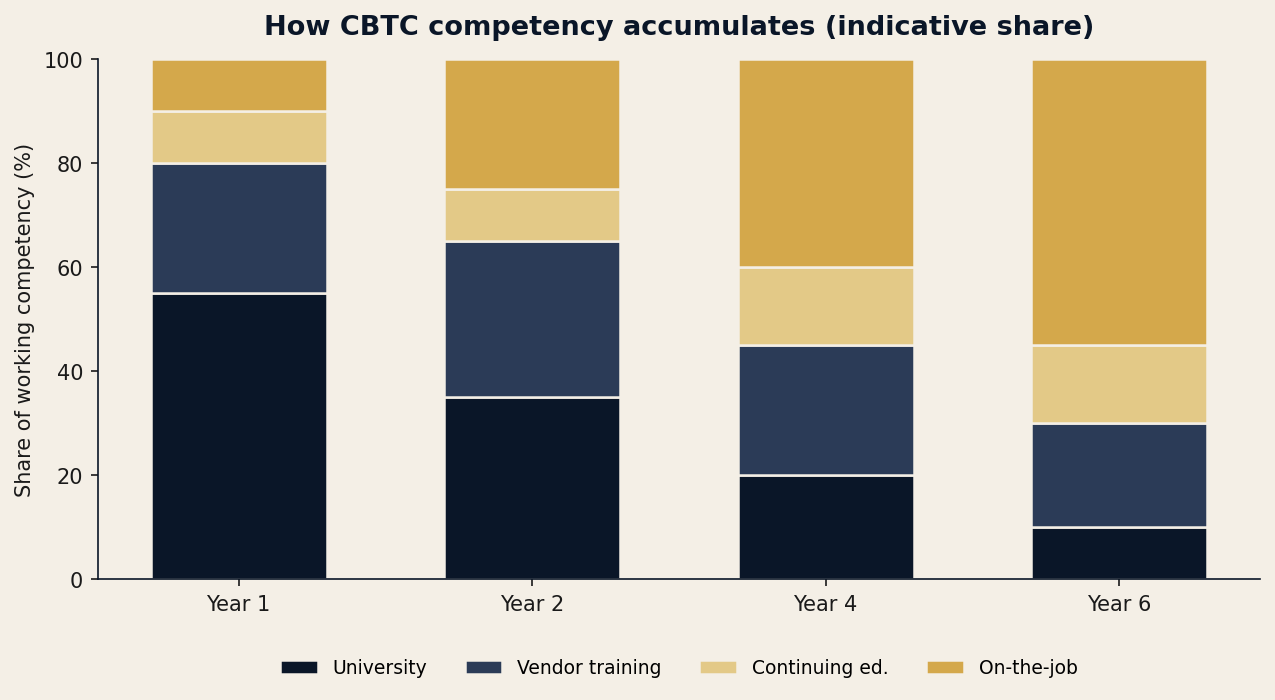 Indicative only — the university share of working competency declines as supervised field experience compounds, and on-the-job apprenticeship becomes the dominant source by roughly year four.
Standards literacy: reading IEEE 1474 and IEC 62290 for yourself
The one form of CBTC training an engineer can begin alone, at no cost beyond the price of the documents, is reading the standards. IEEE Std 1474.1 defines the performance and functional requirements for a CBTC system — high-resolution train location independent of track circuits, continuous bidirectional train-to-wayside data communication, and vital onboard and wayside processors implementing automatic train protection, with optional automatic train operation and supervision. First issued in 1999 and revised since (the 2004 edition is the current baseline), it is the vocabulary every US specification is written in. The international counterpart, the IEC 62290 series on urban guided transport management and command and control systems, defines the grades of automation from GoA 1 through unattended GoA 4 that structure any conversation about driverless operation.
Reading these documents does two things at once. It gives an engineer the shared language that vendor training and agency specifications both assume, and it exposes the fact that the United States lacks a formal signaling-competency credential of its own. The Principles and Practice of Engineering examination behind the US Professional Engineer license has no railway-signaling discipline; the closest structured competency scheme, the Institution of Railway Signal Engineers licensing framework, is British and not widely adopted here. In that vacuum, standards literacy is the most portable, vendor-neutral competency an engineer can build, and it pairs well with the reading list in how to become a CBTC engineer in 2026.
What this means in practice
For an engineer or an agency building CBTC competency deliberately, a workable learning path looks like this:
- Get the foundation right first. Secure the electrical, computer, systems, and reliability primitives through a degree or equivalent study, and prefer a program with a rail track such as those at Michigan Tech or the University of Illinois when the choice is available. These are hard to acquire after the fact.
- Read the standards before the vendor teaches you. Work through IEEE 1474.1 and the IEC 62290 grades of automation early, so that vendor product training lands on a vendor-neutral frame rather than becoming the frame.
- Treat vendor training as depth, not breadth. Use a supplier program — a Siemens rotation, an Alstom University track, or an equivalent — to learn a real product deeply, while remembering that product knowledge is not the same as CBTC judgment.
- Bank continuing-education hours on purpose. Join AREMA, attend the Communications and Signals symposium, follow the APTA recommended practices, and complete the TSI safety-certification training the federal program requires; competency decays without renewal.
- Protect the two-year apprenticeship. Plan for supervised field work on live projects as the part of the path that actually produces a trusted engineer, and staff and schedule accordingly rather than assuming a course can substitute for it.
Where to go next
CBTC training has no single front door, but it has a clear shape, and an engineer or a program manager who understands that shape can build competency on purpose instead of by accident. The full treatment of how competency maps to real work — across the project lifecycle in Chapter 12 and the supplier landscape in Chapter 15 — lives in Communications-Based Train Control, Volume 2: Operations, Deployment and Economics (Buy on Amazon). The free chapter slide decks, Chapter 12 and Chapter 15, condense the lifecycle and vendor material for a team briefing.
Sources
- Wang, C. (2026). Communications-Based Train Control, Volume 2: Operations, Deployment & Economics. Independent. ISBN 979-8-258-54528-2. — [Chapter 12, “Project Lifecycle”; Chapter 15, “Vendor Landscape”]
- American Railway Engineering and Maintenance-of-Way Association. Education and Events. arema.org
- American Public Transportation Association / Transportation Learning Center. Rail Signals Maintenance Training Content and Standards (APTA RT-RMT-RP-002). apta.com · transittraining.net
- Federal Transit Administration / Transportation Safety Institute. Public Transportation Safety Certification Training Program, 49 CFR Part 672. transportation.gov · ecfr.gov
- Siemens Mobility. Mobility Development Program. jobs.siemens.com
- Alstom. Alstom University. alstom.com
- IEEE Standards Association. IEEE Std 1474.1: Standard for Communications-Based Train Control (CBTC) Performance and Functional Requirements. standards.ieee.org
- International Electrotechnical Commission. IEC 62290 series: Railway applications — Urban guided transport management and command/control systems. webstore.iec.ch
- RailTEC, University of Illinois Urbana-Champaign, and the National University Rail (NURail) consortium. railtec.illinois.edu · nurailcenter.org
- Michigan Technological University. Rail Transportation Program. rail.mtu.edu
- Institution of Railway Signal Engineers. IRSE Licensing Scheme. irse.org
How this article was produced. Drafted with AI assistance, then reviewed and fact-checked by Chunjun (Francisco) Wang against Communications-Based Train Control (the author's two-volume reference) and primary sources — agency records, vendor documentation, and IEEE/IEC standards. Every date, vendor, and figure is traceable to a cited source. Spot a mistake? Corrections are welcome via the contact page.
Read the full treatment in the book
Chapter 12 of Communications-Based Train Control, Volume 2, covers this in depth.