comparative · Article
CBTC vs Moving-Block PTC: The Critical Differences
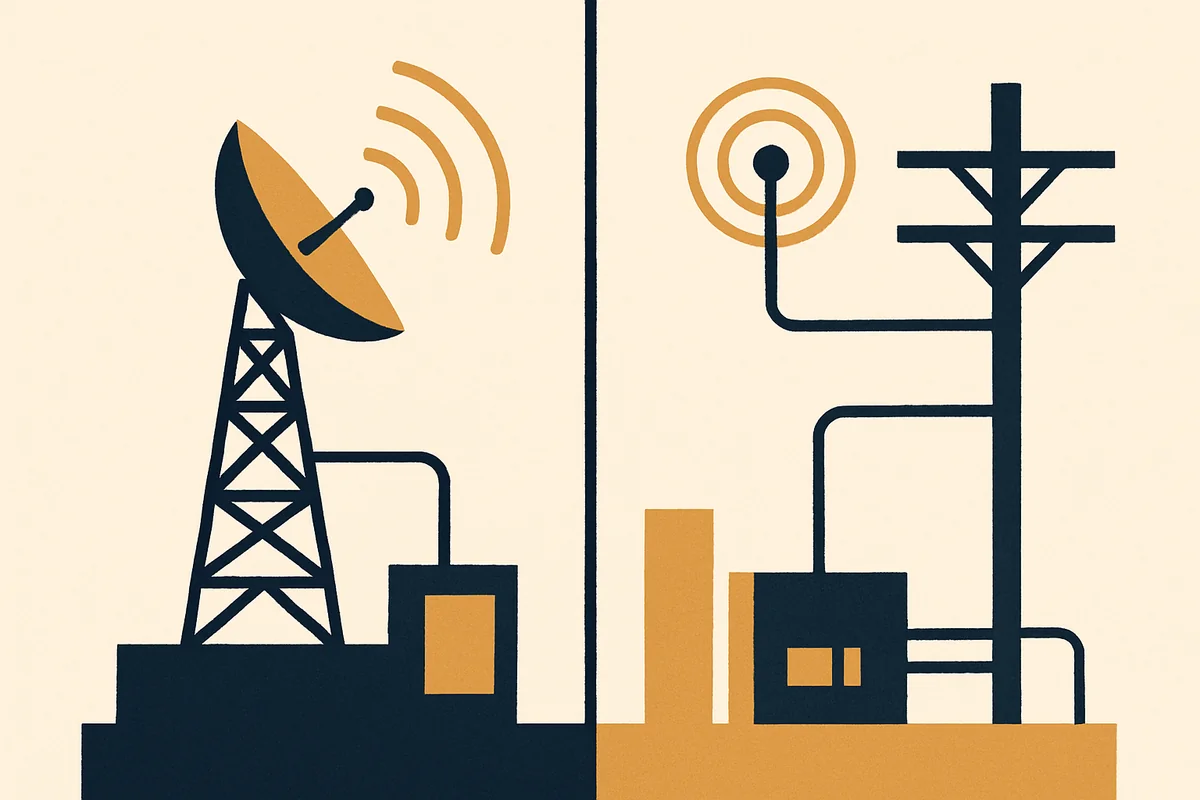
For the first decade after the 2008 Rail Safety Improvement Act mandated Positive Train Control (PTC) on US mainline rail, the assumption was that PTC would remain an overlay system. The trackside infrastructure (signals, track circuits, fixed-block separation) would stay; PTC would prevent overspeed, prevent unauthorized movements, and protect roadway workers. Capacity uplift would not be the deliverable. By the early 2020s, however, several forces (capacity pressure on shared corridors, vendor product consolidation, the European progress on ERTMS Hybrid Level 3, and the maturing FRMCS radio standard) had begun to pull PTC toward something resembling moving-block operation. The question of whether US mainline rail can or should deploy moving-block PTC has become one of the more interesting procurement and regulatory conversations in the industry. The CBTC vs moving-block PTC comparison is therefore relevant in 2026 not because the two systems are likely to converge, but because the institutional, technical, and regulatory differences shape both procurement decisions.
Two systems, two regulators, two ecosystems
CBTC and PTC operate in different regulatory worlds. CBTC is the dominant signaling technology for FTA-jurisdiction urban transit: New York City subway, BART, Honolulu Skyline, JFK AirTrain, Vancouver SkyTrain, Paris Métro Line 14. The institutional environment is metro-grade: dense corridors, short blocks, high frequencies, homogeneous fleets, and operations in a single agency.
PTC is the FRA-jurisdiction safety system mandated by the Rail Safety Improvement Act. It runs on every Class I freight railroad (BNSF, Union Pacific, CSX, Norfolk Southern), Amtrak, and the FRA-regulated commuter rail operators (Metro-North, LIRR, Metra, SEPTA, MARC). The institutional environment is mainline-grade: long corridors, mixed traffic, heterogeneous fleets, multiple operators sharing infrastructure, and integration with the broader Class I freight network.
The two ecosystems share little vocabulary and even less procurement infrastructure. CBTC vendors (Siemens, Alstom, Hitachi Rail) and PTC vendors (Wabtec, with limited overlap from the metro-grade vendors) are largely separate businesses, even within the same parent companies. The standards bodies (IEEE 1474 for CBTC, the AAR’s Interoperable Train Control specifications for PTC) are separate. The certification pathways (FTA State Safety Oversight for CBTC, FRA approval for PTC) are separate. Agencies that deploy in both worlds (the largest US transit agencies that operate FRA-regulated commuter rail alongside FTA-regulated metro) maintain dual procurement infrastructure. (For the regulatory split in more detail, see CBTC vs PTC: Why US Commuter Rail Picked One and US Metro Picked the Other.)
What “moving-block PTC” actually means
The term “moving-block PTC” is doing more work than it appears to. PTC, as specified under 49 CFR Part 236 and as deployed across the US Class I freight network and most commuter operators, is an overlay system. The dominant platform, Wabtec’s Interoperable Electronic Train Management System (I-ETMS), uses continuous GPS, onboard speed-enforcement computers, wireless 220 MHz communication, and a lineside track database to monitor position and enforce speed compliance. I-ETMS does not change fundamental signaling architecture; trackside signals remain, fixed-block separation remains, and the dispatcher retains primary authority over movement decisions.
A moving-block PTC system, in the sense the term is used in 2026 procurement conversations, would either be a substantial enhancement of the I-ETMS architecture or a different platform entirely. The two pathways under serious discussion are distinct.
The first is the PTC plus ATO overlay, in which existing PTC infrastructure is augmented with Automatic Train Operation that optimizes braking and acceleration profiles to extract additional capacity within the existing fixed-block framework. This is the Metra Rock Island Line study path, the Caltrain post-CalMod direction, and the most likely 2026-to-2032 deliverable. The capacity gain is modest (8 to 12 percent based on Metra’s published findings) but the regulatory and procurement risk is small. It is not moving-block in the strict sense; it is an efficiency overlay on top of fixed-block PTC.
The second is the hybrid PTC-CBTC architecture, in which moving-block separation is layered onto a PTC corridor through CBTC-style continuous bidirectional communication, high-resolution train position reporting, and the elimination of trackside detection for trains that can support it. The Caltrain CBOSS program of 2010 to 2015 attempted this and was canceled after substantial vendor coordination challenges, schedule slippage, and cost overruns. Caltrain abandoned CBOSS in favor of conventional I-ETMS PTC paired with rail electrification. The CBOSS failure is the most-cited US data point for what hybrid CBTC-PTC pioneer projects look like when they fail.
How the two architectures compare
The fundamental architectural differences between CBTC and any plausible moving-block PTC system are concentrated in four areas: train detection, communication, positioning, and authority generation.
Train detection. CBTC eliminates trackside train detection for moving-block separation; trains report their own positions and the wayside computes Movement Authorities directly. Moving-block PTC would have to either follow the same path (eliminating trackside detection, with all the implications for mixed-traffic operation) or follow the ERTMS Hybrid Level 3 pattern of retaining reduced-functionality trackside detection (typically axle counters at strategic locations) for trains that cannot report their own integrity. The mixed-traffic constraint on US Class I freight corridors makes the Hybrid Level 3 pattern the more likely template.
Communication. CBTC uses continuous bidirectional digital communication on IEEE 802.11 radio in unlicensed spectrum (most US deployments) or licensed cellular spectrum (some emerging deployments). PTC uses event-based and periodic wireless on the 220 MHz narrowband, a legacy spectrum allocation that is heavily constrained. A moving-block PTC system would require substantially upgraded radio infrastructure; the relevant migration path is FRMCS or private 5G, which would need US regulatory groundwork that does not currently exist.
Positioning. CBTC uses sensor fusion (tachometer, optional Doppler, balise resets) for one-to-two-meter position accuracy. PTC uses GPS plus inertial dead-reckoning with periodic radio validation. The accuracy is comparable in practice but the architectural philosophies differ; moving-block separation requires position knowledge whose accuracy must hold during GPS outages (typical in deep cuttings, tunnels, and urban canyons), which means PTC moving-block would likely need to add balises, axle-mounted odometry, or both.
Authority generation. CBTC’s wayside Zone Controller computes Movement Authorities continuously and refreshes them every 200 to 500 milliseconds. PTC’s authority generation is more episodic; the train periodically reports position and receives speed-restriction updates, with the dispatcher retaining primary authority over routing decisions. Moving-block PTC would need to converge toward the CBTC pattern of continuous wayside authority generation, which is a substantial architectural change to the I-ETMS platform.
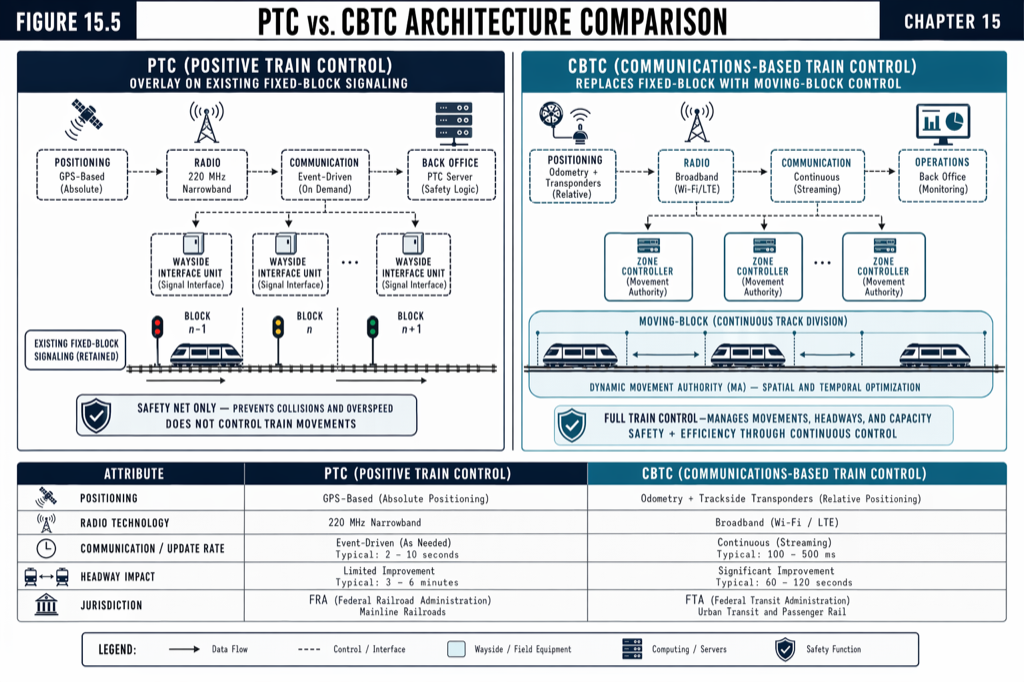 Moving-block PTC is not a single architecture; the three plausible variants differ substantially in technical and procurement risk.
Where the two systems can plausibly converge
Four convergence drivers, identified in mainstream industry analysis, push CBTC and PTC toward technological alignment over the next decade.
Shared-corridor capacity pressure is the first. Long Island Rail Road and Metro-North together carry over 750,000 daily passengers and approach saturation on key trunk lines. Both operators are studying moving-block functionality on subsets of their networks (Hudson Line approach to Grand Central, Jamaica corridor on the LIRR) where the capacity ceiling has become a binding constraint. Caltrain faces analogous pressure to accommodate California High-Speed Rail on shared right-of-way, which would require some form of blended HSR-and-commuter operation.
Vendor product consolidation is the second. Siemens, Hitachi Rail, and Alstom each have mature CBTC and PTC portfolios. Each has begun modularizing and aligning these portfolios with the explicit goal of reducing duplication and enabling product reuse across the metro and mainline product lines. A US commuter railroad procuring a future train control system in the late 2020s will likely encounter modular architectures tuned for either PTC compliance, CBTC capacity, or hybrid operation.
Radio spectrum and FRMCS harmonization is the third. The transition to FRMCS (or the US analogue, when one emerges) opens a window for unified radio architecture that could support both PTC overlay and continuous-communication CBTC on the same physical infrastructure. Current PTC implementations rely on legacy 220 MHz narrowband, which is crowded and constrained; the migration off that spectrum is happening in slow motion.
Automatic Train Operation on mainline corridors is the fourth. Mainline and commuter rail in the US has not embraced ATO, primarily due to labor agreements and operating culture. The European Railway Agency has begun developing specifications for ATO on European mainline systems, particularly on high-density commuter corridors. For a US commuter railroad considering a PTC-to-CBTC pathway, the addition of ATO is strategically important, both as a capacity multiplier and as a step toward eventual GoA 3 or GoA 4 operation.
Where they will not converge soon
Three institutional barriers will keep CBTC and moving-block PTC as distinct procurement decisions through at least the early 2030s.
Jurisdictional division. Any train control system deployed on a corridor with both FTA and FRA jurisdiction must satisfy both rulebooks. This creates a dual-certification requirement that is expensive and slow. As of 2026, there is no formalized pathway for a single system to satisfy both simultaneously; each certification proceeds separately.
AAR interoperability requirements. If a mainline corridor is shared with freight trains, any new train control technology must be compatible with AAR-approved freight equipment. For a shared corridor, this means the moving-block system must have fallback modes that allow a freight train equipped with only legacy PTC to operate safely. This is the same constraint that pushed European mainline rail toward Hybrid Level 3 rather than full Level 3.
Labor agreements and operating culture. The introduction of ATO touches on labor agreements at virtually every commuter railroad. Renegotiation is possible but politically charged and time-consuming. Combined with the cybersecurity requirements imposed by TSA Security Directives 1580 and 1582 on every train control deployment, the institutional friction on hybrid CBTC-PTC systems is substantial.
The Caltrain CBOSS program, which ran from 2010 to 2015 and was ultimately canceled, demonstrated empirically that pioneering a hybrid CBTC-PTC system without a proven vendor reference design at comparable scale is high-risk. Agencies that consider similar pathways now have the CBOSS lessons to draw on; the right posture is to wait for a proven vendor reference, not to pioneer.
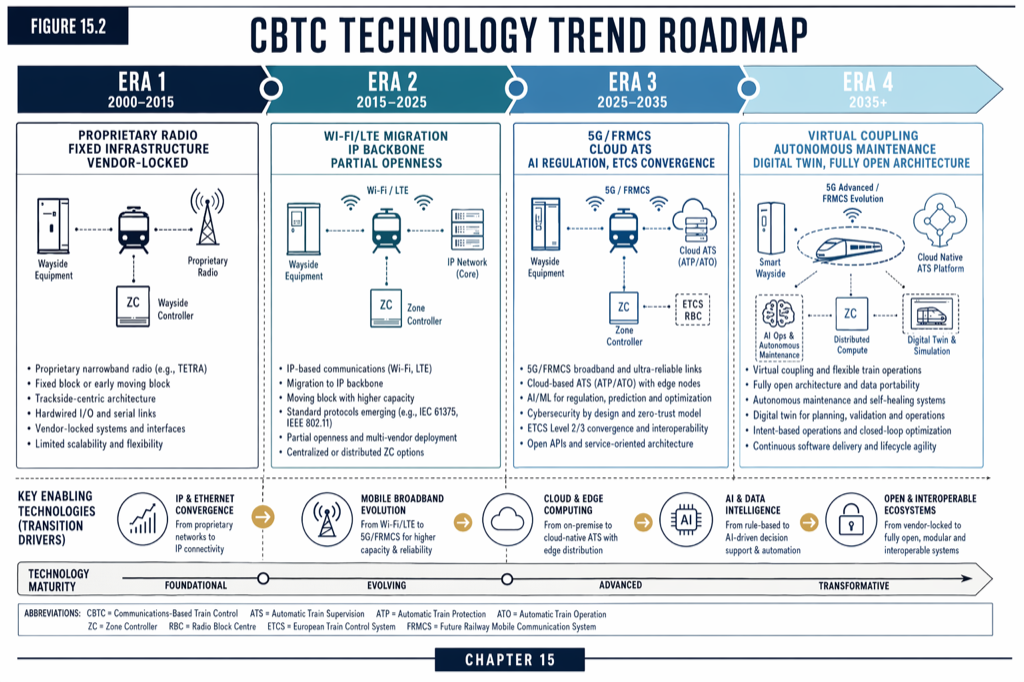 CBTC and PTC are converging on capability while remaining separate on regulation, certification, and operational context.
Realistic timelines
A realistic 2026 timeline for CBTC and moving-block PTC convergence has three phases.
2026 to 2030: Incremental enhancement. Continued PTC overlay enhancements (the Metra Rock Island and Caltrain CalMod direction); FRMCS and 5G-R standardization at the radio layer; vendor product portfolio modularization; FRA-APTA dialogue on future train control concepts. No major new moving-block deployments on PTC-equipped corridors. CBTC procurement on metro lines continues at its current pace.
2030 to 2040: First production convergence. First production deployment of a moving-block overlay or hybrid PTC-CBTC system on a US mainline or FRA-commuter corridor (likely candidates: Metra Rock Island, Caltrain post-CalMod, or a Northeast Corridor segment). FRMCS or its US equivalent becomes standard for new radio deployments. Possible FRA rulemaking on future train control architectures. ETCS Hybrid Level 3 deployment patterns in Europe inform US procurement specifications.
2040 onward: Mature convergence. True moving-block train control on several high-capacity commuter and regional rail corridors. Vendor product lines fully converged. Regulatory alignment between FRA and FTA on joint certification procedures.
This timeline reflects technological readiness, vendor maturity, regulatory opportunity, and real-world procurement lead times. Most US transit agency CBTC procurement decisions through 2030 will not encounter moving-block PTC as a serious option; the architectures remain on parallel but separate tracks for at least the next decade.
What this means in practice
- For US transit agencies under FTA jurisdiction, moving-block PTC is academic in 2026. The relevant procurement decisions remain among CBTC platforms.
- For US commuter rail under FRA jurisdiction, the realistic near-term path is PTC plus ATO overlay (8 to 12 percent capacity uplift, modest risk), not hybrid moving-block PTC.
- The Caltrain CBOSS experience is the most-cited US lesson on what hybrid CBTC-PTC pioneer projects look like when they fail. Do not pioneer; wait for a proven vendor reference design.
- The vendor product modularization trend is real and useful. Procurement specifications for future train control should require modular architectures that support PTC, CBTC, and hybrid operation through software configuration.
- The FRMCS or US-equivalent radio migration is the most consequential near-term technical change. New procurements should anticipate cellular-class radio as a future migration path even if initial deployment is on legacy spectrum.
- Realistic convergence is a 2030-to-2045 horizon. Plan accordingly.
Where to go next
This post is a comparison overview. The full treatment of CBTC, PTC, and the convergence question lives in Chapter 10 (“CBTC in the United States”) and Chapter 15 (“Vendor Landscape and Technology Trends”) of Communications-Based Train Control (Volume 2 on Amazon). Download Chapter 15 slides (free PDF)
Sources
- Wang, C. (2026). Communications-Based Train Control, Volume 2: Deployment, Economics, and the Future. Independent. ISBN 979-8-258-54295-3. — Chapter 10, “CBTC in the United States”; Chapter 15, “Vendor Landscape and Technology Trends.”
- IEEE Standards Association. IEEE Std 1474.1: Standard for Communications-Based Train Control (CBTC) Performance and Functional Requirements.
- Federal Railroad Administration. Positive Train Control Overview, 49 CFR Part 236 Subpart I. railroads.dot.gov/train-control
- Federal Transit Administration. State Safety Oversight Program. transit.dot.gov/regulations-and-guidance/safety/state-safety-oversight
- European Union Agency for Railways. Technical Specifications for Interoperability — Control Command and Signalling. era.europa.eu/activities/technical-specifications-interoperability
- International Union of Railways. Future Railway Mobile Communication System (FRMCS). uic.org/rail-system/frmcs
- Transportation Security Administration. Surface Transportation Cybersecurity Directives 1580 and 1582. tsa.gov/foia/readingroom
How this article was produced. Drafted with AI assistance, then reviewed and fact-checked by Chunjun (Francisco) Wang against Communications-Based Train Control (the author's two-volume reference) and primary sources — agency records, vendor documentation, and IEEE/IEC standards. Every date, vendor, and figure is traceable to a cited source. Spot a mistake? Corrections are welcome via the contact page.
Read the full treatment in the book
Chapter 10 of Communications-Based Train Control, Volume 2, covers this in depth.