definitional · Article
CBTC vs PTC: Why US Commuter Rail Picked One and US Metro Picked the Other
In September 2008, a Metrolink commuter train collided with a Union Pacific freight train in Chatsworth, California, killing 25 people and injuring 135. Within weeks, Congress passed the Rail Safety Improvement Act of 2008. By December 31, 2020 — the final extended deadline — Class I freight railroads, Amtrak, and most US commuter rail operators had implemented Positive Train Control on the corridors the law required. In April 2009, while Congress was still drafting that legislation, New York City Transit declared the L Line fully operational on Communications-Based Train Control. Two completely different US train-control systems went live within months of each other, governed by two different federal regulators, designed for two different operational contexts, and deployed by two different vendor ecosystems. They are still routinely confused. This post explains where the boundary actually lies, why each technology won in its market, and what an agency considering either should understand about the other.
Why this matters for procurement
The CBTC-versus-PTC distinction is not academic. It determines which regulator reviews a project (Federal Railroad Administration or Federal Transit Administration), which standards apply (49 CFR Part 236 Subpart I for PTC; IEEE 1474 series for CBTC), which suppliers can bid, which capital funding mechanisms apply (FRA grants and federal loans for PTC; FTA Capital Investment Grants for CBTC), and what the agency is actually buying. An agency procuring “advanced train control” without naming PTC or CBTC is an agency that has not made the decision that determines all the other decisions. This post is for the program manager, the FRA or FTA reviewer, or the consultant who needs to communicate the difference precisely to a board, a state legislature, or a public stakeholder.
The regulators draw the line
The most consequential difference between CBTC and PTC is the regulator that owns each. Everything else flows from this.
PTC is regulated by the Federal Railroad Administration. The FRA has jurisdiction over mainline freight, intercity passenger rail (Amtrak), and most commuter rail operating on shared or owned mainline track. The mandate flows from the Rail Safety Improvement Act of 2008 and is codified at 49 CFR Part 236 Subpart I. The FRA defines PTC functionally: any system that prevents train-to-train collisions, prevents over-speed derailments, prevents incursions into work zones, and prevents movement through misaligned switches qualifies, regardless of underlying technology.
CBTC is regulated by the Federal Transit Administration. The FTA has jurisdiction over rapid transit, light rail, and other urban passenger systems. The FTA does not mandate CBTC; it funds modernization through the Capital Investment Grant program and reviews safety through the State Safety Oversight (SSO) framework. State SSO agencies, established under federal law in each state with rail transit, conduct the actual safety review. The standards reference set is IEEE 1474.1 through 1474.4 in the United States, complemented by the international IEC 62290 framework.
The boundary between the two regulators is not always clean. Some commuter rail systems run partially on FRA-regulated mainline and partially on FTA-regulated transit territory. Some systems, like the Denver A Line, use PTC technology for FRA compliance but operate at FTA-style capacities and frequencies. The right question for any new project is not “PTC or CBTC?” but “what does the regulator with jurisdiction over this corridor require, and what business needs do we have beyond regulatory compliance?”
The functional scope is different
PTC is a safety overlay. Its statutory function is to prevent the four specific accident classes named in the Rail Safety Improvement Act. A PTC system can be entirely passive most of the time: the train operates under existing fixed-block signaling rules, the operator drives manually, and PTC intervenes only when an unsafe condition is about to occur — a missed signal, an over-speed approach to a curve, an unauthorized entry into a work zone. PTC does not necessarily improve capacity; on most US deployments, capacity is unchanged or slightly reduced because of conservative enforcement margins.
CBTC is the primary control system for the railway. It does not overlay an existing signaling system; it replaces it (or operates alongside it during a multi-year cutover). CBTC manages every train’s position, generates Movement Authorities continuously, and supervises every speed-distance envelope every cycle. The capacity gain — typically 20 to 40 percent over fixed-block — is structural to the architecture, not a side effect.
This difference shows up clearly in how the two systems handle the operator. Under PTC, the operator drives normally and the system intervenes only on violations. Under CBTC at GoA 2 (the dominant deployment), the operator approves departure and monitors but the Automatic Train Operation system actually drives the train. Under CBTC at GoA 4 there is no operator at all.
The architecture is different
PTC, in most US implementations, is built on Interoperable Electronic Train Management System (I-ETMS), a vendor-led architecture developed primarily by Wabtec for Class I freight railroads and adopted by most commuter rail operators. I-ETMS uses GPS for primary positioning, an onboard track database for civil infrastructure (curves, grades, switches), 220 MHz licensed radio for wayside-to-train and train-to-train communication, and back-office servers that issue authorities. The system is overlay-oriented: it works alongside existing signaling and assumes the underlying railway is fixed-block.
CBTC uses the architecture detailed elsewhere on this site: balise-anchored sensor fusion for position, redundant DCS radio (typically 2.4 GHz or 5 GHz, increasingly LTE/private 5G) for communication, and SIL 4 distributed processing across the VOBC and Zone Controller. (For the localization details, see How CBTC Trains Know Where They Are (Without Track Circuits).)
The capacity implications follow directly. PTC’s GPS-based positioning has accuracy of roughly 10 meters in good conditions and degrades in tunnels and urban canyons; CBTC’s sensor-fused positioning is accurate to 1 to 2 meters and works in tunnels. PTC’s overlay design assumes block-level position resolution; CBTC’s primary-control design enables moving block. PTC’s safety case is built around intervention; CBTC’s is built around continuous supervision.
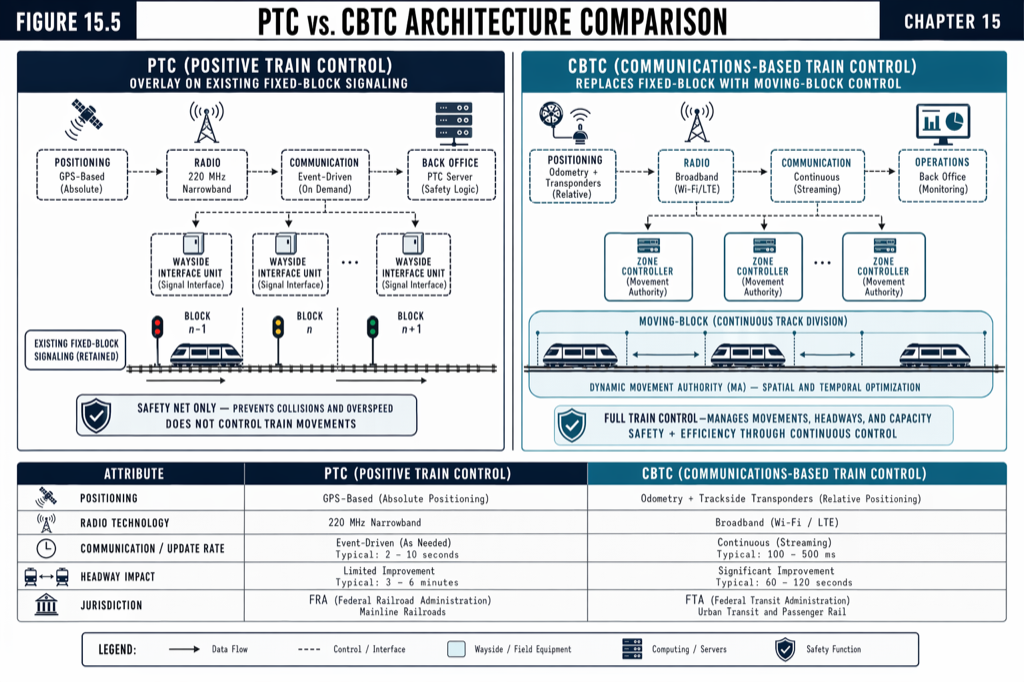 PTC overlays existing fixed-block signaling; CBTC replaces it with a moving-block architecture.
The deployment records are different
The PTC deployment record is dominated by mileage. As of the December 31, 2020 implementation deadline, Class I freight railroads had implemented PTC across approximately 57,000 route-miles; Amtrak across virtually all its operated trackage; commuter rail operators (Metra, Metrolink, MARC, Long Island Rail Road, Metro-North, Caltrain, NJ Transit, SEPTA Regional Rail, MBTA, and others) across most of their FRA-regulated territory. The deployment was driven by federal mandate, funded by a combination of railroad capital, federal grants, and federal loans, and is operationally mature.
The US CBTC deployment record is far smaller and far slower. Notable revenue-service lines include the L Line (full revenue 2009 with extended completion through 2020), the 7 Line (Thales SelTrac, full revenue 2018), the JFK AirTrain (driverless GoA 4, opened 2003), the Honolulu Skyline (GoA 4, opened June 2023), and active programs at BART (Hitachi Rail Train Control Modernization Program), the MTA Queens Boulevard Line (Siemens, partial revenue 2024), and SFMTA Muni (RFP issued 2024). The deployment is not driven by federal mandate; each project is voluntary, funded primarily through FTA Capital Investment Grants, and proceeds at the pace each agency’s capital plan allows.
This is why the answer to “how much CBTC is operational in the US?” is “much less than you would expect given the size of the US transit market,” while the answer to “how much PTC is operational in the US?” is “almost everywhere FRA jurisdiction applies.” Different regulators, different mandates, different rates of deployment.
The vendor landscape is different
The PTC vendor base is dominated by Wabtec (formerly GE Transportation) for I-ETMS and a smaller set of suppliers for non-I-ETMS variants used on certain commuter and intercity systems. The supply chain is mature, primarily US-based, and constrained by interoperability requirements: any train operating on a host railroad’s PTC territory must carry equipment compatible with the host’s PTC system.
The CBTC vendor base is dominated globally by Siemens Mobility (Trainguard MT), Alstom (Urbalis, including the legacy Bombardier CITYFLO 650 platform), Thales (SelTrac, now part of Hitachi Rail STS), and Hitachi Rail STS. CRSC and other Chinese suppliers have substantial international market share but limited US presence due to BABA compliance and procurement security policy. The supply chain is concentrated, primarily European and Japanese, and Build America, Buy America compliance imposes a 5 to 15 percent premium with US assembly and component sourcing requirements.
When an agency might need both
Some US systems sit at the boundary. Commuter rail operators that share track with freight (most of them) need PTC for FRA compliance on shared trackage, and may want CBTC-style capabilities on dedicated transit corridors. Light rail and streetcar systems crossing FRA-jurisdiction track at grade need PTC compatibility on those segments. Heavy-rail transit systems that historically operated under FRA jurisdiction (PATH, Staten Island Railway) face hybrid regulatory questions.
The pragmatic answer for hybrid corridors is usually: comply with FRA via PTC where required, deploy CBTC where the operational benefits justify it, and design the cutover and interface points carefully. The interface engineering is non-trivial. (For the comparable European debate over moving block, see CBTC vs ETCS: A Side-by-Side for US Engineers.)
Practical takeaways
- The regulator is the most important difference. FRA owns PTC; FTA owns CBTC. Everything else follows.
- PTC is a safety overlay on existing signaling. CBTC is a primary control system that replaces existing signaling.
- PTC was driven by federal mandate after the 2008 Chatsworth collision. CBTC is driven by agency-by-agency capacity and modernization business cases.
- The vendor ecosystems are mostly disjoint. Wabtec dominates US PTC; Siemens, Alstom, Thales, and Hitachi dominate global CBTC.
- For hybrid corridors (commuter rail on shared mainline, transit crossing FRA-regulated track), expect both systems with carefully engineered interface boundaries.
Where to go next
This post is a brief summary. The full treatment lives in [Chapter 1 — The Evolution of Train Control] and [Chapter 2 — Standards and Regulation] of Communications-Based Train Control (Volume 1 on Amazon). Download Chapter 2 slides (free PDF →)
Sources
- Wang, C. (2026). Communications-Based Train Control, Volume 1: Foundations & Technical Architecture. Independent. ISBN 979-8-258-54295-3. — Chapter 1, “The Evolution of Train Control”; Chapter 2, “Standards and Regulation.”
- Federal Railroad Administration. Positive Train Control (PTC) Overview. railroads.dot.gov/program-areas/safety/ptc
- Federal Railroad Administration. 49 CFR Part 236 Subpart I — Positive Train Control Systems. ecfr.gov
- Federal Transit Administration. Capital Investment Grants Program. transit.dot.gov/CIG
- Federal Transit Administration. State Safety Oversight Program. transit.dot.gov/regulations-and-guidance/safety/state-safety-oversight
- IEEE Standards Association. IEEE Std 1474.1–1474.4: Communications-Based Train Control Standards.
- National Transportation Safety Board. Chatsworth Collision Investigation Report (RAR-10/01). ntsb.gov
- MTA New York City Transit. L Line CBTC Project Documentation. new.mta.info
How this article was produced. Drafted with AI assistance, then reviewed and fact-checked by Chunjun (Francisco) Wang against Communications-Based Train Control (the author's two-volume reference) and primary sources — agency records, vendor documentation, and IEEE/IEC standards. Every date, vendor, and figure is traceable to a cited source. Spot a mistake? Corrections are welcome via the contact page.
Read the full treatment in the book
Chapter 1 of Communications-Based Train Control, Volume 1, covers this in depth.