international-benchmarks · Article
Chinese Metro CBTC: 50 Cities, 11,000+ Route-km, in 25 Years
In 2002, Guangzhou Metro Line 1 entered revenue service with Communications-Based Train Control (CBTC) supplied by Alstom and Bombardier. It was the first revenue-service CBTC line in China. By 2025 — roughly 25 years later — China operated rapid-transit networks across more than 50 cities, encompassing approximately 11,000 to 11,200 route-kilometers of urban rail, with CBTC the default specification on substantially all new line construction since approximately 2010 and Grade of Automation 4 (GoA 4) deployed on more than 20 lines representing roughly 600-plus route-kilometers. Cumulatively, the Chinese metro industry has deployed more CBTC route-kilometers in 25 years than the rest of the world combined. By comparison, the United States operates approximately 510 route-kilometers of CBTC across roughly six major heavy-rail and light-rail agencies, an approximately 20:1 differential. The disparity is not a measure of engineering maturity, vendor capability, or even technology readiness. It is a structural artifact of two profoundly different institutional and procurement frameworks.
This post is a practitioner’s walk through how the Chinese CBTC scale-up actually happened, what its mechanisms are, and what — if anything — is transferable to US transit agencies operating under Federal Transit Administration (FTA) Buy America (BABA) rules, environmental review, and Davis-Bacon wage frameworks.
The four phases of Chinese CBTC
The Chinese CBTC story divides cleanly into four phases.
Phase 1: Imported technology (2002–2007). Early projects depended on Western suppliers — Alstom and Bombardier on Guangzhou Line 1 (2002), Bombardier on Beijing Line 5 (2007), Siemens on subsequent Beijing lines, Thales on Beijing Line 4 (2009). Spare parts, system maintenance, and technical support flowed from original equipment manufacturers, creating operational dependencies. Capacity building was at the operational level, not the systems integration level.
Phase 2: Joint ventures and technology transfer (2005–2012). The Chinese government required foreign vendors to establish joint ventures with state-owned enterprises, often with explicit domestic-content thresholds and technology-sharing commitments. China Automation Sectional Communication (CASCO) emerged as a Shanghai-based manufacturer producing both CBTC for urban metro and Chinese Train Control System (CTCS) for high-speed and mainline rail, with Hitachi and Alstom partnerships. Beijing Traffic Control Technology (TCT) emerged with explicit research support and commercial partnerships, and a focus on indigenous CBTC development.
Phase 3: Indigenous product lines (2012–2020). From 2012 onward, Chinese suppliers began deploying fully domestic CBTC systems in revenue service on major networks. The Beijing Yanfang Line (December 2017) was the first commercial GoA 4 deployment on a Chinese metro line. By approximately 2018, domestic suppliers — CRSC (China Railway Signal & Communication), CASCO, and TCT — accounted for the majority of new urban CBTC contracts measured by line count. (See Tokyo Metro vs Beijing Metro: Two Approaches to High-Density Operation for the comparative path.)
Phase 4: Domestic dominance and emerging international entry (2020–present). By 2024, Chinese suppliers held the dominant share of new CBTC contracts in China and had begun bidding on third-country projects in Indonesia, Thailand, Malaysia, and the Middle East. Within the United States, Chinese CBTC suppliers have not secured material market share. The barriers — Buy America/BABA, FRA certification pathways, NDAA Section 889 provisions, and the broader political environment — are durable.
How the scale-up actually happened
Three institutional mechanisms enabled the Chinese CBTC scale-up. None is unique to China, but the combination is structurally consequential.
First, a national five-year planning framework with quantitative urban-rail targets. China’s central government, through the National Development and Reform Commission (NDRC) and the Ministry of Housing and Urban-Rural Development (MOHURD), sets multi-year urban-rail expansion targets for major cities and provides forward visibility for vendors. The 14th Five-Year Plan (2021–2025) allocated approximately 2,000 route-kilometers of new metro construction across roughly 40 cities. Vendors entering the Chinese CBTC market in 2025 can reasonably forecast procurement demand through 2030 from published plan targets. This forward visibility encouraged investment in domestic manufacturing, design centers, and engineering capacity.
Second, a coordinated national standards framework. National standards (GB/T codes administered by MOHURD/TC290) and industry-level group standards (T/CAMET series, organized by the China Association of Metros, CAMET) define the technical specifications, testing requirements, and interoperability guidelines for urban CBTC. Foreign vendors supplying to Chinese projects must obtain dual certification — Chinese national standards plus IEC standards (IEC 61508 functional safety, IEC 61375 train communications). The standards are not identical to IEEE 1474.1 (the dominant North American CBTC performance standard) or the European EN 50126/128/129 family, but the functional requirements and safety-assurance approaches are broadly compatible.
Third, EPC-style turnkey project delivery with strong municipal owner engineering capability. Chinese urban CBTC projects typically use Engineering-Procurement-Construction (EPC) contracts in which a single integrator accepts responsibility for design, procurement, testing, and revenue-service demonstration. Municipal metro operators retain in-house project management offices typically staffed by 15–30 engineers, drawing on institutional experience from supervising 10–20 line deployments in the major networks. The fixed-price, lump-sum contract structure spans approximately 24 to 36 months from award to revenue service on a 15- to 30-kilometer line.
The combination produces a 36-to-48 month feasibility-to-revenue calendar for a Chinese urban CBTC line, against a 180-to-204 month equivalent in the US — roughly a 4:1 calendar differential. (See Chapter 16 of Communications-Based Train Control (Volume 2) for the comparative procurement analysis.)
What the scale numbers actually look like
The scale of the Chinese CBTC deployment is worth seeing in raw numbers.
| Year | China route-km (urban CBTC) | China CBTC lines | US route-km (CBTC) | US CBTC lines |
|---|---|---|---|---|
| 2010 | ~150 | 8–10 | ~200 | 3–4 |
| 2015 | ~750 | 33–38 | ~320 | 5–6 |
| 2020 | ~3,500 | 85–95 | ~450 | 6–7 |
| 2025 | ~7,200 | 150–170 | ~510 | 6–7 |
Beijing Subway alone operates 27 lines and approximately 800 route-kilometers, with 24 lines on CBTC and several at GoA 4. Shanghai Metro operates 17 lines and approximately 707 route-kilometers — the longest metro network in the world by route-kilometers — with substantially full CBTC coverage and several GoA 4 lines. Guangzhou Metro and Shenzhen Metro together exceed 900 route-kilometers and have pioneered through-running CBTC operations between two cities, a globally unique example of cross-municipal CBTC integration at scale. (See Chapter 11 of Communications-Based Train Control (Volume 2) for detail.)
The cost arithmetic is correspondingly different. Chinese urban CBTC capital costs run approximately $0.8 to $1.5 million per route-kilometer for greenfield deployment. US brownfield retrofit costs run approximately $4 to $8 million per route-kilometer. The differential reflects labor cost (Chinese site labor at 30–50 percent of US Davis-Bacon prevailing-wage equivalents), regulatory streamlining, greenfield versus brownfield context, and vendor commodity-product economics.
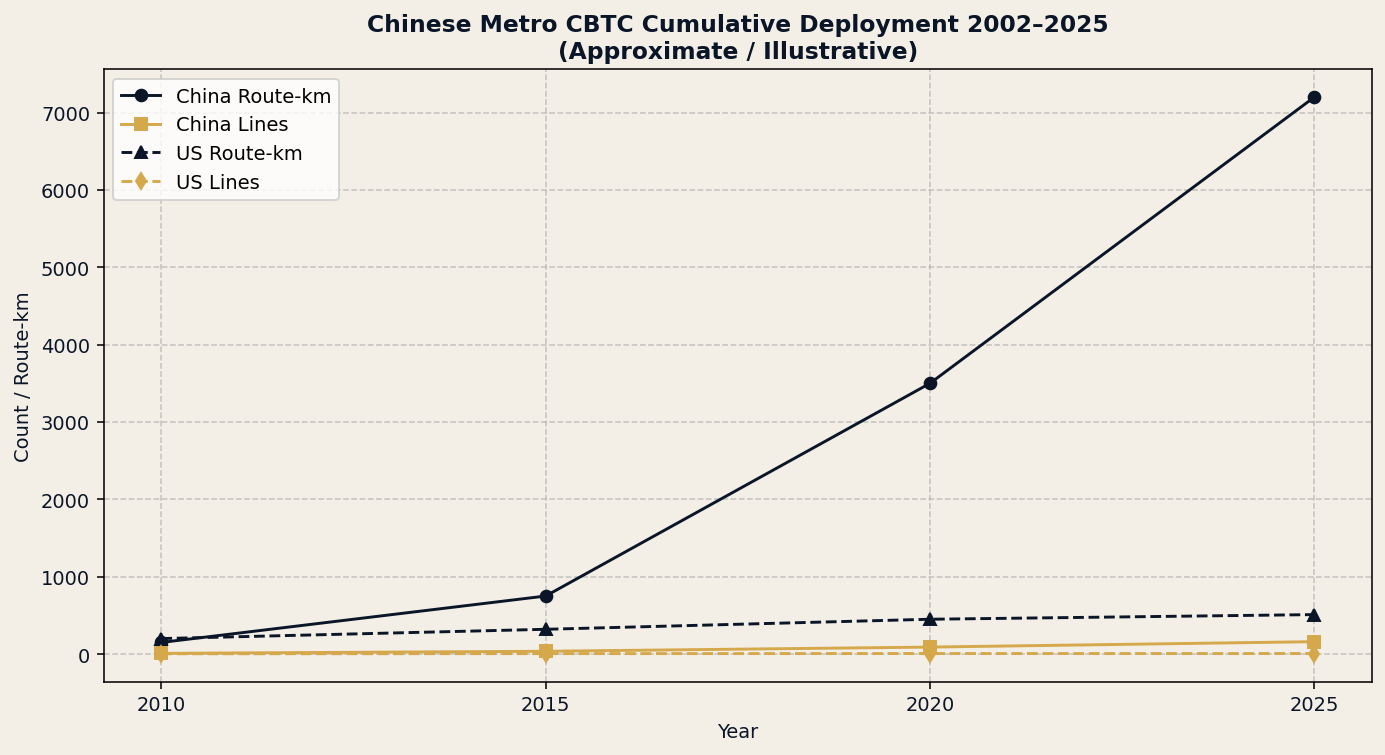 China deployed more CBTC route-kilometers in 23 years than the rest of the world combined.
What does not transfer
Three things do not transfer cleanly from the Chinese context to US transit agencies.
First, the cost structure. Chinese labor markets, regulatory timelines, and procurement frameworks are structurally different from US conditions. A US transit agency cannot replicate the $0.8 to $1.5 million per route-kilometer figure regardless of procurement reform; the structural cost gap is too large. Buy America domestic content requirements, Davis-Bacon prevailing wages, NEPA environmental review, and FTA grant management are durable features of US transit procurement, not reformable line items.
Second, the calendar. The 36-to-48 month feasibility-to-revenue calendar is not achievable in the US under current procurement law. The structural gap is roughly 5 to 9 years of front-end calendar (environmental review, grant authority, RFP development, vendor selection) that has no Chinese counterpart.
Third, vendor procurement directly from Chinese suppliers. Buy America, NDAA Section 889, FRA certification pathway constraints, and the political environment together preclude Chinese CBTC supplier entry into the US transit market in any near-term horizon.
What does transfer
Three things do transfer.
First, standardization and design reuse drive cost reduction even within the US procurement framework. CRSC’s ability to reuse 70 to 80 percent of CBTC design across multiple lines is the single largest cost lever in Chinese CBTC. US agencies procuring repeated CBTC lines can negotiate for the same design reuse with Alstom, Hitachi Rail, Siemens, and other vendors active in the US market. Multi-line procurement at the program level, rather than the line level, captures this. (See CBTC Procurement: Cost Drivers Beyond the Sticker Price.)
Second, competitive vendor structure improves bargaining power. China’s three to four competing domestic suppliers (CRSC, CASCO, TCT, plus regional variants) drove unit costs down approximately 40 to 50 percent over the past decade. US agencies cannot procure from Chinese suppliers, but they can preserve and encourage the four-vendor US market structure (Alstom, Hitachi Rail STS, Siemens Mobility, plus emerging entrants). Single-source procurement on multi-decade programs erodes this.
Third, rolling stock interoperability across an operator’s fleet is achievable. Shanghai Metro’s specifications requiring Vehicle On-Board Controller (VOBC) interoperability across multiple rolling stock manufacturers reduces per-vehicle VOBC cost and improves operational flexibility. US operators can specify, in CBTC RFPs, a commitment to interface standards that allow rolling stock from multiple manufacturers to operate on a single CBTC platform. The procurement language is straightforward; the willingness to specify it has been the binding constraint historically. (For European context, see Why Madrid Metro Has More CBTC Lines Than the Entire US.)
What this means for US transit agencies
Five points follow from the Chinese CBTC scale-up that any US transit agency should price into its planning, even though the cost and calendar do not transfer.
First, the technology is mature and the operational case is settled. Twenty-five years of Chinese deployment, two decades of European deployment, and the US deployment record at NYCT, BART, Honolulu Skyline, and elsewhere all support the same conclusion: CBTC works. The remaining US barriers are institutional, financial, and procurement-related, not technical.
Second, scale matters for cost. Beijing Subway has procured CBTC on dozens of lines from multiple vendors over fifteen years. The unit cost of the most recent procurements is materially lower than the unit cost of the early procurements, because the suppliers, the operators, and the regulators all know how to do this now. US agencies that procure single-line projects in isolation cannot capture this learning curve. Multi-line, multi-year procurement programs can.
Third, standardize specifications across procurements within a single agency. The most consistent finding across the Chinese, Singaporean, and London Underground 4LM programs is that operators with multi-line standardized specifications procure faster and cheaper than operators that bespoke each project. US agencies can do this within Buy America rules.
Fourth, preserve multi-vendor competition. Even in the constrained US market, Alstom, Hitachi Rail STS, and Siemens Mobility — plus emerging entrants — are capable of supplying CBTC at scale. Single-source procurement on long-term programs erodes the bargaining power that scale otherwise creates.
Fifth, build in-house owner engineering capability that survives political cycles. RATP, LTA, Beijing Subway, and TfL all retain large in-house signaling and operations teams. The technology decisions are made by people with decades of operational depth. US agencies that outsource all CBTC engineering decisions to a single system integrator pay the cost in lost institutional memory and downstream procurement bargaining power.
 What transfers is the institutional pattern, not the cost or calendar.
Practical takeaways for US transit agencies
- Procure CBTC at the program level, not the line level. Multi-line procurement on a standardized specification captures the cost-reduction effects of design reuse, even within Buy America rules.
- Preserve four-vendor competition. Single-source procurement on multi-decade programs erodes the bargaining power that scale otherwise creates.
- Specify VOBC interoperability across multiple rolling stock manufacturers in CBTC RFPs. The Shanghai Metro precedent is achievable in the US procurement context.
- Build in-house owner engineering capability that survives political and budget cycles. The agencies with the strongest international CBTC outcomes — RATP, LTA, TfL, Beijing Subway — all have it.
- Anchor cost expectations on US benchmarks, not Chinese benchmarks. The $4-to-$8 million per route-kilometer brownfield retrofit figure is the realistic floor; $0.8-to-$1.5 million per route-kilometer is structural to a market the US is not in.
Where to go next
This post is an 11-minute summary. The full treatment of Chinese CBTC scale-up and US-China comparative analysis lives in Chapter 16 (“US–China Comparative Perspectives”) of Communications-Based Train Control (Volume 2), with international context in Chapter 11. Buy on Amazon. Download Chapter 16 slides (free PDF).
Sources
- Wang, C. (2026). Communications-Based Train Control, Volume 2: US Deployment, Procurement & Future Directions. Independent. ISBN 979-8-258-54295-3. — Chapter 11 (Section 11.3 on Beijing and Shanghai Metro) and Chapter 16 (Sections 16.1–16.3 on US-China comparative).
- China Association of Metros (CAMET). Industry Reports and T/CAMET Standards. camet.org.cn
- Beijing Subway. Annual Operating Report. bjsubway.com
- Shanghai Metro. Annual Report. service.shmetro.com
- UITP (International Association of Public Transport). Observatory of Automated Metros and World Metro Figures. uitp.org
- Railway Gazette International. China Metro Reporting. railwaygazette.com
- International Railway Journal (IRJ). Asian Metro Coverage. railjournal.com
- IEEE Standards Association. IEEE Std 1474.1: Standard for Communications-Based Train Control (CBTC) Performance and Functional Requirements.
- Federal Transit Administration. Buy America Program. transit.dot.gov/buyamerica
How this article was produced. Drafted with AI assistance, then reviewed and fact-checked by Chunjun (Francisco) Wang against Communications-Based Train Control (the author's two-volume reference) and primary sources — agency records, vendor documentation, and IEEE/IEC standards. Every date, vendor, and figure is traceable to a cited source. Spot a mistake? Corrections are welcome via the contact page.
Read the full treatment in the book
Chapter 11 of Communications-Based Train Control, Volume 2, covers this in depth.