international-benchmarks · Article
Copenhagen Metro Driverless: What Twenty Years of GoA 4 Teaches US Agencies
On 19 October 2002 a short section of underground railway between Nørreport and the reclaimed flats of Vestamager opened for revenue service in Copenhagen with no one in the front of the train and no front cab to sit in. Denmark had no prior heavy-metro tradition, the capital had leaned on buses and the suburban S-train for decades, and yet the line ran at the highest grade of automation from its first paying passenger. That October date is the origin point of the longest uninterrupted record of Copenhagen Metro driverless operation in continental Europe, and for a United States transit engineer it is one of the cleanest available demonstrations of what Communications-Based Train Control (CBTC) delivers when unattended operation is a founding requirement rather than a retrofit ambition bolted onto a signaling estate built two generations earlier.
The United States reached the same milestone only in 2023, when Honolulu opened the first mass-transit line in the country certified for unattended Grade of Automation 4 (GoA 4) service. Copenhagen had by then accumulated more than 20 years of the operating history that American program managers routinely cite when they argue that driverless metro technology remains unproven. It is not unproven; it is Danish, Canadian, French, and Spanish, and it has been carrying passengers since the 1980s. Copenhagen earns a place in a US benchmark set for a specific reason: it is a compact, well-documented, single-authority system that went from greenfield civil works to GoA 4 revenue service on one supplier’s CBTC platform, then extended that same platform twice under an unchanged architecture. Understanding what Copenhagen built, and which parts of it a US agency structurally cannot copy, sharpens the business case an engineer brings to a domestic resignaling.
Why a Danish metro belongs in a US benchmark set
American agencies instinctively benchmark against London and Paris, and those comparisons appear elsewhere on this site. Copenhagen earns its slot for a structural reason that maps directly onto the two variables that dominate every US CBTC business case: whether the line is greenfield or brownfield, and whether one authority controls the whole procurement. The original Copenhagen Metro was greenfield twice over. Metroselskabet, the publicly owned company that owns the system, built new tunnel, new track, new stations, and a new fleet with no legacy signaling to overlay and no existing operating rules to preserve. The train control, the platform screen doors, the vehicles, and the central control were specified as one integrated system, so the interface risk that US agencies carry between separate civil, systems, and vehicle contracts was absorbed inside a single main supplier rather than litigated across three.
That is the same structural advantage examined in the case of Dubai Metro’s greenfield GoA 4 network, and it is why the schedule and unit cost of either system travel poorly into an American brownfield proposal. What does travel is the demonstration itself. Copenhagen proves that a mid-sized capital with no metro heritage can specify unattended operation from the first survey stake, procure it on the open market, and run it for more than two decades at a punctuality figure most manually driven US systems never reach. The obstacle in the United States has never been the maturity of the technology; it is the brownfield tax, the split-contract interface risk, and the multi-year funding and labor cadence that shape every domestic capital program. Copenhagen is useful precisely because it removes those variables and lets the technology be judged on its own.
How the Copenhagen Metro went driverless in 2002
The original network — the M1 and M2 lines that share a common trunk through the city center before branching to Vestamager, Vanløse, and the airport corridor — opened in stages from 19 October 2002 and reached its early build-out over the following years. Ansaldo STS, the Italian signaling house now part of Hitachi Rail, supplied the train control, communications, and control-center systems, while sister company AnsaldoBreda supplied a fleet of 34 three-car driverless trainsets. From revenue day one the system operated at Grade of Automation 4, the unattended level defined in the five grades of automation: no driver, no attendant required in the leading car, and full-height platform screen doors at every underground station to enforce the platform-edge separation that unattended operation demands.
The technical stack is unremarkable to a US engineer, which is exactly the point. The CBTC continuously determines each train’s position independent of track circuits, exchanges data with wayside controllers over a radio network, and computes the moving-block braking authority that lets trains follow one another closely at a top speed near 80 kilometers per hour. What was unusual in 2002 was not any single component but the completeness of the specification: every element was procured together, for a system with no trains, no track, and no inherited operating rules that anything had to remain compatible with. The three-car trainsets are short by US heavy-rail standards, carrying roughly 300 passengers each at crush load, a deliberate choice that pairs small trains with tight headways rather than long trains at wide spacing — the operating philosophy that defines a driverless metro and separates it from a conventional manually driven line.
Cityringen: a 15.5-kilometer loop and a 100-second design headway
The system’s second act is the more instructive one for a US audience, because it demonstrates extension rather than origination. In 2011 Metroselskabet awarded Ansaldo STS a turnkey contract worth roughly €700 million to design, supply, and install the signaling, power, communications, supervisory control, platform screen doors, control center, depot, and driverless rolling stock for the Cityringen, the M3 City Circle Line. The line opened on 29 September 2019 as a fully underground loop of 15.5 kilometers serving 17 stations, tying together Copenhagen Central, Nørrebro, Østerbro, and Frederiksberg in a ring that a train completes in roughly 28 minutes. The CBTC on Cityringen is a later generation of the same driverless platform used on M1 and M2, engineered for a design capacity of 36 trains per hour in each direction — a headway near 100 seconds — at a top speed close to 90 kilometers per hour.
Copenhagen then extended the ring twice without disturbing it. The M4 branch to Nordhavn opened on 28 March 2020, and a five-station southern extension to Sydhavn, adding about 4.5 kilometers, opened on 22 June 2024. Each extension brought new track and new stations into an already automated system under the same signaling architecture, which is an engineering problem of a fundamentally lower order than the American pattern of splicing new CBTC into a legacy interlocking on a line carrying passengers. Where a US brownfield extension must negotiate a cutover window and re-certify the safety case across the boundary between old and new signaling, Copenhagen extended homogeneous automated railway into more homogeneous automated railway. That homogeneity, not any single clever subsystem, is the source of the program’s cost and schedule discipline, and it is the variable a US agency most often cannot buy at any price.
What makes the Copenhagen Metro driverless record a clean reference
The operating record is where the benchmark value concentrates, and Copenhagen keeps unusually public numbers. In 2025 the system carried 135 million passengers, up nine million on the 126 million of 2024, split between roughly 71.2 million on the original M1 and M2 lines and 64 million on the newer M3 and M4. The network now spans 43.3 kilometers and 44 stations across four lines, all of it unattended GoA 4. The operator, Metro Service, reports that better than 99 percent of roughly 12 million annual departures run on time, a punctuality figure held on a system that runs 24 hours a day on weekends and never depends on driver availability, driver rostering, or driver sick leave to keep its timetable.
Those figures are the empirical answer to the question US boards actually ask, which is not whether GoA 4 can be built but whether it holds up in daily service across decades. Copenhagen sits unambiguously in the genuine-GoA-4 column described in Driverless Operations Worldwide: Who’s GoA 4, Who’s Faking It, and its two-era history — a 2002 core and a 2019 circle line on one architecture — lets an engineer watch how a driverless platform ages and re-scales, not only how it launches. A system that has absorbed a fleet expansion, a new central control center, and two branch extensions while holding better than 99 percent punctuality is a stronger reference than any single opening-day ribbon-cutting.
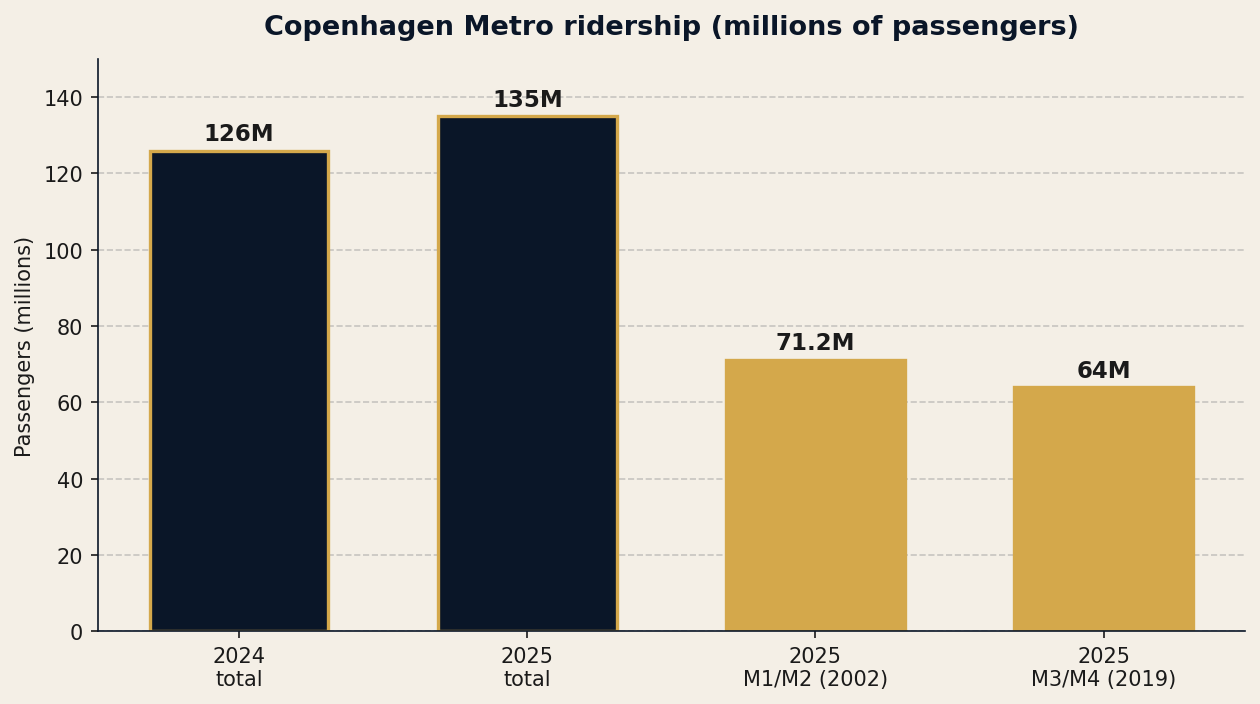 Copenhagen Metro ridership in millions: 126 million in 2024, 135 million in 2025, with the 2002-era M1/M2 carrying 71.2 million and the 2019-era M3/M4 64 million.
 Copenhagen’s whole metro is GoA 4 on one Hitachi Rail (Ansaldo STS) lineage.
The US bridge: the same platform now runs in Honolulu
For a US agency the most concrete link is no longer hypothetical. On 30 June 2023 Honolulu opened the first segment of Skyline, the first mass-transit line in the United States certified for unattended GoA 4 operation, built by Hitachi Rail on the same driverless-metro platform whose lineage runs directly back to the trains Copenhagen has operated since 2002. The technology that American program managers spent two decades treating as a foreign experiment is now revenue-operating on Oahu, procured through a federally funded capital program subject to the same Federal Transit Administration (FTA) oversight that any domestic project must satisfy.
The lesson Copenhagen offers is therefore not that the platform is buyable — Honolulu settles that — but where the difficulty actually sits. Two structural facts limit how far the Danish record transfers. First, greenfield economics do not travel: Copenhagen and Honolulu each built new alignments, while most US GoA 4 aspiration involves retrofitting unattended operation onto brownfield lines with legacy signaling, mixed traffic, and at-grade exposure that a fully grade-separated, platform-door-protected metro never faces. Second, unattended is a claim about the cab, not about the payroll. Copenhagen runs two control centers and staffs roving stewards who move among passengers and can drive a train manually when required; platform screen doors, obstacle and intrusion detection, and a control room able to address any train are the capital and operating substitutes for the driver’s eyes, and a US business case inherits every one of those line items. Driverless removes the driver from the cab; it does not remove people, or cost, from the safety case.
What this means in practice
- Copenhagen retires the “unproven” objection. More than two decades of continuous GoA 4 revenue service, 135 million passengers in 2025, and better than 99 percent punctuality are the empirical counter to the American reflex of treating unattended operation as experimental. The technology is mature and buyable, as Honolulu’s 2023 opening now demonstrates on US soil.
- Greenfield economics do not transfer. Copenhagen built new tunnel, new fleet, and new operating rules with no legacy to preserve, so citing its schedule or unit cost inside a domestic brownfield business case invites a false comparison. The Danish record proves capability, not price.
- The extension record is the real lesson. Cityringen in 2019, the Nordhavn branch in 2020, and the Sydhavn branch in 2024 all rode the same CBTC architecture, avoiding the legacy-cutover boundary that consumes US resignaling budgets. Homogeneity is the asset; the boundary between new and old signaling is where domestic cost concentrates.
- Platform doors and detection are part of the price. Full-height platform screen doors at every underground station, obstacle and intrusion detection, and continuously staffed control centers are not optional add-ons to GoA 4; they are the substitutes for the driver’s eyes, and any US aspiration inherits the full capital and operating cost.
- Unattended is not unstaffed. Copenhagen still fields stewards who can take manual control and two control centers that supervise every departure. Removing the driver from the cab reduces one cost center while creating others, and a credible business case must carry all of them.
Where to go next
This post is an 11-minute case study. The full treatment of international CBTC benchmarks and their relevance to US deployment decisions lives in Chapter 11 (“International Benchmarks with US Relevance”) of Communications-Based Train Control, Volume 2: Operations, Deployment & Economics (Buy on Amazon). Download Chapter 11 slides (free PDF) for the comparative benchmark tables.
Sources
- Wang, C. (2026). Communications-Based Train Control, Volume 2: Operations, Deployment & Economics. Independent. ISBN 979-8-258-54528-2. — [Chapter 11, “International Benchmarks with US Relevance”]
- Metroselskabet. Passenger numbers on the Metro. metroselskabet.dk
- Metro Service. The Metro — driverless operation. metroservice.dk
- Hitachi Rail. Copenhagen Cityringen M3/M4. hitachirail.com
- International Railway Journal. Ansaldo STS secures Copenhagen systems contract. railjournal.com
- Railway Technology. Cityringen Metro, Copenhagen, Denmark. railway-technology.com
- Railway Age. “Skyline” Opens in Honolulu. railwayage.com
- IEEE Standards Association. IEEE Std 1474.1: Standard for Communications-Based Train Control (CBTC) Performance and Functional Requirements.
How this article was produced. Drafted with AI assistance, then reviewed and fact-checked by Chunjun (Francisco) Wang against Communications-Based Train Control (the author's two-volume reference) and primary sources — agency records, vendor documentation, and IEEE/IEC standards. Every date, vendor, and figure is traceable to a cited source. Spot a mistake? Corrections are welcome via the contact page.
Read the full treatment in the book
Chapter 8 of Communications-Based Train Control, Volume 1, covers this in depth.