technical · Article
The Cybersecurity Surface of a Modern CBTC System
In May 2021, a ransomware attack on Colonial Pipeline shut down a 5,500-mile fuel artery on the US East Coast for six days and prompted the Transportation Security Administration (TSA) to issue the first federal cybersecurity directives for surface transportation, including rail and transit. Five years later, every Communications-Based Train Control (CBTC) procurement in the United States now carries a substantial cybersecurity scope: the Request for Proposal includes an attack-surface analysis requirement, the safety case includes an EN 50159 communication-security argument, and the operations and maintenance plan includes incident-response procedures coordinated with the Cybersecurity and Infrastructure Security Agency (CISA). This article maps the attack surface of a modern CBTC system, identifies the four entry points that account for most of the realistic threat, and walks through the defense patterns that an agency should expect to see in a vendor’s response.
Why the attack surface grew when CBTC arrived
Traditional fixed-block signaling is, by accident of its 1880s lineage, a remarkably hard target. Track circuits are physically distributed; relay interlocking is hardwired; cab signaling uses inductive coupling at audio frequencies. A determined attacker with a software-defined radio and physical access to a single tunnel can disrupt one segment, but cannot scale that disruption to a network. The cyber-physical attack surface is small because the network is small.
CBTC inverted that pattern. The CBTC train is a wireless node on an IP network. The Zone Controller is a server in an equipment room. The Automatic Train Supervision (ATS) is a software application running in an Operations Control Center. The interlocking, the Passenger Information System, the SCADA power management — all sit on a converged network reachable, in principle, from any compromised endpoint. The functional benefits of CBTC come from this convergence; the cybersecurity cost comes from the same source. Any modern CBTC procurement therefore carries a security scope that did not exist in 1995, and any safety case that ignores cybersecurity is incomplete.
This article is for the system engineer, security architect, or procurement specialist who needs to understand where the attack surface lives, what defenses are reasonable to require, and how those defenses interact with the safety case.
The four high-value attack surfaces
A CBTC system is large, and an exhaustive attack-surface enumeration runs to dozens of components. But four surfaces dominate any realistic threat model.
The radio link
The wireless link between train and wayside is the most exposed surface. It is, by design, accessible to any radio receiver within propagation range of the line. Eavesdropping requires a software-defined radio costing a few hundred dollars. Jamming requires only RF energy at the right frequency. Spoofing — injecting forged messages — requires understanding the protocol but not breaking the encryption.
The defenses are well-established and standard in modern CBTC. WPA2 or WPA3 encrypts the Wi-Fi link itself, but encryption alone does not stop spoofing or replay. The application-layer defenses come from EN 50159 (Safety-Related Communication in Railway Systems): every safety-critical message carries a sequence number that increments per session, a timestamp bounded against the receiver’s clock, a cryptographic message authentication code (MAC) tied to a per-session key, and a cyclic redundancy check. A receiver that gets a message with a stale sequence number, an out-of-window timestamp, an invalid MAC, or a CRC failure rejects the message and treats the channel as failed. The combination defeats replay (sequence numbers and timestamps), spoofing (MAC), and corruption (CRC) at the safety layer, independent of whether the underlying transport is encrypted.
The backbone network
The wired backbone connects Zone Controllers, the Operations Control Center, the interlocking, the SCADA, and the maintenance network. It is typically a self-healing fiber ring with dual-ring or PRP/HSR redundancy carrying CBTC traffic alongside non-safety operational data. The exposure depends on whether the backbone is genuinely private (transit-owned fiber and switches end to end) or includes leased carrier services or wireless backhaul links — the latter exposes the backbone to attackers outside the agency’s physical perimeter.
The defense pattern is VLAN segmentation with strict gateway rules. CBTC vital traffic lives on a dedicated VLAN with no routing to passenger Wi-Fi, station systems, or general IT. ATS, station systems, and maintenance networks each get their own VLAN. Cross-VLAN traffic flows only through firewalls with explicit allow-rules and packet-level inspection. IPsec or TLS encrypts inter-site traffic. The dual-ring redundancy needed for safety availability also makes the backbone harder to disable: cutting one fiber does not disable the network, and cutting both is a coordinated physical attack rather than a remote cyber attack.
Maintenance and remote access
Maintenance laptops, vendor remote access portals, and field technician interfaces are the third major surface. Modern CBTC systems require remote diagnostic capability — the supplier needs to look at fault data, push patches, and tune parameters. That remote access is, in attacker terms, a pre-authorized tunnel into the vital network. The 2015 IOActive demonstration of remote train control vulnerabilities in a European CBTC system was carried out via the maintenance interface, not via the radio link.
The defenses are operational rather than purely technical. Maintenance access should require multi-factor authentication; sessions should be logged and recorded; vendor access should be time-bounded and granted per ticket rather than persistently; maintenance workstations should be hardened (no email, no general internet, no removable media). Air-gapping the maintenance network from the operational vital network during normal operation, with a controlled gateway that is opened only for explicit maintenance windows, is a common pattern for the highest-assurance deployments.
The supply chain
Supply chain risk is the surface that is hardest to assess. CBTC components — radio modules, processor boards, software libraries, embedded operating systems — come from a global supply chain. Compromises during manufacturing or shipping have been demonstrated in nation-state-level operations. The transit agency cannot directly audit the supply chain, but procurement language can require the supplier to certify component traceability, sign firmware images, implement secure boot to refuse unsigned code, and maintain a software bill of materials that can be cross-checked against vulnerability databases.
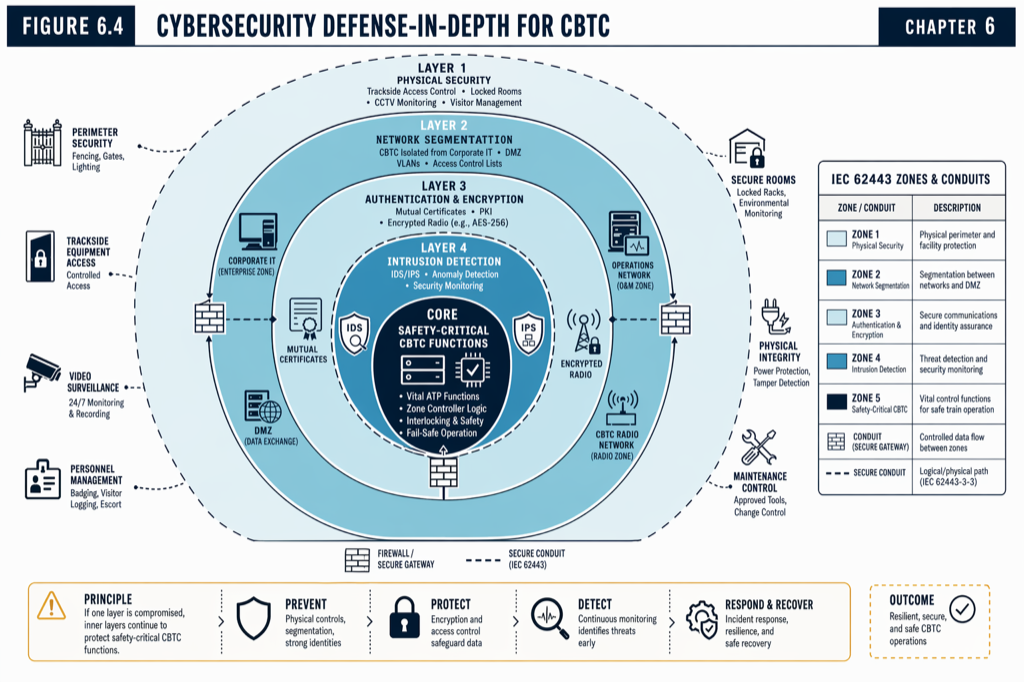 The four surfaces account for most realistic threat. The defenses combine standards (EN 50159, IEC 62443, NIST CSF) with architectural patterns (VLAN segmentation, MFA, secure boot).
The standards that actually govern CBTC cybersecurity
US transit agencies typically point to four standards in CBTC cybersecurity scope.
IEC 62443 (Industrial Automation and Control Systems Security) is the dominant framework for industrial cybersecurity, including rail. It defines security levels 1 through 4 and provides a zone-and-conduit model for segmenting networks, plus security requirements organized by system function (access control, data integrity, logging). Most CBTC procurements target Security Level 2 or 3 against IEC 62443.
EN 50159 (Safety-Related Communication in Railway Systems) is the safety-side standard governing communication-channel security. It is older and narrower than IEC 62443 — it is concerned with whether a safety message is delivered correctly, not with whether the network is protected — but it is the standard the safety case actually argues against. The sequence number, timestamp, MAC, and CRC pattern described above is EN 50159’s required protection set.
NIST Cybersecurity Framework is a US-developed framework organized around five functions (Identify, Protect, Detect, Respond, Recover). It is more flexible than IEC 62443 and is used by US transit agencies as the program-level framework that maps onto IEC 62443 and EN 50159 at the implementation level.
TSA Security Directives for Surface Transportation (issued in 2021 and updated since) impose regulatory cybersecurity requirements on US rail and transit operators. They are not voluntary. Compliance includes a risk assessment, a documented cybersecurity plan, security awareness training, an incident response plan, and reporting relationships with TSA, CISA, and the FBI.
The relationship between these standards in a typical US CBTC project is: NIST CSF as the program framework, IEC 62443 as the architectural standard for the supplier’s system, EN 50159 inside the safety case, and TSA directives as the regulatory floor.
What the safety case actually argues
The safety case argument for CBTC cybersecurity is more interesting than it sounds. Cybersecurity is, in the safety vocabulary, a threat to the integrity of safety messages. The safety case must argue that the protections in place reduce the residual risk of a successful attack causing a safety event below tolerable hazard rates — typically 10⁻⁹ per hour for SIL 4 functions.
The argument is split into two layers. The first layer is the safety-message-level argument under EN 50159: even if the underlying network is compromised, the sequence-number / timestamp / MAC / CRC protections ensure that a forged or replayed safety message will be rejected with very high probability. This argument does not depend on the strength of the network defenses.
The second layer is the network-level argument under IEC 62443: the network is segmented, monitored, and defended such that the rate of attempted attacks reaching the vital channel is bounded. This argument is independent of the first; both must hold for the safety claim to be defensible.
A vendor that argues only one layer is presenting an incomplete safety case. An agency reviewer who sees only EN 50159 evidence in the cybersecurity section of the safety case should ask for the IEC 62443 architectural argument, and vice versa.
Operational realities the standards do not cover
Three operational realities tend to dominate cybersecurity outcomes more than any standard.
Patching cadence. SIL 4 ATP code cannot be patched casually. Every change triggers regression testing and, depending on scope, partial recertification. A CBTC supplier that takes nine months to issue a patch for a known critical vulnerability is exposing the agency for nine months. A defensible procurement specifies maximum patch latency by severity (e.g., critical CVE within 90 days, high within 180 days) and requires the supplier to maintain a patch-management process compatible with the safety case.
Lifecycle scope. CBTC systems run for 25 years. The cybersecurity threat at year 25 will not look like the threat at year 0. The procurement should require the supplier to commit to a quarterly threat reassessment, an annual penetration test, and a midlife technology refresh that includes a cybersecurity refresh of all components whose protection technology has been overtaken (TLS versions, encryption algorithms, key lengths). (For the analogous onboard refresh decision, see The Onboard Side of CBTC: Inside the VOBC.)
Insider threat. Maintenance technicians, dispatchers, and contractors with authorized access have already cleared the perimeter. Privileged-access management, separation of duties, and audit logging matter more here than firewall rules. The TSA directives explicitly require insider-threat programs for surface transportation operators.
Practical takeaways
- The CBTC attack surface concentrates in four places: radio link, backbone network, maintenance access, and supply chain. A vendor’s response should explicitly address each of the four.
- The radio-link defense argument rests on EN 50159 message-layer protections (sequence number, timestamp, MAC, CRC), not on transport encryption alone. Encryption is necessary but not sufficient.
- VLAN segmentation with strict gateway rules is the canonical backbone defense. CBTC vital traffic should never share a routable network with passenger systems or general IT.
- Maintenance access is the most underestimated surface in many procurements. Multi-factor authentication, session logging, and air-gap-with-controlled-gateway architectures are the established defenses.
- The safety case must argue cybersecurity at two layers: EN 50159 at the message layer and IEC 62443 at the network layer. Either argument alone is incomplete.
- Patching cadence and lifecycle refresh commitments are operational specifications that often outweigh architectural choices in real-world security outcomes. They belong in the procurement contract, not the appendix.
Where to go next
This post is an 11-minute summary. The full treatment of CBTC cybersecurity — threat taxonomy, defense-in-depth architecture, EN 50159 protections, IEC 62443 zone-and-conduit modeling, and incident response — lives in Chapter 6, sections 6.3 and 6.5, of Communications-Based Train Control (Volume 1 on Amazon). Download Chapter 6 slides (free PDF).
For how the safety case is structured around the vital partition the cybersecurity argument depends on, see Vital vs Non-Vital Functions in CBTC: Where the Safety Boundary Lives. For how communication loss is detected and handled when the radio channel fails (whether benignly or under attack), see Communication-Loss Fallback: How Trains Behave When the Radio Drops.
Sources
- Wang, C. (2026). Communications-Based Train Control, Volume 1: Foundations & Technical Architecture. Independent. ISBN 979-8-258-54295-3. — Chapter 6, “Communication Systems,” sections 6.3 and 6.5.
- International Electrotechnical Commission. IEC 62443: Security for industrial automation and control systems.
- CENELEC. EN 50159: Railway applications — Communication, signalling and processing systems — Safety-related communication in transmission systems.
- National Institute of Standards and Technology. NIST Cybersecurity Framework Version 2.0. nist.gov/cyberframework
- Transportation Security Administration. Security Directives for Surface Transportation. tsa.gov/news/press/releases
- Cybersecurity and Infrastructure Security Agency. Transportation Systems Sector Cybersecurity Resources. cisa.gov/topics/critical-infrastructure-security-and-resilience/critical-infrastructure-sectors/transportation-systems-sector
- Federal Transit Administration. Cybersecurity Resources for Transit Agencies. transit.dot.gov
- IEEE Standards Association. IEEE Std 1474.1: Communications-Based Train Control (CBTC) Performance and Functional Requirements.
How this article was produced. Drafted with AI assistance, then reviewed and fact-checked by Chunjun (Francisco) Wang against Communications-Based Train Control (the author's two-volume reference) and primary sources — agency records, vendor documentation, and IEEE/IEC standards. Every date, vendor, and figure is traceable to a cited source. Spot a mistake? Corrections are welcome via the contact page.
Read the full treatment in the book
Chapter 6 of Communications-Based Train Control, Volume 1, covers this in depth.