international-benchmarks · Article
Delhi Metro CBTC: Driverless Operation Inside a Fast, Cost-Disciplined Program
On 28 December 2020, a train pulled out of Janakpuri West on the Delhi Metro’s Magenta Line with no one in the cab. It was the first driverless revenue service in India, and it ran on a network that had not existed two decades earlier. For a US transit engineer, the interesting fact is not the empty cab; it is the program behind it. Delhi Metro CBTC reached unattended operation on a system built from nothing since 2002, grown to nearly 375 route-kilometers, and delivered — at least in its early phases — largely on schedule and within budget, a combination American resignaling programs rarely achieve.
Why a US engineer should study Delhi’s metro program
The United States usually benchmarks its train-control ambitions against London, Paris, and its own agencies. Delhi belongs in that set for a different reason than Dubai does. Dubai is the clean greenfield case — one authority, one turnkey contract, no legacy. Delhi is the opposite kind of lesson: a very large, still-growing network, built in phases across a dense capital city, that nonetheless moved from its first line to fully driverless Communications-Based Train Control (CBTC) at a pace and a cost discipline most US programs would envy. What makes Delhi useful is not that an American agency can copy it wholesale — the labor economics, procurement law, and funding structure differ sharply — but that it isolates a set of management choices, standardization decisions, and an emerging indigenisation strategy that map directly onto questions US agencies are asking right now under Buy America and Build America, Buy America (BABA). This piece looks at what Delhi actually built, and what parts of it travel.
A very large network, built fast and on budget
The Delhi Metro Rail Corporation (DMRC) opened its first elevated section on the Red Line on 25 December 2002. By 2025 the network spanned roughly 374 route-kilometers across about 271 stations and 10 color-coded lines, carrying on the order of 6.4 million passenger trips on a typical day and more than two billion a year (The Metro Rail Guy, 2025). That places it among the largest metro systems in the world and by a wide margin the largest in India. Phase 4, under construction, is expected to push the network past 450 kilometers.
The number that should get an American program manager’s attention is not the length but the delivery record. Phase 1 — roughly 65 kilometers of new metro in a congested capital — was completed around 2006, reported at close to three years ahead of the original schedule and within its budget of about ₹10,571 crore, financed largely through concessional Japanese (JICA) loans (Centre for Public Impact). The founding managing director, E. Sreedharan, built the organization around punctuality, a lean two-department structure, international standards for safety and quality, and a low-interference relationship with the political layer. None of that is a signaling decision, but all of it is why the signaling could be standardized and rolled out quickly across successive phases rather than renegotiated line by line.
For US agencies, the transferable insight is organizational, not technical. Delhi did not invent a cheaper CBTC; it created the conditions — schedule certainty, standardized rolling stock and train control, and a single technical authority — under which a modern signaling estate could be procured and commissioned at scale. That is the same lever that separates a smooth resignaling from a decade-long overrun, and it is treated at length in the deployment economics of Volume 2.
Delhi Metro CBTC: moving block on the Magenta and Pink Lines
Delhi’s two driverless lines run radio-based moving-block CBTC from two different suppliers: the Magenta Line (Line 8) on Nippon Signal’s SPARCS, and the Pink Line (Line 7) on Bombardier’s CITYFLO 650, now part of Alstom (International Railway Journal; Railway-News, 2018). Both support the full range of operating modes up to Unattended Train Operation (UTO). Each train continuously determines its own position, reports it over a radio network to wayside equipment, and receives a movement authority computed as a moving block rather than a fixed track-circuit section — the same functional architecture, shaped by IEEE Std 1474, described in GoA 0–4 Explained: The Five Grades of Train Automation. On the Magenta and Pink Lines the system drives Hyundai Rotem rolling stock at speeds up to about 85 km/h, with a design capability for headways near 90 seconds, and every station is fitted with platform screen doors to enforce the platform-edge separation that unattended running requires.
Nothing in that stack is unusual to a US engineer. What is worth noting is the supplier lineage. The Pink Line’s CITYFLO 650 was delivered by Bombardier Transportation, whose rail business became part of Alstom when that acquisition closed in early 2021, and Alstom has continued as a train-control and rolling-stock supplier on the Phase 4 extensions (Metro Rail Today). The Magenta Line’s first-driverless system, by contrast, came from Nippon Signal — a reminder that even a single network can carry more than one CBTC lineage. The consolidation of the global CBTC vendor field — Bombardier into Alstom, and the broader thinning of independent suppliers — is exactly the market condition that makes vendor-neutral specification harder for US agencies, and it is why Delhi’s later indigenisation push is more than a nationalist gesture.
December 2020: India’s first driverless train
The Magenta Line, designated Line 8, runs about 38 kilometers between Janakpuri West and Botanical Garden. It had already been in revenue service with drivers when, on 28 December 2020, DMRC inaugurated driverless operation on it — the first anywhere in India. The regulatory groundwork mattered as much as the technology: the Union Ministry of Housing and Urban Affairs had to issue a gazette notification, reported in mid-December 2020, adding UTO to the metro operating rules, because the existing framework did not permit trains to run without an operator on board.
The transition was deliberately gradual, and the distinction matters for anyone reading the headline. “Driverless” at the December 2020 inauguration did not mean an empty, unstaffed train from day one. DMRC initially kept roving attendants on board — staff trained to intervene only in an emergency — and withdrew them over the following months as confidence in the system grew, moving the line toward true unattended operation. That two-step path, from driverless-capable running under supervision to full UTO with staff removed from the cab, is the same maturation curve every credible GoA 4 operator follows, and it is the honest test of who is genuinely unattended versus merely automated, examined in Driverless Operations Worldwide: Who’s GoA 4, Who’s Faking It. Delhi’s willingness to run attended for a transition period, rather than claim the empty cab immediately, is a model of conservative commissioning that US safety regulators would recognize and reward.
The Pink Line and the shape of a driverless network
Delhi did not stop at one line. In 2021 it brought Grade of Automation 4 (GoA 4) service to the Pink Line, designated Line 7, a roughly 59-kilometer corridor from Majlis Park to Shiv Vihar that forms the network’s near-circular ring and stands as the longest driverless line in the country. With the Magenta and Pink Lines together, Delhi’s unattended network reached close to 97 route-kilometers, which by one accounting placed it among the four largest driverless metro systems in the world at the time (Wikipedia: Delhi Metro).
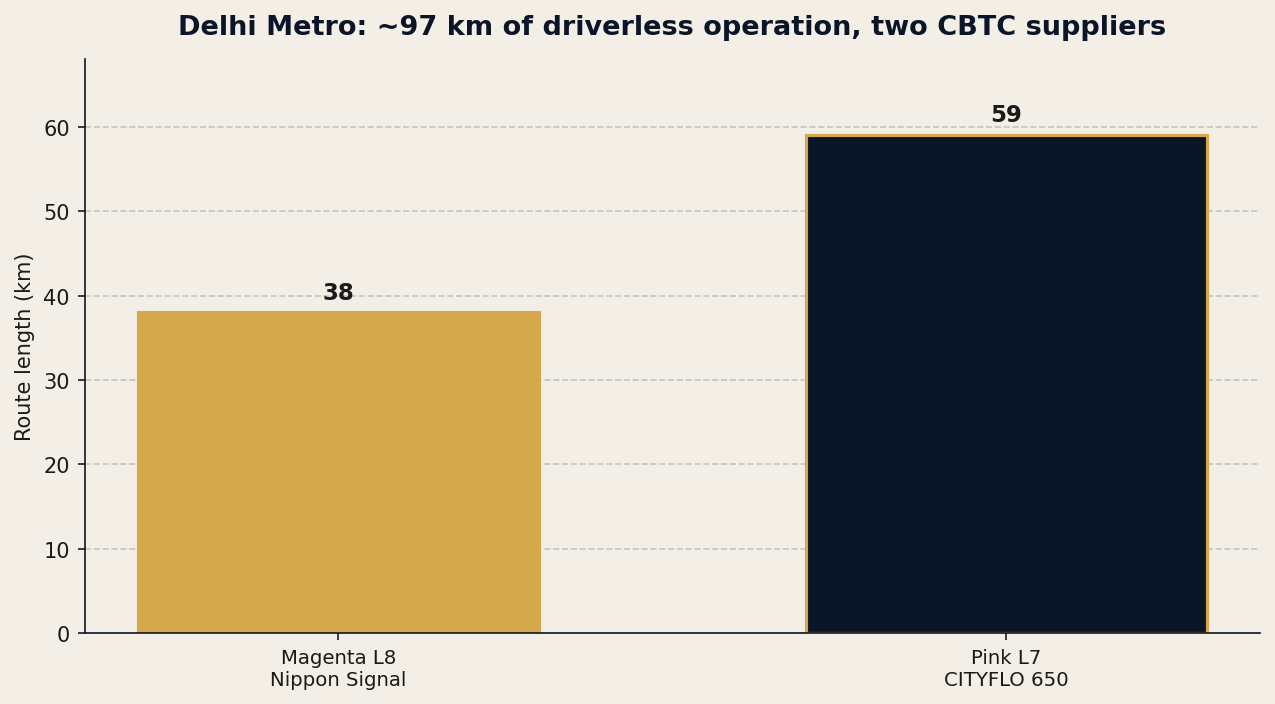 Close to 97 route-km of unattended operation on two CBTC platforms — the Magenta Line’s 38 km (Nippon Signal SPARCS) and the Pink Line’s 59 km (Bombardier/Alstom CITYFLO 650).
 Delhi’s two driverless lines run different CBTC products — Nippon Signal and CITYFLO 650.
The engineering significance is the reverse of Dubai’s. Where the Dubai Metro’s driverless network shows what GoA 4 looks like when it is designed into a greenfield system from the first survey stake, Delhi shows unattended operation added to an operating railway, phase by phase, with the standardization done up front so that later lines and extensions could inherit the same train-control approach. Phase 4 continues that logic: DMRC is procuring more than 300 driverless metro cars from Alstom — trainsets for the Pink and Magenta extensions and for the new Golden Line — designed for unattended operation and rated to a maximum safe speed near 95 km/h (Metro Rail Today). Extending a homogeneous automated line is a far smaller engineering problem than stitching new CBTC into a legacy interlocking, which is the boundary that consumes American brownfield schedules.
Indigenisation: i-ATS and owning the signalling stack
The most forward-looking part of the Delhi story is not the driverless trains; it is the deliberate move to own the signaling stack. In 2023, DMRC and Bharat Electronics Limited (BEL) put an indigenously developed Automatic Train Supervision layer, branded i-ATS, into service on the Red Line — reported as the first train-control-and-supervision product designed and built in India, and enough to place the country in a small group of nations with their own ATS technology (The Print, 2023; BEL). The explicit aim, under the government’s Make in India and AatmaNirbhar Bharat programs, is to reduce dependence on a small field of foreign train-control vendors. DMRC and BEL have since said they are developing a fully indigenous CBTC prototype on a dedicated test track — the harder, vital core beneath the supervision layer.
An engineer should be precise here. Automatic Train Supervision is the command-and-control and scheduling layer; it is not the vital, safety-critical CBTC train control that computes movement authorities and enforces braking curves. Building an indigenous ATS is a real and useful milestone, but it is the less safety-critical part of the stack, and a homegrown vital CBTC still has to clear the same independent safety-case and certification bar as any imported product. The value of the i-ATS effort is that it establishes domestic engineering capacity and a certification pathway before the harder problem is attempted.
For US agencies, this is the most quotable part of the whole case. American programs are wrestling with domestic-content rules under Buy America and BABA at the same moment the global CBTC vendor field is consolidating. Delhi’s answer — start with the supervision layer, build the domestic team and the certification experience, and only then reach for the vital core — is a sequenced indigenisation strategy rather than a slogan. Whether the safety case ultimately holds up is the open question, and it is exactly the question a US agency contemplating a domestic-content mandate on train control should be asking.
What this means in practice
- The bottleneck is management, not the technology. Delhi reached fully driverless CBTC on a very large network because it standardized rolling stock and train control up front and delivered on schedule; the transferable lesson for US agencies is organizational discipline, not a cheaper product.
- Adding UTO to a live network is a phased discipline. Delhi ran attended for a transition period before withdrawing staff from the cab. That conservative, two-step commissioning is the credible path to GoA 4 and the one US safety oversight will expect.
- Vendor consolidation is a procurement risk, not a footnote. Delhi’s two driverless lines run different CBTC products — Nippon Signal SPARCS on the Magenta Line, Bombardier’s CITYFLO 650 (now part of Alstom) on the Pink Line. A thinning supplier field makes vendor-neutral specification harder and raises the stakes on writing supplier-agnostic requirements.
- Indigenisation should be sequenced, not slogan-driven. Delhi started with the non-vital supervision layer (i-ATS) to build domestic capacity before attempting vital CBTC. A US domestic-content push on train control should respect the same order and the same certification bar.
- Do not copy the unit costs. Delhi’s labor economics, procurement law, and concessional financing do not transfer; citing its per-kilometer cost or schedule in a US business case invites a false comparison, even as its management model does travel.
Where to go next
This post is an 11-minute case study. The full treatment of international CBTC benchmarks and their relevance to US deployment decisions lives in Chapter 11 (“International Benchmarks with US Relevance”) of Communications-Based Train Control, Volume 2: Operations, Deployment & Economics (Buy on Amazon). Download Chapter 11 slides (free PDF) for the comparative benchmark tables.
Sources
- Wang, C. (2026). Communications-Based Train Control, Volume 2: Operations, Deployment & Economics. Independent. ISBN 979-8-258-54528-2. — [Chapter 11, “International Benchmarks with US Relevance”]
- Railway-News. Delhi Metro Line 7 Section Opens with Bombardier CITYFLO 650 System. railway-news.com
- International Railway Journal. Nippon Signal to supply CBTC for Delhi Metro Line 8 (Magenta Line). railjournal.com
- The Print. PM Modi launches India’s first driverless metro train in Delhi. Here’s all you need to know. theprint.in
- Metro Rail Today. Alstom powers Delhi Metro’s Pink and Magenta Line with Driverless Trains and CBTC Signalling. metrorailtoday.com
- Metro Rail Today. DMRC receives first driverless trainset for Delhi Metro Phase 4 Project. metrorailtoday.com
- The Print. Delhi Metro launches India’s first-ever indigenously developed signalling system i-ATS on Red Line. theprint.in
- Bharat Electronics Limited. Indigenous Automatic Train Supervision (i-ATS). bel-india.in
- Centre for Public Impact. The Construction of the Delhi Metro. centreforpublicimpact.org
- The Metro Rail Guy. Delhi Metro Information, Map & Updates. themetrorailguy.com
- IEEE Standards Association. IEEE Std 1474.1: Standard for Communications-Based Train Control (CBTC) Performance and Functional Requirements.
How this article was produced. Drafted with AI assistance, then reviewed and fact-checked by Chunjun (Francisco) Wang against Communications-Based Train Control (the author's two-volume reference) and primary sources — agency records, vendor documentation, and IEEE/IEC standards. Every date, vendor, and figure is traceable to a cited source. Spot a mistake? Corrections are welcome via the contact page.
Read the full treatment in the book
Chapter 8 of Communications-Based Train Control, Volume 1, covers this in depth.