international-benchmarks · Article
Dubai Metro: How CBTC Runs the World's Longest Driverless Network
On 9 September 2009 — at exactly nine minutes past nine in the evening, a date chosen for its numerical symmetry — the first train on the Dubai Metro Red Line pulled out of a station with no driver in the cab, and no cab at all. Seven years before an American transit agency would place a single revenue train under Communications-Based Train Control on a brownfield line, an emirate with no prior heavy-rail tradition opened a fully automated metro that holds the Guinness World Record for the world’s longest driverless metro line. For a US transit engineer, Dubai is the cleanest available demonstration of what Communications-Based Train Control (CBTC) delivers when it is designed into a system from the first survey stake rather than retrofitted into a signaling estate built during the Truman administration.
Why a US engineer should study a Gulf metro
The United States tends to benchmark itself against London, Paris, and its own agencies, and those comparisons are covered elsewhere on this site. Dubai belongs in the set for a different reason: it is the purest large-scale example of greenfield Grade of Automation 4 (GoA 4) — unattended train operation — built at metro scale in a single procurement, on a compressed schedule, without the legacy constraints that dominate every American project. Understanding what made that possible, and what parts of it are structurally unavailable to a US agency, sharpens the judgment an engineer or program manager brings to a domestic CBTC business case. This piece is that comparison, grounded in what Dubai actually built rather than in the marketing that surrounded its opening.
The system: Thales SelTrac, driverless from the first day
The Dubai Metro runs on a Thales SelTrac CBTC system, the same product family — under different generational designations — that governs the automated lines of Vancouver, London, and dozens of other networks. From revenue day one the metro operated at GoA 4: no driver, no attendant in the leading car, and full-height platform screen doors at every station to enforce the platform-edge separation that unattended operation requires. The CBTC continuously determines each train’s position independent of track circuits, exchanges data with wayside zone controllers, and computes the moving-block braking authority that lets trains follow one another at close moving-block headways — Thales cites service headways as short as two minutes — at a maximum speed near 90 kilometers per hour.
Nothing in that architecture is exotic to a US engineer; it is the same IEEE 1474-shaped functional stack described in GoA 0–4 Explained: The Five Grades of Train Automation. What is unusual is that every element — the vital onboard processor, the radio, the platform doors, the central Automatic Train Supervision — was specified together, by one authority, for a system that had no trains, no track, and no operating rules to be compatible with. The integration risk that consumes American brownfield schedules simply did not exist.
The scale: two lines, a record, and an Expo extension
The network opened in September 2009 with the Red Line, then roughly 52 kilometers along the Sheikh Zayed Road spine; the Green Line, about 22.5 kilometers and 20 stations through the older urban core, followed in 2011. The Red Line set the Guinness World Record for the world’s longest driverless metro line, a distinction Dubai has retained as the network grew — the Red Line reaching about 67 kilometers and 35 stations when the 15-kilometer Route 2020 branch opened in 2021, for a present-day network of roughly 90 route-kilometers.
The 2021 milestone matters more than a record certificate. Ahead of the World Expo, the Roads and Transport Authority (RTA) extended the Red Line by a 15-kilometer branch — the project marketed as Route 2020 — again contracting Thales for the signaling and again bringing the extension into service as a seamless part of the existing automated system. A brownfield US extension of comparable length would have required interfacing new CBTC with a legacy interlocking, negotiating a cutover window on a line carrying passengers, and re-certifying the safety case across the boundary. Dubai extended a homogeneous automated line into more homogeneous automated line, which is an engineering problem of a fundamentally lower order.
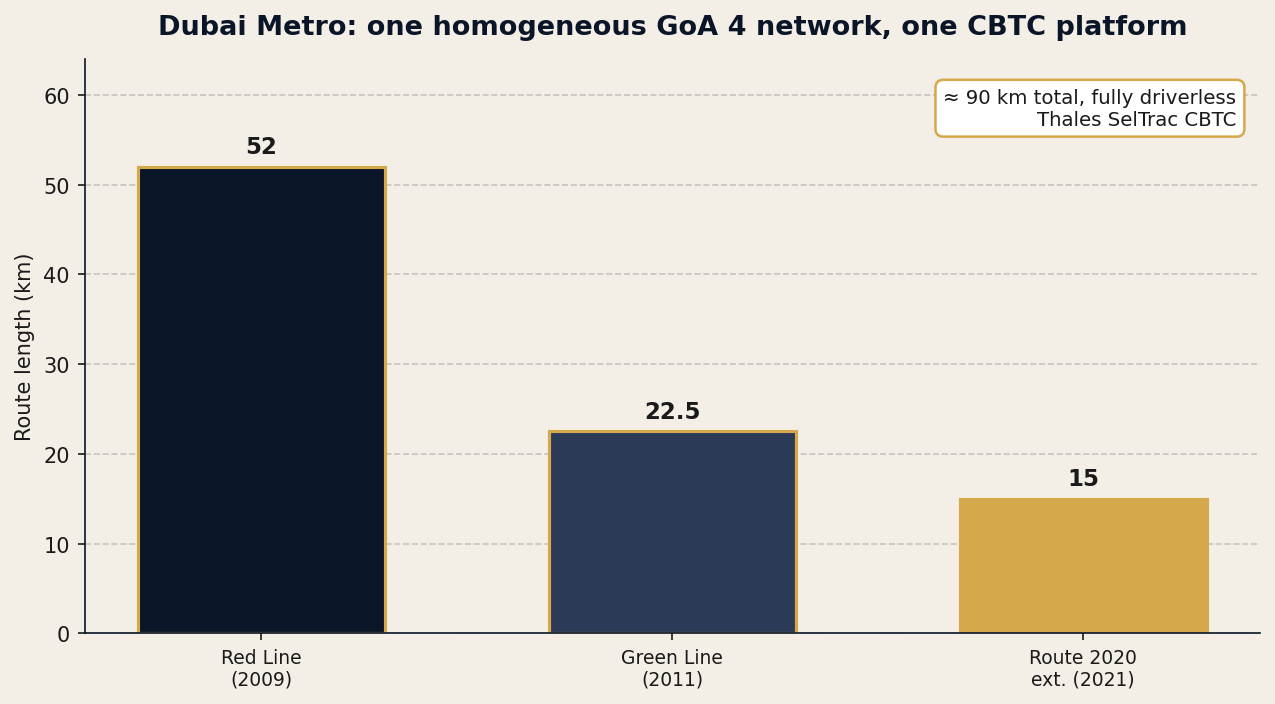 Dubai grew one homogeneous GoA 4 network to roughly 90 route-km on a single Thales SelTrac CBTC platform, without a legacy cutover.
 Dubai’s two-line network on one Thales SelTrac platform, driverless from day one.
Why greenfield changed the economics
The reason Dubai reached unattended operation years before New York or San Francisco is not that its engineers were better; it is that its problem was easier, and its decision structure was faster. Three conditions did most of the work.
First, there was no legacy signaling to overlay, no aging fleet to retrofit, and no decades of accumulated operating rules to preserve — the constraints that turn US resignaling into what why Madrid Metro has more CBTC lines than the entire US describes as a brownfield tax. Second, the civil works and the train control were procured as an integrated turnkey package under a single main contractor consortium, so the interface risk that US agencies carry between separate civil, systems, and vehicle contracts was internalized by the supplier. Third, the political decision to build driverless was made once, at the top, and did not have to survive the multi-year public-comment, labor-negotiation, and federal-funding cycles that shape every American capital program.
None of this makes Dubai a template a US agency can lift. It makes Dubai a controlled experiment that isolates the variable: when the brownfield tax, the split-contract interface risk, and the institutional friction are removed, GoA 4 CBTC is a mature, buyable, on-schedule technology. The technology was never the bottleneck.
Operations: unattended, but not unstaffed
Driverless is a claim about the train, not about the system. The Dubai Metro operates under the RTA with operations and maintenance contracted to a private operator — Serco through 2021, and a Keolis–Mitsubishi Heavy Industries consortium since — and it runs a conventional control center, roving station staff, and maintenance crews on the same discipline any GoA 4 network requires. Unattended train operation removes the driver from the cab; it does not remove people from the safety case. Platform screen doors, obstacle and derailment detection, and a control center that can talk to passengers and dispatch staff to any train are the substitutes for the driver’s eyes, and they are capital and operating costs that a business case must carry.
That distinction is exactly the one US agencies wrestle with when they weigh GoA 2 against GoA 4, and it is treated at length in Driverless Operations Worldwide: Who’s GoA 4, Who’s Faking It. Dubai sits unambiguously in the genuine-GoA-4 column, alongside Paris Métro Line 14 — the European reference case examined in Paris Métro Line 14: The Original Driverless Showcase — and its fifteen years of revenue service are a useful counter to the American reflex of treating unattended operation as unproven.
What this means in practice
- Dubai isolates the variable. Its fifteen years of driverless GoA 4 service demonstrate that the CBTC technology for unattended operation is mature and buyable; the obstacles in the United States are brownfield integration, split contracts, and institutional cadence, not the signaling itself.
- Greenfield economics do not transfer. A US agency cannot copy Dubai’s turnkey, single-authority, no-legacy procurement, so citing Dubai’s schedule or unit cost in a domestic business case invites a false comparison.
- Platform screen doors are part of the price. Any US GoA 4 aspiration inherits the full-height platform-door and detection cost that Dubai built in from the start; it is not an optional add-on.
- One vendor, one platform, one safety case. Dubai’s ability to extend the network for Route 2020 without a legacy cutover is the payoff of homogeneity — a reminder that the most expensive part of US CBTC is usually the boundary between the new system and the old.
Where to go next
This post is a 10-minute case study. The full treatment of international CBTC benchmarks and their relevance to US deployment decisions lives in Chapter 11 (“International Benchmarks with US Relevance”) of Communications-Based Train Control, Volume 2: Operations, Deployment & Economics (Buy on Amazon). Download Chapter 11 slides (free PDF) for the comparative benchmark tables.
Sources
- Wang, C. (2026). Communications-Based Train Control, Volume 2: Operations, Deployment & Economics. Independent. ISBN 979-8-258-54528-2. — [Chapter 11, “International Benchmarks with US Relevance”]
- Railway Gazette International. SelTrac IS to be used in Dubai. railwaygazette.com
- ITS International. Dubai metro — the world’s longest automated rail system. itsinternational.com
- Thales Group. Train control / CBTC (SelTrac). thalesgroup.com
- Gulf News. Thales selected to provide signalling tech on Expo Metro link (Route 2020). gulfnews.com
- IEEE Standards Association. IEEE Std 1474.1: Standard for Communications-Based Train Control (CBTC) Performance and Functional Requirements.
How this article was produced. Drafted with AI assistance, then reviewed and fact-checked by Chunjun (Francisco) Wang against Communications-Based Train Control (the author's two-volume reference) and primary sources — agency records, vendor documentation, and IEEE/IEC standards. Every date, vendor, and figure is traceable to a cited source. Spot a mistake? Corrections are welcome via the contact page.
Read the full treatment in the book
Chapter 8 of Communications-Based Train Control, Volume 1, covers this in depth.