standards · Article
FTA State Safety Oversight (SSO): The CBTC Approval Pathway

In 2009, the Washington Metropolitan Area Transit Authority’s Red Line Fort Totten collision killed nine people, exposed long-standing track-circuit reliability issues at WMATA, and produced a National Transportation Safety Board investigation that reshaped how the United States oversees transit safety. The legislative response in MAP-21 (2012), the FAST Act (2015), and the Bipartisan Infrastructure Law (2021) gave the Federal Transit Administration the statutory framework to require Safety Management Systems and to fund and certify State Safety Oversight programs in every state with rail transit. By the time New York’s MTA, San Francisco’s BART, or Honolulu’s HART takes a CBTC project from concept to revenue service, the FTA’s State Safety Oversight pathway has shaped the schedule, the safety case, and the documentation burden as much as any technical specification has. Understanding this pathway is not optional for anyone running a US CBTC program.
Why this matters for procurement
State Safety Oversight is the regulatory pathway. The FTA establishes federal safety standards under 49 CFR Part 674, but actual approval authority for transit safety modifications — including a major CBTC project — rests with the state-designated SSO agency. The SSO is the body that reviews safety plans, approves system modifications, witnesses key tests, and authorizes revenue service. Failing to engage the SSO early is the single most common procedural cause of CBTC project delay. This post is for the program manager, the consulting engineer building the project schedule, and the agency safety officer who must coordinate the approval pathway alongside the vendor’s certification work.
The legislative foundation
Federal authority over transit safety originates in 49 USC and is implemented through 49 CFR. The relevant portions for CBTC are:
- 49 CFR Part 673, Public Transportation Agency Safety Plan, which mandates that every rail transit agency operate under a Safety Management System (SMS) with safety risk assessment, safety performance targets, safety control measures, and ongoing monitoring.
- 49 CFR Part 674, State Safety Oversight, which establishes the requirements for state-designated SSO agencies.
- 49 CFR Part 661, Buy America, which imposes US domestic-content requirements on rolling stock and signal equipment funded with FTA grants.
- 49 USC 5329, the Public Transportation Safety Program, which is the underlying statute.
The FTA does not approve CBTC systems directly. It establishes the framework, funds compliant projects through the Capital Investment Grants program, and audits SSO programs for adequacy. The SSO agency, established under federal law in each state with rail transit, conducts the project-by-project safety review.
What the SSO agency actually does
The SSO agency is typically the state Department of Transportation rail office or an independent safety board with rail-transit jurisdiction. New York operates an SSO under the State Department of Transportation; California’s SSO for BART is the Public Utilities Commission; Illinois, Massachusetts, Hawaii, and other states with rail transit each operate their own. The SSO’s CBTC-specific responsibilities include:
- Reviewing the agency’s Safety Management System documentation, including the Safety Risk Assessment specific to the CBTC project.
- Reviewing the project’s design and testing documentation, including independent verification of safety-critical software validation and factory acceptance testing results.
- Confirming operator training adequacy and maintenance practice alignment with the manufacturer’s specifications.
- Reviewing operational protocols for manual fallback, emergency response, and system recovery.
- Witnessing key system integration tests and revenue-service demonstration runs.
- Issuing approval to transition from non-revenue testing to revenue service.
State capacity varies. New York, California, Illinois, and Massachusetts have mature SSO programs with specialized staff who have reviewed multiple CBTC projects. Smaller states with one or two transit operators may rely on contracted consultants for technical depth. The procedural rigor is comparable; the speed of review is not.
The SMS gate
Before the SSO can approve a CBTC project, the agency must demonstrate that the project fits coherently within its Public Transportation Agency Safety Plan. The PTASP is the agency’s living SMS document, and the CBTC project will appear in it as a Safety Risk Assessment, a set of Safety Performance Targets, and a set of Safety Control Measures.
The Safety Risk Assessment must cover not just the future CBTC operating state but the transition. A typical SRA for a CBTC project covers: hazards in the existing legacy signaling, hazards in the proposed CBTC design, hazards specific to the multi-year transition during which legacy and CBTC operate on the same line, and hazards in the cutover itself. (For why cutover dominates project risk, see The Safety Case Document: What’s Inside, How It’s Reviewed.)
This is where the shift from compliance-based to performance-based federal safety oversight becomes operationally visible. Under the older model, the agency demonstrated that it had followed the prescribed steps. Under the SMS model, the agency demonstrates that it has identified the hazards, mitigated them, and committed to monitoring the outcomes. The SSO is auditing the process, not the technology specification.
The approval timeline
The SSO approval timeline is one of the most consistently underestimated elements of a CBTC project schedule. Industry experience and FTA guidance suggest budget for:
- 6 to 12 months for FTA Capital Investment Grant application preparation and review (if federal funding is sought).
- 12 to 24 months for SSO safety approvals, running concurrent with detailed design and factory acceptance testing.
- 6 to 18 months for National Environmental Policy Act review (if applicable; most pure signal replacements qualify for categorical exclusion).
- 18 to 36 months for detailed design, manufacturing, factory acceptance testing, and on-site installation.
For a brownfield CBTC project at a major US transit agency, the total federal-pathway timeline from initial planning to revenue service typically spans five to eight years. Local-funded projects without FTA involvement can compress this to three to five years, but most major US deployments use FTA Capital Investment Grants and accept the longer pathway.
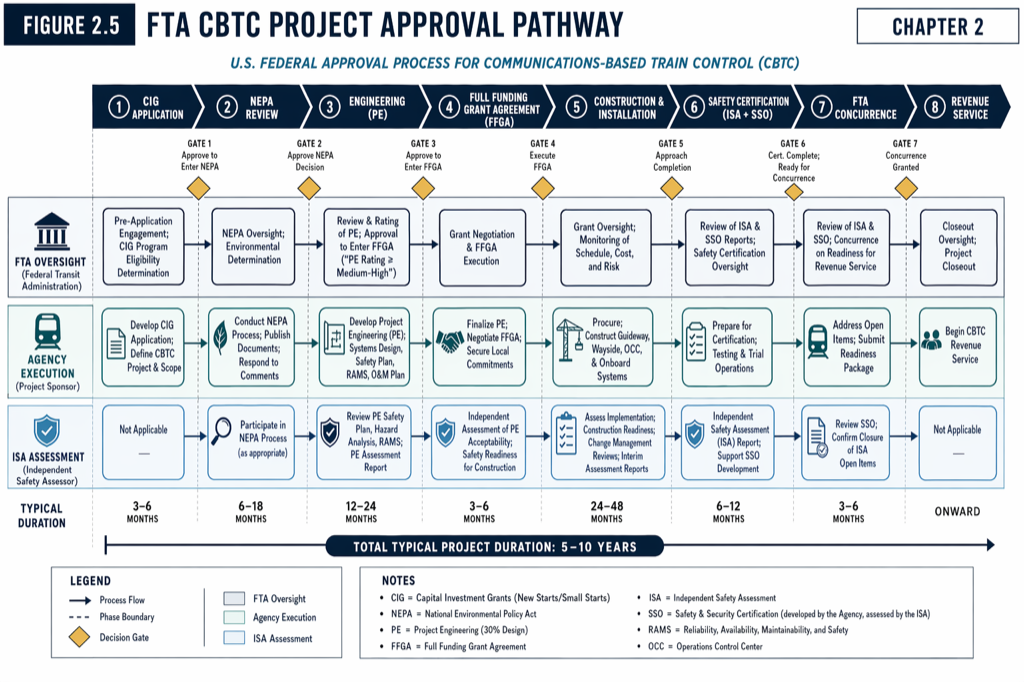 Three federal review tracks run in parallel; revenue service authorization waits on all three.
The MTA L Line precedent
The MTA’s L Line CBTC project illustrates the pathway in practice. When the MTA proposed CBTC deployment on the 14th Street line, the New York State SSO required comprehensive documentation of the signal system’s fail-safe design, communication network redundancy, and operator training. The SSO’s review involved quarterly design reviews and witness testing across the integration phase. The MTA’s experience on the L Line then informed a more efficient SSO pathway for subsequent CBTC projects on the 7 Line and Queens Boulevard. This pattern is repeating at other agencies: the first CBTC project takes the longest SSO review, and subsequent projects benefit from the precedent.
Engaging the SSO early
The strongest predictor of a clean SSO approval pathway is early engagement. Agencies that schedule the first SSO meeting at the conceptual design phase — before the safety case is structured, before the supplier is selected, sometimes before the funding is secured — face fewer late-stage surprises. Agencies that approach the SSO with a finished design and a request for a sign-off near the end of construction typically face rework, additional testing, and a multi-month delay.
The pragmatic protocol most mature US agencies follow:
- Identify the SSO agency at project inception.
- Schedule a pre-application meeting at concept stage. Discuss the proposed automation level, the safety case structure, and the SSO’s expectations.
- Establish a monthly or quarterly design review cadence with SSO participation.
- Embed SSO review checkpoints in the project schedule at each major design phase (preliminary design review, critical design review, factory acceptance test, site integration test).
- Witness-test critical safety functions with SSO observers.
- Submit the final safety case package with all dependencies resolved before requesting revenue-service authorization.
The agencies that follow this protocol typically get revenue-service authorization on schedule. The agencies that do not typically face schedule slips of three to twelve months at the end of the project, when there is the least margin to absorb them.
The Buy America layer
Buy America, codified at 49 CFR Part 661, is not strictly an SSO matter, but it sits in the same federal review pathway and routinely affects CBTC procurement. The current threshold for signal and train control equipment is approximately 60 percent US-manufactured content, calculated on delivered cost. Major CBTC vendors (Siemens, Alstom, Hitachi Rail STS) maintain US assembly and engineering operations at facilities including Sacramento, Pittsburgh, and elsewhere to satisfy the requirement. The Buy America compliance plan is a routine deliverable in any FTA-funded CBTC procurement. Failure to plan for it has caused project delays at multiple US agencies. (For the broader regulatory context including PTC, see CBTC vs PTC: Why US Commuter Rail Picked One and US Metro Picked the Other.)
What the SSO does not do
The SSO is not a vendor certification body. It does not certify that a Siemens Trainguard MT or an Alstom Urbalis platform is “FTA-approved” or “SSO-approved” generically. Each project is reviewed on its own — its specific configuration, its specific operating environment, its specific safety case. A vendor whose platform has been deployed at five US agencies still must satisfy each new SSO on each new project.
The SSO also does not fund the project. FTA Capital Investment Grants fund the project; the SSO reviews safety. The two pathways are parallel and must be coordinated, but they are administratively separate.
Where IEEE 1474, IEC 62290, and the SSO meet
The SSO does not mandate IEEE 1474 compliance, IEC 62290 conformance, or any specific technical standard. What the SSO requires is a credible safety case showing that the proposed CBTC system, as designed and as integrated into the agency’s specific operating environment, achieves the safety performance targets the agency has committed to in its PTASP.
In practice, the safety case in any modern US CBTC project leans heavily on IEEE 1474 for performance specification, IEC 62290 for functional architecture and automation level, IEC 61508 / EN 50129 for the SIL framework, and EN 50128 for software lifecycle. (For the standards stack that supports the safety case, see IEEE 1474.1 Explained: Why It’s Performance-Based, Not Prescriptive.)
Practical takeaways
- The FTA does not approve CBTC systems directly. State Safety Oversight agencies, established under 49 CFR Part 674, are the actual approval authorities.
- Engage the SSO at concept stage, not at design completion. Late SSO engagement is the single most common procedural cause of CBTC project delay.
- The safety case must cover the legacy state, the future CBTC state, and the multi-year transition. The cutover phase is where most safety case rework concentrates.
- Plan for 12 to 24 months of SSO review running concurrently with detailed design and FAT. For an FTA-funded brownfield project, the full federal pathway is typically five to eight years.
- Buy America compliance is a separate but parallel federal review track. Plan for the 60 percent domestic-content threshold from the start of procurement.
Where to go next
This post is a brief summary. The full treatment lives in Chapter 2 of Communications-Based Train Control (Volume 1 on Amazon). Download Chapter 2 slides (free PDF)
Sources
- Wang, C. (2026). Communications-Based Train Control, Volume 1: Foundations & Technical Architecture. Independent. ISBN 979-8-258-54295-3. — Chapter 2, “Standards, Regulations, and the US Framework.”
- Federal Transit Administration. State Safety Oversight Program. transit.dot.gov/regulations-and-guidance/safety/state-safety-oversight
- Federal Transit Administration. Public Transportation Agency Safety Plan (49 CFR Part 673). transit.dot.gov
- Code of Federal Regulations. 49 CFR Part 674 — State Safety Oversight. ecfr.gov
- Code of Federal Regulations. 49 CFR Part 661 — Buy America Requirements. ecfr.gov
- Federal Transit Administration. Capital Investment Grants Program. transit.dot.gov/CIG
- National Transportation Safety Board. Railroad Accident Report RAR-10/02: WMATA Fort Totten Collision. ntsb.gov
How this article was produced. Drafted with AI assistance, then reviewed and fact-checked by Chunjun (Francisco) Wang against Communications-Based Train Control (the author's two-volume reference) and primary sources — agency records, vendor documentation, and IEEE/IEC standards. Every date, vendor, and figure is traceable to a cited source. Spot a mistake? Corrections are welcome via the contact page.
Read the full treatment in the book
Chapter 2 of Communications-Based Train Control, Volume 1, covers this in depth.