procurement · Article
Funding a CBTC Project: FTA, Federal, State, and Local Sources

A modern US Communications-Based Train Control (CBTC) project costs $800 million to $2.5 billion across capital deployment and the first 25 years of operations. Approximately 70 to 80 percent of major CBTC programs rely on federal grant or credit assistance; the remaining 20 to 30 percent comes from state bonds, dedicated local sales taxes, farebox-backed agency debt, and (rarely) Public-Private Partnership financing. The Bipartisan Infrastructure Law (Infrastructure Investment and Jobs Act, IIJA, Public Law 117-58, enacted November 2021) substantially expanded the available federal resources, and the funding stack that an agency assembles today reflects that expansion. This post walks through the federal, state, and local sources that make up a typical US CBTC funding stack, the eligibility and evaluation criteria each applies, and how the pieces combine into a defensible capital plan.
Why funding structure matters
Funding structure is the second-most-consequential decision in a CBTC project lifecycle, after procurement strategy. The mix of grant, loan, and dedicated-revenue financing determines the agency’s debt service obligations across the operating life of the system, the discount rate that applies to the lifecycle cost analysis, the federal compliance overhead (BABA, Davis-Bacon, NEPA, Title VI), and the rating agency’s view of the project’s credit quality. An agency that scopes only the capital cost without scoping the funding structure has not actually planned the project. This piece is for the chief financial officer, the director of capital programs, the FTA grants officer, and the rating-agency analyst building the financial plan that the board approves and the FTA reviews. The depth lives in Chapter 14 of Communications-Based Train Control, Volume 2, and Chapter 2 covers the regulatory framework. This post is the funding-stack walkthrough.
Federal Transit Administration Capital Investment Grants
The Capital Investment Grant (CIG) program is the principal federal source for CBTC funding. CIG comprises three relevant categories.
New Starts funds new fixed-guideway transit projects above $400 million in total project cost (or above $150 million in federal funding). CBTC projects on new lines (greenfield) compete in this category. Federal share is typically up to 60 percent for New Starts, with 40 percent or more from non-federal sources. Project development and engineering phases each require FTA approval before funding flows.
Small Starts funds smaller new fixed-guideway projects, capped at $400 million total project cost or $150 million in federal funding. Smaller agency CBTC projects (single-line deployments at moderate scale) often qualify. Project development timelines for Small Starts are typically 12 to 18 months, faster than the 24 to 36 months typical for New Starts.
Core Capacity is the historical primary source for CBTC funding. It funds projects that increase the capacity of an existing fixed-guideway system to handle passenger loads not accommodable on the existing system. Federal share is typically 50 to 60 percent of project cost, sometimes higher under specific authorization. CBTC resignaling projects compete most directly here when they demonstrably unlock corridor capacity.
CIG funding availability under the Bipartisan Infrastructure Law authorized approximately $2.2 billion annually for Core Capacity grants from fiscal year 2022 through fiscal year 2026 — a substantial increase over pre-BIL baselines. Recent CIG awards include Chicago’s Red and Purple Lines modernization at $2.1 billion (approved 2020), BART’s Train Control Modernization Program with $500 million in CIG allocation, and multiple MTA signal modernization awards. The L Line, BART TCMP, WMATA, Honolulu HART, SEPTA Regional Rail, and proposed MBTA Red and Orange Line upgrades have all been CIG recipients or applicants.
CIG evaluation applies four primary criteria: Project Justification, Local Financial Commitment, Project Readiness, and Cost-Effectiveness. CBTC projects clear the cost-effectiveness threshold (BCR ≥ 1.0 minimum, ≥ 1.5 for meaningful federal support, ≥ 2.0 for competitive discretionary funding) when capacity is binding, ridership is established, and the local financial commitment is credible.
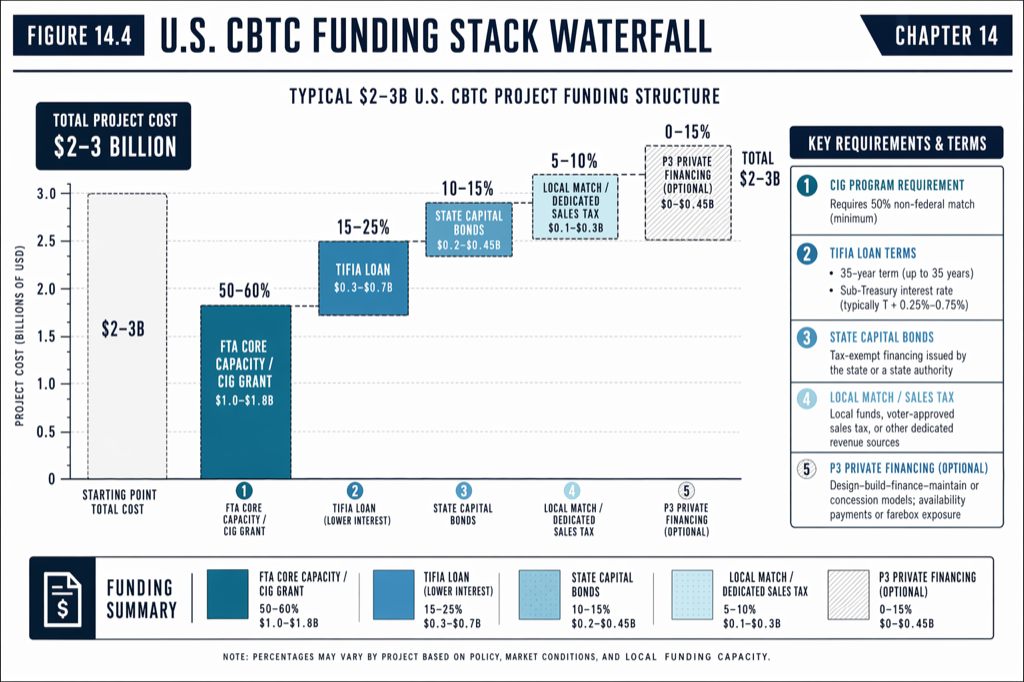 A representative US CBTC funding stack. CIG is the dominant federal source; TIFIA, state, and local contributions complete the package.
TIFIA: federal credit assistance, not federal grants
The Transportation Infrastructure Finance and Innovation Act (TIFIA) program, administered jointly by the FTA and the Federal Highway Administration (FHWA), provides low-interest loans to projects of regional and national significance. TIFIA is fundamentally different from a CIG grant: TIFIA is debt the agency repays from project revenues; CIG is a grant the agency does not repay.
TIFIA terms are favorable. Loans can cover up to 49 percent of a project’s development cost for transit projects with dedicated revenue sources, or 33 percent without. Interest rates are typically 2 to 4 percent real, below municipal bond market rates of 4 to 6 percent real. Loan tenor extends to 35 years. The Bipartisan Infrastructure Law expanded TIFIA eligibility for transit projects.
The credit constraint is real. TIFIA requires demonstration of sufficient revenues to support debt service at a defined coverage ratio (typically 1.25 times annual debt service). CBTC projects that produce induced ridership and farebox growth, or that have dedicated revenue streams (sales tax pledges, parking revenue, congestion-pricing revenue), can support TIFIA terms. Projects that rely on cost-cutting or pure safety benefits, without identifiable revenue growth, struggle to meet the coverage requirement.
State and local funding
The 30 to 50 percent non-federal share of a CBTC project comes from a combination of state, local, and farebox-backed sources.
State bond programs. Large states periodically issue dedicated transportation bonds. California’s Proposition 1A (2008), New York State infrastructure bonds, and Illinois Capital Bill have all funded transit projects, including signaling. The competitive context: CBTC must compete against road repair, commuter rail expansion, bus rapid transit, and other transit modes for the same bond proceeds.
Local transit authority debt. Major transit agencies issue revenue bonds backed by farebox revenue, sales-tax pledges, or property-tax revenue. The MTA, BART, WMATA, and SEPTA all have substantial bond programs. Issuance limits and credit ratings constrain the available capacity. A typical major-agency CBTC project supports $100 million to $300 million in additional debt.
Local sales-tax dedications. Cities and counties can dedicate portions of sales tax to transit capital. Bay Area Measures (RM3, BB), Los Angeles Measure M, Chicago RTA programs, and Atlanta MARTA dedicated revenues all contribute. Effectiveness depends on local tax-base stability, political support, and competing priorities. The dedicated-revenue piece is often what makes a TIFIA loan financeable.
Congestion pricing revenue. New York’s congestion pricing program, the country’s first urban congestion charge, dedicates a substantial revenue stream to MTA capital. Other agencies are exploring similar dedications. This is a developing area with substantial capital implications for CBTC programs in dense urban regions.
Public-Private Partnerships
A small number of US CBTC deployments have explored Public-Private Partnership (P3) structures, in which a private operator or consortium finances, designs, builds, operates, and maintains the system across 25 to 35 years. The agency retains ownership and regulatory authority.
P3 advantages: large upfront capital transferred to the private sector, long-term operational responsibility, performance-based contract structure. P3 disadvantages: the private partner’s WACC (typically 5 to 8 percent real, sometimes higher) compresses to a 10 to 20 percent total project cost premium relative to public financing at OMB rates, loss of public control over operations, complex negotiations.
The London Metronet PPP (2003-2007) is a cautionary case: the PPP collapsed in 2007, returning full control to Transport for London. Honolulu HART explored a P3 structure in the mid-2010s and ultimately adopted a modified hybrid in which the agency retained operational control while contracting depot maintenance and station services to a private operator.
P3 makes sense in narrow circumstances: large up-front capital needs, willingness to accept higher overall cost in exchange for transferred risk, sufficiently sophisticated public-side procurement capacity to negotiate the structure. In the absence of those conditions, the conventional federal-state-local stack is more economical.
Discretionary grants beyond CIG
Several BIL-era discretionary programs supplement CIG for transit signaling.
The RAISE program (Rebuilding American Infrastructure with Sustainability and Equity, formerly TIGER and BUILD) funds transportation projects of national or regional significance. Awards typically range from $5 million to $50 million per project; CBTC projects rarely receive RAISE as a primary funding source but can use RAISE for design, planning, or pilot deployment phases.
The MEGA program (formerly INFRA, the National Infrastructure Project Assistance program) funds large-scale projects of national or regional significance, with award sizes from $100 million up. Major CBTC programs can compete for MEGA but face strong competition from highway, port, and rail freight projects.
The Federal-State Partnership for Intercity Passenger Rail program (formerly Federal-State Partnership for State of Good Repair) funds intercity passenger rail and shared-corridor projects. Where a CBTC deployment supports intercity passenger rail (such as on the Northeast Corridor), this program can contribute.
The Bus Rapid Transit program does not fund CBTC directly but can fund corridor improvements that complement CBTC deployment.
The funding stack in practice
A representative funding stack for a $2 to $3 billion brownfield CBTC project assembled in 2026:
- FTA Core Capacity grant: $1.2 to $1.6 billion (60 percent)
- TIFIA loan: $300 to $500 million (15 to 25 percent), repaid over 30 years using farebox or dedicated revenue
- State bond or grant: $200 to $300 million (10 to 15 percent)
- Local agency debt or cash: $100 to $200 million (5 to 10 percent)
- P3 or private equity (if applicable): $0 to $200 million
This structure balances low-cost federal grants (CBTC typically achieves 60 percent or higher federal share given strong BCR), supplementary low-interest federal credit (TIFIA), state and local matching resources, and optional private financing. The Local Financial Commitment Rating that FTA applies to CIG applications scores the credibility of this stack — an agency with weak local commitments will struggle to attract federal grant dollars regardless of the project’s technical merits.
| Funding Source | Eligibility | Federal Share | Typical Award Size |
|---|---|---|---|
| CIG - New Starts | New fixed-guideway projects above $400 million or $150 million in federal funding | Up to 60% | — |
| CIG - Small Starts | New fixed-guideway projects capped at $400 million or $150 million in federal funding | — | — |
| CIG - Core Capacity | Projects increasing capacity of existing systems | 50-60%, sometimes higher | $2.2 billion annually (FY 2022-2026) |
| TIFIA | Projects of regional and national significance | Up to 49% with dedicated revenue, 33% without | — |
| RAISE | Projects of national or regional significance | — | $5 million to $50 million |
| MEGA | Large-scale projects of national or regional significance | — | $100 million and up |
Compliance overhead the funding decision drives
The funding decision drives multiple compliance overheads.
BABA (Build America, Buy America). Federal capital funding triggers BABA’s 70 percent manufactured-product domestic content threshold and 90 percent steel-and-iron threshold. The compliance premium on CBTC equipment runs 5 to 15 percent over international market prices.
Davis-Bacon prevailing wage. Federal funding triggers Davis-Bacon, adding 30 to 50 percent to installation and commissioning labor in major metros.
NEPA environmental review. Federal funding triggers NEPA. Pure CBTC signaling replacements often qualify as a Categorical Exclusion (CATEX) requiring only a brief environmental checklist; deployments with station accessibility improvements, new substations, or communication tower construction can trigger Environmental Assessment ($500K to $1.5M) or Environmental Impact Statement ($1.5M to $3M+) review.
Title VI civil rights. Federal funding triggers Title VI civil rights compliance, including service equity analysis and public engagement requirements.
Project Management Oversight (PMO). Federal funding above defined thresholds triggers FTA Project Management Oversight Contractor engagement, with quarterly reports, design review participation, and a System Integration Review (SIR) gate before revenue cutover.
The honest planning rule: build the BABA, Davis-Bacon, NEPA, Title VI, and PMO costs into the project budget as line items, not as overhead. They are the cost of admission to federal grant funding.
Practical takeaways
- CBTC funding stacks are roughly 60 to 65 percent FTA grant (CIG Core Capacity for most resignaling projects), 15 to 25 percent TIFIA loan, and 15 to 25 percent state and local match.
- CIG evaluation rests on four criteria: Project Justification, Local Financial Commitment, Project Readiness, and Cost-Effectiveness. BCR thresholds: 1.0 minimum, 1.5 for meaningful support, 2.0 for competitive discretionary funding.
- TIFIA loans require demonstration of revenues sufficient to support debt service at 1.25× coverage. Projects with induced ridership and dedicated revenue streams meet this; pure safety-driven projects often do not.
- State and local match (typically 30 to 50 percent of total project cost) is the credibility test. A weak local commitment kills CIG competitiveness.
- P3 carries a 10 to 20 percent total project cost premium over conventional public financing. It makes sense only where transferred risk and large upfront capital justify the premium.
- BABA, Davis-Bacon, NEPA, Title VI, and PMO are the compliance overheads federal funding triggers. Build them into the budget, not into a single contingency reserve.
Where to go next
This piece is the funding-stack walkthrough. The full Capital Investment Grant and lifecycle cost framework lives in Chapter 14 of Communications-Based Train Control, Volume 2 (Buy on Amazon). Download Chapter 14 slides (free PDF).
For the all-in CAPEX picture that the funding stack must cover, see CBTC Procurement: Cost Drivers Beyond the Sticker Price. For the discounted lifecycle cost model that supports the BCR derivation, see CBTC Lifecycle Cost: A 30-Year Model Walk-Through.
Sources
- Wang, C. (2026). Communications-Based Train Control, Volume 2: Operations, Deployment & Economics. Independent. ISBN 979-8-258-54295-3. — Chapter 2, “Standards and Regulation”; Chapter 14, “Lifecycle Costs and Economic Justification.”
- Federal Transit Administration. Capital Investment Grants Program. transit.dot.gov/CIG
- US Department of Transportation. Bipartisan Infrastructure Law (Infrastructure Investment and Jobs Act, P.L. 117-58). transportation.gov/bipartisan-infrastructure-law
- Build America Bureau, US Department of Transportation. TIFIA Program Overview. transportation.gov/buildamerica/financing/tifia
- Federal Transit Administration. Build America, Buy America Act Implementation Guidance. transit.dot.gov/BuyAmerica
- Office of Management and Budget. OMB Circular A-94: Guidelines and Discount Rates for Benefit-Cost Analysis of Federal Programs. whitehouse.gov/omb
- US Department of Transportation. Benefit-Cost Analysis Guidance for Discretionary Grant Programs (2024). transportation.gov
- MTA New York City Transit. Communications-Based Train Control Status Update. new.mta.info/project/communications-based-train-control-cbtc
- Bay Area Rapid Transit. Train Control Modernization Program. bart.gov/about/projects/cbtc
Read the full treatment in the book
Chapter 2 of Communications-Based Train Control, Volume 1, covers this in depth.