procurement · Article
Hidden Cost of CBTC Vendor Lock-In (and How to Avoid It)

When the New York City Metropolitan Transportation Authority (MTA) deliberately structured its Communications-Based Train Control (CBTC) program around three different vendors — Siemens on the L Line, Thales SelTrac (now Hitachi Rail) on the 7 Line, and Siemens again on Queens Boulevard — the agency was making an explicit strategic bet. The cost of multi-vendor operation across a single rapid-transit network is real: dual training programs, dual spare-parts inventories, dual diagnostic toolchains, dual maintainer competency. Industry analysts and agency post-deployment reports estimate that single-vendor inertia imposes a cost premium of 10 to 25 percent over an asset’s 30-year life, in lieu of which the multi-vendor strategy preserves competitive leverage on every subsequent procurement. This post unpacks where that 10 to 25 percent premium actually shows up — across procurement, refresh, OPEX, and cross-line expansion — and what contractual mechanisms a US transit agency can use to bound the cost without abandoning the operational simplicity of a single-supplier ecosystem.
Why lock-in is not a single line item
CBTC vendor lock-in is not a single negotiation outcome that the agency loses on contract day one. It is the cumulative effect of dozens of small dependencies that compound across a 30-year asset life: training and certification, spares and diagnostic tooling, software support and OEM updates, midlife technology refresh, and the procurement competition for follow-on lines. Each individual dependency costs the agency 1 to 3 percent in negotiated price or operational efficiency. Stacked across 30 years and several procurements, the cumulative cost reaches the 10 to 25 percent figure that experienced US transit procurement officers cite. This piece is for the program manager and the chief financial officer building the multi-decade capital plan. It assumes familiarity with the vendor-neutral RFP structure and the 30-year lifecycle cost model. The depth lives in Chapter 15 of Communications-Based Train Control, Volume 2.
Where the premium shows up
Lock-in cost compounds across five recurring surfaces.
1. The initial procurement premium. A CBTC procurement from a single qualified bidder, or from a two-vendor short list that the incumbent dominates, runs roughly 10 to 20 percent above an open competitive procurement of similar scope. Vendor consolidation has narrowed the field of tier-1 suppliers from approximately six to approximately five capable of delivering a complete US CBTC system. On a $200M to $500M procurement, the captive-procurement premium translates to $20M to $100M in initial CAPEX.
2. Refresh procurement at year 12 to 15. A midlife technology refresh — VOBC replacement, Zone Controller refresh, OCC re-platform — typically runs 15 to 20 percent of original CAPEX. The competitive question at refresh is whether the agency can credibly procure the replacement from a different vendor or whether it is contractually bound (by the original supplier’s IP, ICDs, or proprietary protocols) to return to the incumbent. An agency without source-code escrow, ICDs, or interface licenses faces a 10 to 25 percent refresh premium. On a $30M to $50M refresh, that is another $3M to $12M.
3. Spare parts and ongoing support. OEM software support contracts run 8 to 15 percent of original software CAPEX annually. Spare parts, especially for safety-critical electronics with limited supplier alternatives, frequently carry 30 to 50 percent margins above competitive pricing. A maintenance organization with no credible alternative supplier pays whatever the OEM asks, with limited recourse.
4. Cross-line expansion. This is where the largest dollar figures accumulate. An agency with three lines under three different vendors can credibly competitively procure each subsequent line. An agency with three lines under one vendor will face a fourth-line procurement at incumbent pricing, with all the integration and training advantages favoring continuation. The MTA’s deliberate multi-vendor strategy across the L Line, the 7 Line, and Queens Boulevard has cost the agency something in operational complexity but has preserved the competitive leverage that — across the dozens of additional MTA lines awaiting CBTC — will save tens to hundreds of millions over the multi-decade modernization.
5. Operational embedding. Training programs, simulators, diagnostic toolchains, and spare-parts inventories all accumulate around the incumbent supplier’s product family. This is the lock-in surface that no contract clause fully prevents — and the one that drives the day-to-day cost of multi-vendor operation when an agency does choose that path. Standardized data formats, open APIs for non-vital subsystems, and modular spare-parts strategies bound the cost; they do not eliminate it.
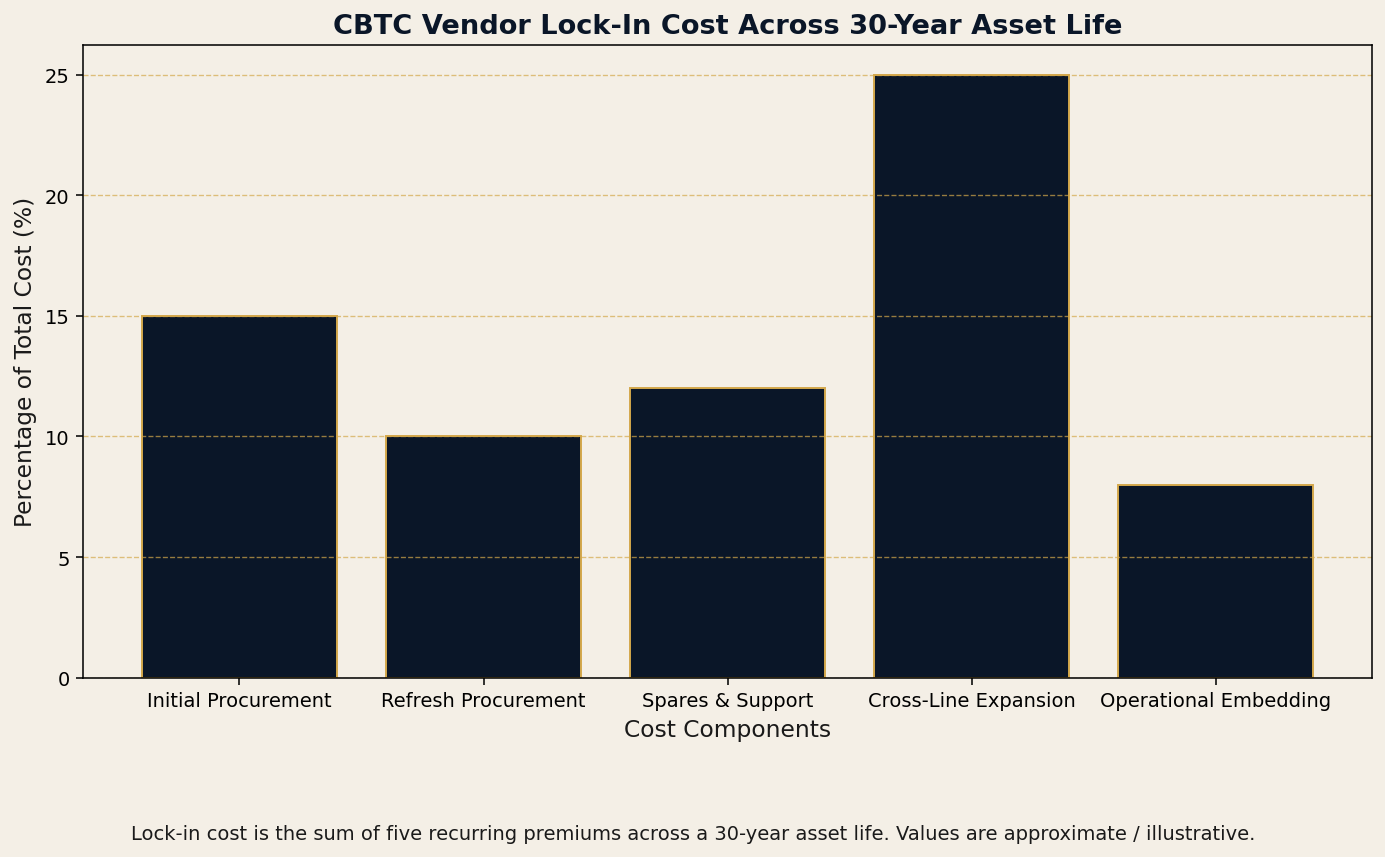 Lock-in cost is the sum of five recurring premiums across a 30-year asset life. The largest component is cross-line expa.
The three sources of structural lock-in
Three structural features of CBTC architecture are the underlying drivers of lock-in.
Interface opacity. Every CBTC architecture has internal boundaries — VOBC to zone controller, zone controller to interlocking, central ATS to wayside, balise to onboard reader. If those boundaries are documented only in the supplier’s internal engineering archives, no other supplier can connect to them. A subsequent procurement faces a binary choice: pay the incumbent or rip out the deployed equipment.
Intellectual property capture. CBTC’s safety-critical software, particularly the Automatic Train Protection logic, is the supplier’s most valuable asset. A contract that grants only an operational license, without source-code escrow, patent licensing, or rights to commission third-party maintenance, makes the safety case the supplier’s property rather than the agency’s. If the supplier exits the market, gets acquired, or simply chooses not to support the platform after year 15, the agency is stranded.
Type approval and certification. SIL 4 type approval is awarded to a specific product configuration by a specific notified body. Substituting any subsystem — even a functionally equivalent one from a different supplier — typically requires a new type approval cycle of 18 to 24 months. This certification cost is the practical reason that full plug-and-play interchangeability at the safety-critical level is unlikely within the next decade.
What contracts can bound — and what they cannot
US transit agencies have developed a layered contractual response to lock-in.
Mandatory Interface Control Documents (ICDs). Every subsystem boundary documented as a contract deliverable, in editable format, owned by the agency upon acceptance, with the contractor obligated to maintain ICDs throughout the warranty period. ICDs do not solve type-approval recertification, but they make subsequent recertification by a different supplier feasible rather than impossible.
Source-code escrow with enforceable release triggers. Source code, build instructions, qualification test suites, and dependency manifests deposited with a neutral third party (Iron Mountain, NCC Group, EscrowTech) and released on bankruptcy, cessation of support, change of control, or material breach of maintenance obligations. Without enforceable triggers, the escrow is decorative. With them, the escrow establishes a credible exit option that is — by itself — the strongest source of negotiating leverage the agency will ever have.
Royalty-free perpetual patent licensing. Patents that cover how the supplier’s subsystems talk to each other become unusable property without licenses. A contract that escrows source code without patent licensing leaves the agency unable to legally use the protocols even if the code is released.
Modular procurement. Some agencies unbundle the CBTC procurement into separate contracts for onboard, wayside, and central systems, taking on the systems-integrator role themselves. This is the European procurement model. It is organizationally demanding — the agency must staff a competent internal integration team, typically with a Program Management Consultant from WSP, AECOM, HNTB, STV, or Jacobs as the engineering arm — but it gives the strongest possible competitive leverage on every subsequent procurement.
Open APIs for non-vital subsystems. Inside a CBTC system, a clean line separates the SIL 4 vital functions from the surrounding non-vital subsystems (asset management, predictive maintenance, customer information, energy management). Vital functions cannot yet be plug-and-play interchangeable. Non-vital functions should be required to expose REST or OPC UA APIs so the agency can build, buy, or replace surrounding tools on a competitive basis.
 Bundled and unbundled CBTC procurement each preserve different forms of competitive leverage. The right answer depends o.
What contracts cannot bound
Two structural lock-in surfaces no contract can fully eliminate.
Type approval and re-certification. A subsystem swap that triggers re-certification carries the 18 to 24 month timeline regardless of how perfectly the contract bounds IP and ICDs. The mitigation is to plan refresh procurements 30 months ahead of the replacement window, not to expect contract language to compress the certification timeline.
Operational embedding. Maintainer training, diagnostic tooling, spare-parts inventory, and operational procedures all accumulate around the incumbent supplier’s product family. Standardized data formats and open APIs for non-vital subsystems bound the embedding cost. They do not eliminate the day-to-day cost of operating multiple supplier ecosystems on the same network.
These constraints do not undermine the contractual response. They establish that the contractual response is a cost-bounding strategy, not a lock-in elimination strategy. The agency that signs a CBTC contract is choosing which supplier it will be partnered with for at least the first 15 years; the contract determines the cost of changing partners later, not whether changing partners is free.
What NYC, BART, and SFMTA each chose
Three contemporary US procurement strategies illustrate the tradeoffs.
NYC MTA: deliberate multi-vendor. L Line (Siemens, full revenue 2009), 7 Line (Thales SelTrac, full revenue 2018, now Hitachi Rail), Queens Boulevard (Siemens, partial revenue 2024). The cost of dual training, spares, and tooling is real. The leverage on every subsequent procurement — and there are many MTA lines awaiting CBTC — is the strategic payoff.
BART: single Design-Build to Hitachi Rail STS for the Train Control Modernization Program. Awarded January 2018 at approximately $798M. Single supplier, single contract, single integration responsibility, single set of training and tooling. The lock-in cost is built into the lifecycle financial plan; the operational simplicity is the strategic payoff.
SFMTA: ongoing procurement structured for vendor neutrality. The 2024 RFP for the Train Control Upgrade Project on Muni Metro (replacing the 1998 CITYFLO 650 system, an early automated train control predating modern CBTC standards) is structured around an IEEE 1474 performance specification, mandatory ICDs, and explicit BABA compliance requirements. Vendor selection is in process.
None of the three is wrong. Each reflects the agency’s internal engineering capacity, capital plan structure, and political appetite for operational complexity.
Practical takeaways
- Treat lock-in cost as the sum of five recurring premiums (initial procurement, refresh, spares and support, cross-line expansion, operational embedding) across the 30-year asset life. Total is typically 10 to 25 percent of lifetime CBTC cost.
- Bound interface opacity with mandatory ICDs as contract deliverables, in editable format, owned by the agency upon acceptance.
- Bound IP capture with source-code escrow and enforceable release triggers, plus perpetual royalty-free patent licensing on every interface the agency will ever need.
- Choose between bundled (single Design-Build) and unbundled (owner-integrated) procurement deliberately, based on the agency’s internal engineering capacity. Bundle if you must; unbundle if you can.
- Mandate open APIs for every non-vital subsystem. Vital safety functions stay locked in; the operational data layer does not have to.
- Plan refresh procurements 30 months ahead of the replacement window. Type approval timelines are not compressible by contract.
- For agencies with multi-line networks, consider deliberate multi-vendor diversification across lines. The operational complexity is real; the cross-line negotiating leverage is the strategic payoff.
Where to go next
This piece quantifies the lock-in surface. The full vendor and architecture treatment lives in Chapter 15 (Vendor Landscape and Technology Trends) of Communications-Based Train Control, Volume 2 (Buy on Amazon). Download Chapter 15 slides (free PDF).
For the procurement-side counterpart, see How to Write a CBTC RFP That Doesn’t Lock You Into One Vendor. For the multi-vendor strategy in practice, see Single-Vendor vs Multi-Vendor CBTC: NYC’s Lessons Learned.
Sources
- Wang, C. (2026). Communications-Based Train Control, Volume 2: Operations, Deployment & Economics. Independent. ISBN 979-8-258-54295-3. — Chapter 12, “Project Lifecycle”; Chapter 14, “Lifecycle Costs”; Chapter 15, “Vendor Landscape and Technology Trends.”
- IEEE Standards Association. IEEE Std 1474.1, 1474.2, 1474.3, 1474.4: Communications-Based Train Control Standards.
- Federal Transit Administration. (2016). FTA Report No. 0045: Communications-Based Train Control (CBTC) Technology. transit.dot.gov
- MTA New York City Transit. Communications-Based Train Control Status Update. new.mta.info/project/communications-based-train-control-cbtc
- Bay Area Rapid Transit. Train Control Modernization Program. bart.gov/about/projects/cbtc
- San Francisco Municipal Transportation Agency. Train Control Upgrade Project. sfmta.com/projects/train-control-upgrade-project
- Hitachi Rail. Acquisition of Thales Ground Transportation Systems, April 2024.
- Alstom. Acquisition of Bombardier Transportation, January 2021.
How this article was produced. Drafted with AI assistance, then reviewed and fact-checked by Chunjun (Francisco) Wang against Communications-Based Train Control (the author's two-volume reference) and primary sources — agency records, vendor documentation, and IEEE/IEC standards. Every date, vendor, and figure is traceable to a cited source. Spot a mistake? Corrections are welcome via the contact page.
Read the full treatment in the book
Chapter 12 of Communications-Based Train Control, Volume 2, covers this in depth.