international-benchmarks · Article
Hong Kong MTR CBTC: Resignalling Seven Lines Without Going Driverless
At 2:57 on the morning of 18 March 2019, in the crossover tunnel between Admiralty and Central, two empty Mass Transit Railway (MTR) trains ran into one another. No passengers were aboard; the Tsuen Wan Line was closed for the night while engineers commissioned a new moving-block signalling system. One train derailed the leading car across two bogies, the other took structural damage over three cars, and the two operators on board — present only because commissioning rules required a driver in the cab — were taken to hospital, one with a leg injury and one after inhaling smoke. For a railway with one of the best safety records in the world, the collision was a genuine shock, and it landed in the middle of the largest signalling effort the network had ever attempted: the Hong Kong MTR CBTC program, a seven-line retrofit of Thales SelTrac Communications-Based Train Control (CBTC) onto a system that had been carrying passengers since 1979.
That incident, and the rollout that followed, make Hong Kong one of the most instructive international cases a US transit engineer can study — a brownfield resignaling under live-service constraints, which is exactly the problem American agencies face and Gulf greenfield projects do not.
Why a US engineer should study Hong Kong’s brownfield resignalling
The United States rarely benchmarks itself against Hong Kong, and when it does the reference is usually the MTR’s farebox recovery or its property-development model rather than its train control. That is a missed lesson. The MTR is retrofitting CBTC onto lines opened in 1982 and 1985, on a network where a single overnight engineering window is the only time a line can be touched. Strip away the language and the corporate structure, and that is the same engineering situation confronting New York City Transit, the Bay Area Rapid Transit District, and the Washington Metropolitan Area Transit Authority: aging fixed-block signalling, no tolerance for extended shutdowns, and a moving-block overlay that has to be commissioned alongside the system it will replace. Hong Kong is one of the few places that has run that gauntlet at scale, in public, including the part where it went wrong. This piece is that case study, grounded in what the MTR actually built and what its regulator actually found.
The seven-line Hong Kong MTR CBTC program: one platform, one contract
In January 2015 the MTR Corporation awarded a consortium of Alstom and Thales a contract worth about €330 million — roughly US$371 million at the time — to resignal seven lines with Communications-Based Train Control. The scope named the four core urban lines (Tsuen Wan, Island, Kwun Tong, and Tseung Kwan O), the two high-speed lines to the airport and the outer islands (Airport Express and Tung Chung), and the short Disneyland Resort Line. Thales supplied its SelTrac CBTC — the same moving-block product family that runs Vancouver, London, and dozens of other networks — and led the consortium on technical scope, while Alstom carried overall project management and the interlocking and integration work. The consortium replaced the whole train-control estate on each line: the Automatic Train Supervision in the control center, the trackside interlocking, and the Automatic Train Control carried on the trains and at the stations.
What is being torn out is worth naming, because it explains the difficulty. The urban lines had run for three decades on SACEM, a French cab-signalling automatic train control system installed in the 1990s. Moving from a mature fixed-block automatic train control to a radio-based moving block is not a settings change; it is a new position-determination principle, a new safety case, and a new fleet fit, all commissioned against a legacy system that must keep carrying passengers until the last possible night. The MTR could not close the Tsuen Wan Line for a year the way a greenfield builder simply never opens one. Every hour of installation and test had to fit inside the roughly three-hour engineering window between the last train and the first.
The first line crossed the line into passenger service on 15 March 2026, when the Tsuen Wan Line began revenue operation on SelTrac CBTC, replacing signalling installed in 1996. It is the first of the four urban lines to convert; the MTR has said the Island, Kwun Tong, and Tseung Kwan O lines will follow at roughly one per year, with the urban program scheduled for completion in 2029. That is eleven years from contract award to a four-line rollout — a timeline US program managers should sit with, because it includes a serious setback in the middle.
The 2019 Central collision: what a commissioning failure looks like
The setback was the collision described above, and it is the most useful part of the Hong Kong story precisely because the industry usually only talks about CBTC when it works. The trains that hit each other in the Admiralty–Central crossover were running under the new SelTrac system during an overnight trial of the software intended to replace SACEM. The Electrical and Mechanical Services Department (EMSD), Hong Kong’s railway safety regulator, published its investigation on 5 July 2019 and traced the accident to a specific engineering failure: a programming error introduced during software rectification by the system contractor.
The mechanism is worth understanding in signalling terms. SelTrac, like other vital CBTC architectures, runs zone controllers in a redundant configuration so that control can fail over from a primary processor to a standby without losing train separation. In this case, when control switched from the primary zone controller to a warm-standby tertiary zone controller, the standby failed to establish the data describing the crossover track at Central. With the track geometry effectively invisible to the controller that had taken over, the Automatic Train Protection function could not do the one thing it exists to do — prevent two trains from occupying the same crossover at the same time. The protection did not fail loudly; it failed silently, in the redundancy path most operators assume is their safety net.
The consequences ran well beyond the two damaged trains. The Admiralty–Central section stayed shut for about 48 hours, an unprecedented suspension between two of the busiest interchanges in the city, and the MTR faced a record fine of HK$25 million. A public row followed over responsibility, with the MTR pointing to the supplier’s software and the supplier noting the scope of testing it had and had not been directed to perform. The EMSD’s own conclusion was pointed in a way that transfers directly to US practice: the contractor’s programming error and inadequate risk assessment caused the incident, and the operator should not have placed so much reliance on the contractor given the non-standard design work involved. In other words, the buyer owns the safety case even when the supplier writes the code.
GoA 2, not driverless: why the urban lines keep their drivers
Here is the point most coverage of the Hong Kong MTR CBTC program gets wrong. Moving-block CBTC and driverless operation are frequently treated as the same purchase, and they are not. The four urban lines, Airport Express, and Tung Chung run — and after resignalling will continue to run — at Grade of Automation 2 (GoA 2): the system automates acceleration and braking under Automatic Train Operation, but a train captain remains in the cab, monitors the line, closes the doors, and takes over in degraded conditions. The CBTC retrofit buys tighter, more reliable headways and moving-block capacity on the existing infrastructure. It does not remove the driver, and the MTR never proposed that it would.
That distinction, laid out in GoA 0–4 Explained: The Five Grades of Train Automation, is the crux of what a US agency is actually buying when it resignals a legacy line. The capacity and reliability benefits of CBTC are available at GoA 2 without touching the labor model, the emergency-evacuation concept, or the full-driverless safety case. Hong Kong makes the separation unusually clean because it does both things on the same network at the same time: it keeps drivers on the retrofitted heavy-rail lines while running two genuinely driverless lines a few kilometers away. The platform screen doors that GoA 4 requires are, in Hong Kong, already installed on the underground urban stations — the MTR retrofitted them years ago — so the physical platform-edge protection is not what separates its GoA 2 lines from its GoA 4 lines. The operating concept is.
The two exceptions: Disneyland Resort Line and South Island Line
The two driverless lines are where the network’s automation ambitions actually live, and both predate the seven-line retrofit. The Disneyland Resort Line, a 3.3-kilometer shuttle with two stations, opened on 1 August 2005 running Thales SelTrac CBTC at GoA 4 with no staff on board — the network’s first unattended line, and a small automated people-mover in everything but name. The South Island Line, about 7 kilometers with five stations from Admiralty to South Horizons, opened on 28 December 2016 as Hong Kong’s first fully automatic urban metro line, running Alstom’s Urbalis 400 CBTC with platform screen doors and driverless GoA 4 operation from day one.
Those two lines are the reason Hong Kong belongs in the same conversation as the genuine driverless networks examined in Driverless Operations Worldwide: Who’s GoA 4, Who’s Faking It. They also show a procurement pattern US agencies should note: the MTR did not standardize on a single CBTC supplier. Thales SelTrac runs the Disneyland shuttle and the seven-line urban retrofit, while Alstom Urbalis runs the South Island Line. A single authority chose different products for different lines and accepted the multi-vendor maintenance burden that follows — the opposite of the one-platform homogeneity that makes a Gulf greenfield network so clean to extend. The Disneyland Resort Line is now being renewed again, with three new battery-capable CRRC Qingdao Sifang trains and a fresh signalling system targeted for 2028, a reminder that even a short automated line is a recurring capital commitment rather than a one-time build.
The brownfield tax, in Hong Kong terms
Set Hong Kong beside a greenfield reference such as Dubai Metro: How CBTC Runs the World’s Longest Driverless Network and the structural difference is stark. Dubai specified one Thales SelTrac platform for a system that had no trains, no track, and no legacy rules to be compatible with, and it opened driverless on the first day. Hong Kong is doing the harder thing: threading a new moving-block system through lines that opened in 1982 and 1985, on a fleet that must be retrofitted car by car, inside nightly engineering windows, with the old SACEM system still live until cutover. The 2019 collision was, in a real sense, the brownfield tax coming due — a redundancy-path software defect that would never have surfaced on paper and only appeared when new and legacy behaviors met under test.
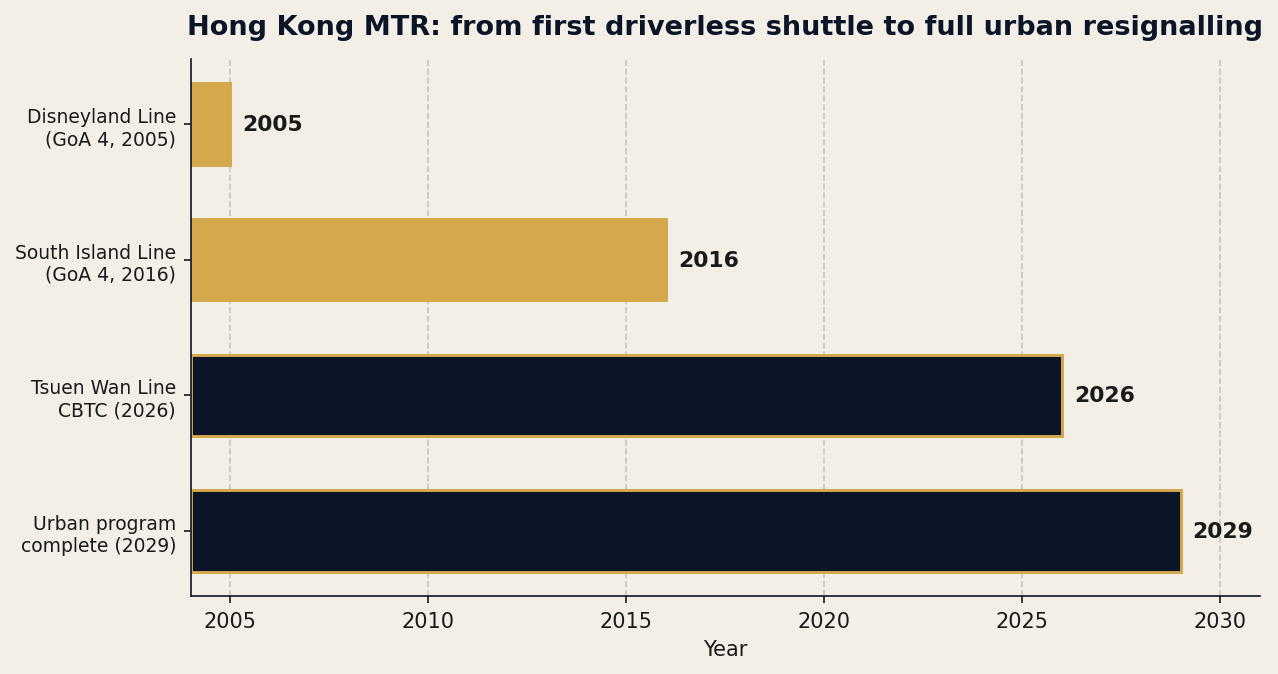 Hong Kong took 21 years to move from its first driverless shuttle (Disneyland Line, 2005) to a full urban CBTC resignalling program, with the driver-operated core lines converting one at a time to a 2029 completion.
 Hong Kong: driver-operated urban lines being resignalled, plus two GoA 4 lines.
The lesson is not that Hong Kong is slow or that Dubai is fast; it is that the two are solving different problems, and only one of them resembles the American one. When a US agency cites a foreign schedule or unit cost in a business case, the first question should be whether that number came from a greenfield build or a live-service retrofit. Hong Kong’s eleven-year, HK$3.3 billion program — the figure local media attached to the wider signalling replacement — is the retrofit benchmark, and it comes with a documented commissioning failure any US program plan should assume it could repeat.
What this means in practice
- CBTC is not the same purchase as driverless. Hong Kong is retrofitting moving-block CBTC on its urban lines at GoA 2, keeping a driver in the cab. A US agency can capture CBTC capacity and reliability without committing to a full GoA 4 safety case, and should price the two decisions separately.
- The redundancy path is where CBTC bites. The 2019 collision came from a standby zone controller that failed to load crossover data on switchover, not from the primary system under normal load. Commissioning test plans must exercise failover and degraded modes as hard as they exercise the happy path.
- The buyer owns the safety case. The EMSD faulted the contractor’s software but also faulted the operator for over-relying on that contractor. US agencies procuring CBTC should staff enough in-house signalling competence to challenge, not just accept, supplier verification evidence.
- Multi-vendor networks carry a real maintenance cost. Hong Kong runs Thales SelTrac and Alstom Urbalis on different lines by choice. That preserves competition but multiplies spares, training, and interface burdens — a trade every US agency with more than one CBTC line will face.
- Plan the engineering window, not just the technology. The hardest constraint in Hong Kong was time on the track, not the maturity of the product. A US retrofit schedule lives or dies on how much can be installed and tested in a nightly window measured in hours.
Where to go next
This post is an 11-minute case study. The full treatment of international CBTC benchmarks and their relevance to US deployment decisions lives in Chapter 11 (“International Benchmarks with US Relevance”) of Communications-Based Train Control, Volume 2: Operations, Deployment & Economics (Buy on Amazon). Download Chapter 11 slides (free PDF) for the comparative benchmark tables.
Sources
- Wang, C. (2026). Communications-Based Train Control, Volume 2: Operations, Deployment & Economics. Independent. ISBN 979-8-258-54528-2. — [Chapter 11, “International Benchmarks with US Relevance”]
- Alstom. (2015). Alstom and Thales to supply advanced CBTC signalling system to Hong Kong’s seven metro lines. alstom.com
- Thales Group. (2015). Thales and Alstom to supply advanced CBTC signalling system to Hong Kong’s seven metro lines. thalesgroup.com
- Electrical and Mechanical Services Department (EMSD), HKSAR. (2019). Investigation Report on Incident of the New Signalling System Testing on MTR Tsuen Wan Line. emsd.gov.hk
- South China Morning Post. (2019). MTR Corp faces record HK$25 million fine after crash that left line between two of Hong Kong’s busiest stations closed for two days. scmp.com
- Hong Kong Free Press. (2019). Two MTR trains collide near Central during system test, drivers hospitalised. hongkongfp.com
- International Railway Journal. (2026). CBTC deployed on Hong Kong’s Tsuen Wan metro line. railjournal.com
- Metro Magazine. (2016). Alstom systems equip Hong Kong’s newly opened first driverless metro (South Island Line). metro-magazine.com
- International Railway Journal. (2024). MTR to upgrade Disneyland Resort Line. railjournal.com
- MTR Corporation. (2026). New Signalling System for MTR Tsuen Wan Line (PR015/26). mtr.com.hk
- IEEE Standards Association. IEEE Std 1474.1: Standard for Communications-Based Train Control (CBTC) Performance and Functional Requirements.
How this article was produced. Drafted with AI assistance, then reviewed and fact-checked by Chunjun (Francisco) Wang against Communications-Based Train Control (the author's two-volume reference) and primary sources — agency records, vendor documentation, and IEEE/IEC standards. Every date, vendor, and figure is traceable to a cited source. Spot a mistake? Corrections are welcome via the contact page.
Read the full treatment in the book
Chapter 8 of Communications-Based Train Control, Volume 1, covers this in depth.