procurement · Article
Negotiating Performance Guarantees in a CBTC Contract

When the Bay Area Rapid Transit (BART) Train Control Modernization Program (TCMP) executed its Design-Build contract with Hitachi Rail STS in January 2020 at approximately $798 million, the negotiated contract reportedly carried liquidated damages of $150,000 per calendar day for missing the final Revenue Service Ready (RSR) date, capped at $50 million. The original RSR target was 2021. Actual revenue service has slipped multiple years, and change orders have accompanied scope and schedule extensions. The contract worked the way contracts work: it priced delay, allocated risk, and gave the agency a formal mechanism to claim against retention and liquidated damages when targets were missed. Negotiating performance guarantees in a Communications-Based Train Control (CBTC) contract is the discipline of converting performance specifications — the IEEE 1474.1-style language about Movement Authority response time, Mean Time Between Failures, and headway capability — into enforceable contractual remedies that work for both sides.
Why performance guarantees decide the post-cutover years
The 24 to 36 months immediately after Revenue Service Ready determine whether the agency operates the system the RFP described or operates a slower, less reliable, less available cousin. Modern US CBTC contracts rest on three connected mechanisms during that window: a 2 to 3 year performance guarantee period; 3 to 5 percent retention held against availability and headway demonstration; and liquidated damages tied to specific schedule milestones. The structure is well-established, but the parameters are negotiated in every procurement, and the negotiation outcome materially affects who absorbs which risks for the next decade. This post is the procurement-desk walkthrough for the deputy general manager for capital programs, the contract attorney, and the Owner’s Engineer who must turn a CBTC scope of work into a contract that actually performs. Depth lives in Chapter 12 (Project Lifecycle) and Chapter 13 (Performance Criteria) of Communications-Based Train Control, Volume 2.
What “performance” actually means in a CBTC contract
A CBTC contract has at least four distinct performance dimensions, and each requires its own guarantee structure. Headway capability is the contractual minimum trains-per-hour-per-direction (TPHPD) the system shall sustain at peak operation under defined conditions — the parameter the entire business case rests on. System availability is the percentage of operating hours during which the CBTC system is delivering its intended function, typically specified at 99.5 to 99.9 percent across the relevant subsystem boundaries. Punctuality and dwell-time performance govern the Automatic Train Operation (ATO) function — station-stopping accuracy, dwell-time enforcement, and schedule adherence. Reliability metrics include Mean Time Between Failures (MTBF) and Mean Time To Restore (MTTR) at the Vehicle On-Board Controller (VOBC), Zone Controller, and Data Communication System (DCS) levels.
A guarantee that addresses only one dimension — say, headway — but not the others is not a complete performance guarantee. A vendor that meets headway capability in a controlled demonstration but cannot sustain 99.5 percent availability in routine operation has not delivered the contracted system. Manuscript Chapter 13 covers the metric definitions; the contract negotiation is about which definitions the agency adopts and which thresholds become binding.
Headway demonstration: the make-or-break test
The headway demonstration is the contractual proof that the system delivers the capacity uplift that justified the project. Manuscript Chapter 14 notes that the MTA L Line achieved sustained 24 to 29 trains per hour (tph) post-CBTC against a pre-CBTC baseline of approximately 20 tph, and that the RATP Line 1 in Paris sustains 42 tph at a 1-minute-55-second headway. US contracts typically specify a headway demonstration over a 30 to 90 day window during which the system must sustain the contracted TPHPD under defined operational conditions: peak-hour service, full revenue load, defined weather and adhesion ranges.
Three negotiation parameters matter most. First, the duration: a 30-day demonstration window is too short to surface seasonal availability issues; 60 to 90 days is standard. Second, the operational conditions: the demonstration must be conducted under realistic peak-hour operations, not an artificially favorable schedule. Third, the cure mechanism: if the system fails the demonstration, what is the cure period before the agency may claim against retention? Standard practice is 30 to 90 days for the vendor to identify and remediate, with a second demonstration window following. A contract that does not specify the duration, conditions, and cure mechanics is a contract that will be negotiated under crisis conditions instead of in advance.
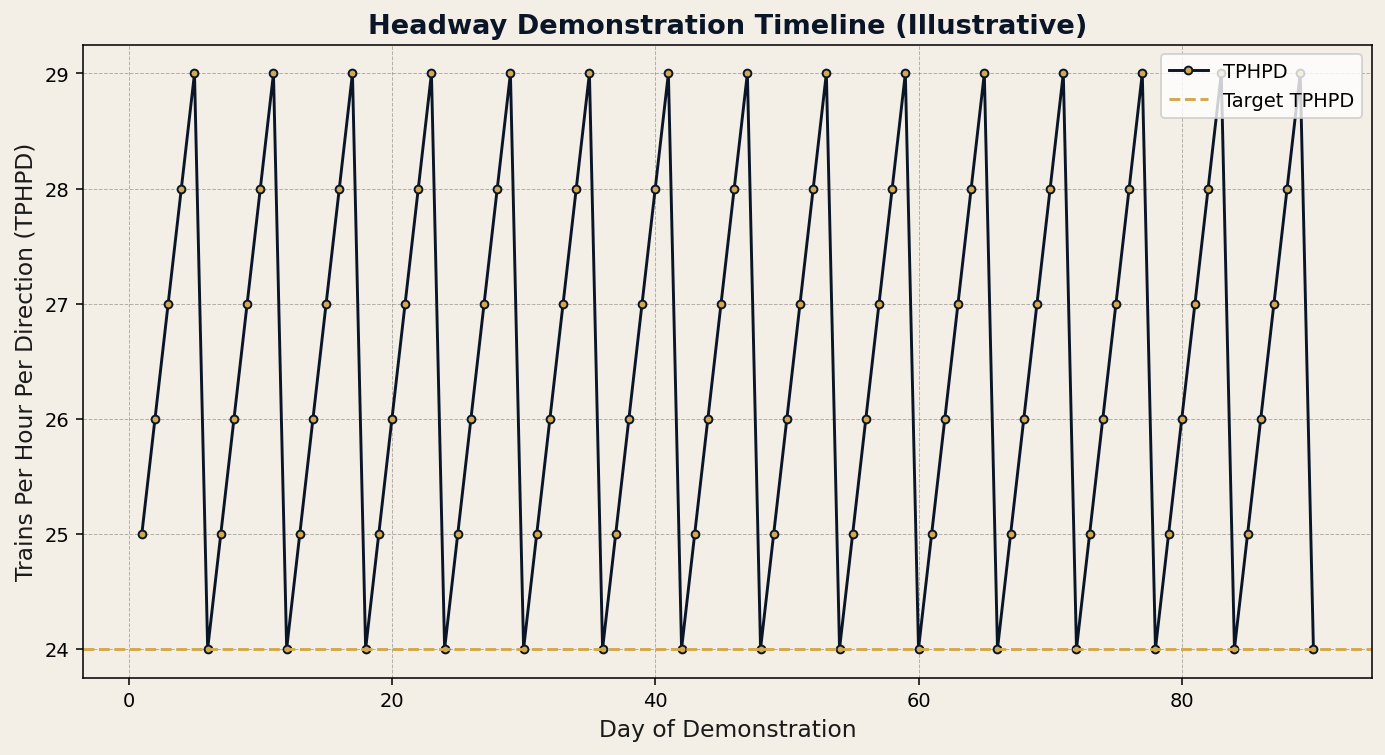 The headway demonstration is the contractual proof that the agency got the capacity uplift it paid for. Duration, condit.
Availability targets: the parameter most often misnegotiated
Manuscript Chapter 13 references availability targets typically in the range of 99.5 to 99.9 percent. The negotiation is rarely about the target percentage; it is about the calculation method and the carve-outs. Five questions decide whether an availability target is meaningful.
First, what is the boundary? Is availability measured at the system level (CBTC end-to-end), at the subsystem level (VOBC, Zone Controller, DCS, ATS independently), or at the per-train level? A 99.5 percent system-level target permits substantially more downtime than a 99.5 percent target applied at every subsystem.
Second, what counts as downtime? A “service-affecting” definition counts only outages that delay revenue trains. A “function-loss” definition counts any time a CBTC function is unavailable, even if no service was affected. The difference can be 10x in measured downtime over a year.
Third, what carve-outs are allowed? Standard carve-outs include planned maintenance windows, force majeure events, and Owner-caused outages (track closures for non-CBTC work, power failures upstream of the agency-Vendor demarcation). An overly broad carve-out list permits the vendor to attribute extended outages to the agency and exclude them from availability measurement.
Fourth, what is the measurement window? A monthly window is more demanding than an annual window. A 99.5 percent target measured annually permits 43.8 hours of downtime; the same target measured per month permits only 3.65 hours, with monthly accountability.
Fifth, what is the consequence? If the vendor misses the availability target, what happens? Retention claim, liquidated damages, or just an obligation to investigate and report? The contract is only as strong as the consequence it specifies.
Liquidated damages: schedule, not performance
Liquidated damages (LDs) typically address schedule milestones, not ongoing performance. Manuscript Chapter 12 documents standard LD structures of $50,000 to $500,000 per calendar day for missing key milestones, capped at 5 to 10 percent of total contract value. The BART TCMP $150,000 per day, capped at $50 million, is consistent with this range for an $800 million contract.
The negotiation parameters for LDs are the daily rate, the cap, the trigger milestones, and the exclusions. The trigger milestones to specify: Factory Acceptance Test completion, Site Integration Test completion, Dynamic Test completion, Shadow Running start, Revenue Service Demonstration start, Revenue Service Ready (RSR), and Final Acceptance. Each can carry its own LD rate. A common structure layers a smaller LD on intermediate milestones and a larger LD on RSR — the milestone that actually drives ridership and revenue.
The cap is the hardest parameter to set. Too low and the LDs are not sufficient incentive on a multi-year delay; too high and the vendor’s risk-adjusted bid price absorbs the headroom into the base contract value. Industry experience puts caps in the 5 to 10 percent of contract value range, which on a $500 million project produces $25 million to $50 million of accumulated exposure. That magnitude focuses attention without driving bid prices into bid-rejection territory.
Retention against post-RSR performance
Retention — money the agency holds until contracted performance is demonstrated — is the post-RSR mechanism that ensures the vendor stays engaged through the performance guarantee period. Standard practice is 3 to 5 percent of contract value held in retention, released on a defined schedule after RSR: typically a third released at RSR, a third at 12 months post-RSR with availability and headway demonstration, and the final third at 24 to 36 months with full performance acceptance.
The retention dollar amount on a $500 million project at 5 percent is $25 million — large enough to incentivize sustained engagement, but not so large that the vendor walks away if the project is otherwise complete. The release schedule matters as much as the dollar amount: a single release tied to a single milestone gives the vendor little incentive to address issues that surface in months 13 to 24, while a staged release ties continued performance to continued payment.
The retention claim mechanics are the third parameter. The contract should specify the conditions under which the agency may claim against retention (specific availability or headway shortfalls, not general dissatisfaction), the cure-period mechanics, and the dispute resolution process. Without specified mechanics, retention claims become commercial disputes that are resolved by who has more leverage, not by what the contract said.
Cure periods: the most important parameter no one negotiates
Cure periods are the windows during which the vendor may remedy a missed performance target before the agency may claim against retention or liquidated damages. They are the most important and most under-negotiated parameter in a CBTC contract.
Three patterns appear in US contracts. The first, vendor-favorable: 90-day cure with extension rights at vendor’s discretion, claim available only after the third missed measurement window. This essentially forecloses claims for the first 12 to 18 months post-RSR. The second, balanced: 30 to 60 day cure for first occurrences, 14 to 30 day cure for repeated occurrences within the same 12-month window, escalating consequences for systemic patterns. The third, agency-favorable: 14-day cure on every occurrence, immediate claim available on the second occurrence within 30 days. This pattern is rare and tends to drive bid prices upward as vendors price the risk.
The negotiation outcome on cure periods reveals the agency’s leverage and the vendor’s risk appetite. Both parties know which pattern they face. Codifying the pattern in the contract means the cure mechanic is enforceable; leaving it ambiguous means it is renegotiated under crisis conditions when the system is actually missing targets.
Tying performance guarantees to RAMS deliverables
Performance guarantees connect to a contractually delivered Reliability, Availability, Maintainability, and Safety (RAMS) program. (For the depth on what the agency should specify, see CBTC RAMS Requirements: What to Specify, What to Leave to the Supplier.) A contract that specifies a 99.5 percent availability target without specifying RAMS deliverables — Reliability Block Diagram, Failure Mode and Effects Analysis (FMEA), MTBF and MTTR predictions, sparing strategy — has specified an outcome without specifying the engineering work that would credibly support it.
Best practice is to require RAMS deliverables at preliminary design, critical design, and pre-RSR milestones, with RAMS values tied to the availability and headway guarantees. If the predicted MTBF for the VOBC is 50,000 hours at preliminary design, the field-measured MTBF over the performance guarantee period must be within a defined tolerance (typically 70 to 80 percent of predicted) or the vendor must demonstrate corrective action. RAMS deliverables that are not tied to performance guarantees are documents; RAMS deliverables that are tied to guarantees are engineering commitments.
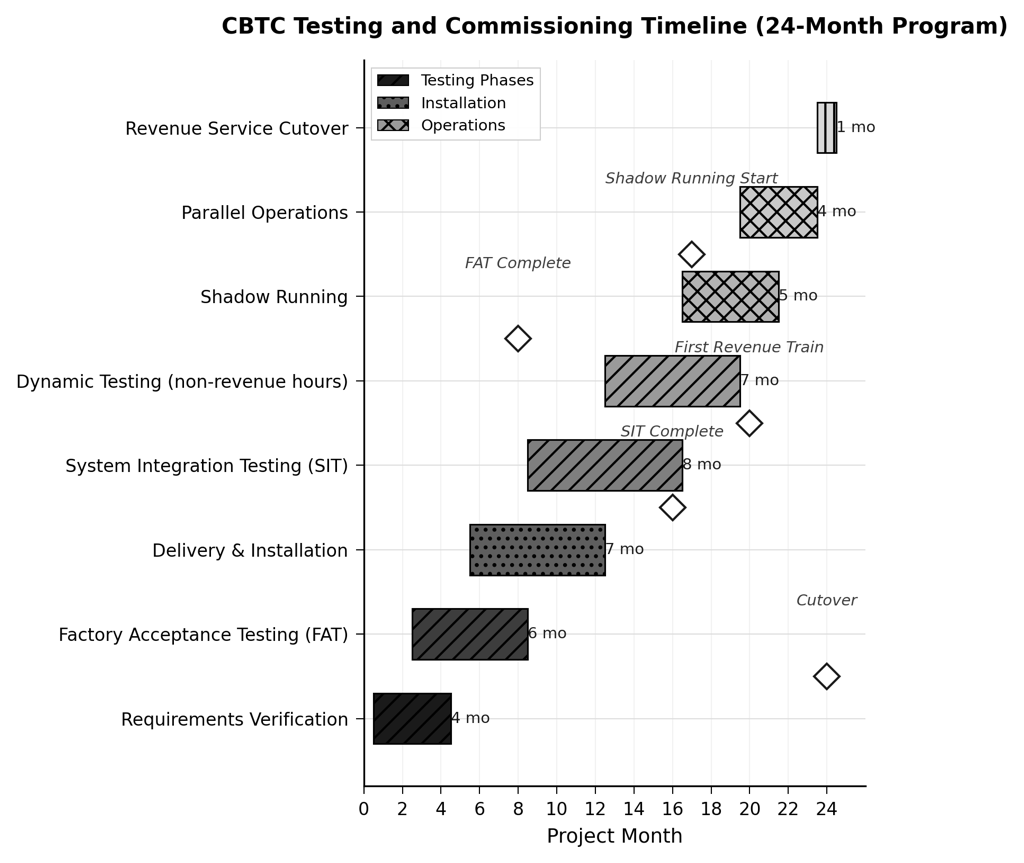 Performance guarantees are a four-pillar structure: headway demonstration, availability target, punctuality, and RAMS deliverables, each tied to retention and LD mechanics.
Practical takeaways
- Specify performance guarantees on at least four dimensions — headway, availability, punctuality, and reliability — not just headline TPHPD. A single-dimension guarantee leaves three dimensions unconstrained.
- Negotiate the availability calculation method as carefully as the percentage. The same 99.5 percent target produces 10x different downtime tolerances depending on boundary, definition, carve-outs, and measurement window.
- Specify cure periods, claim mechanics, and dispute resolution explicitly in the contract. The cure mechanism is the parameter that matters most when performance is actually missed.
- Tie liquidated damages to specific schedule milestones (FAT, SIT, Dynamic Test, RSR, Final Acceptance), not just to a single date. Layered LDs maintain pressure across the project lifecycle.
- Require RAMS deliverables at design milestones with MTBF, MTTR, and FMEA values tied to the performance guarantees. RAMS without guarantee linkage is engineering theater.
- Stage retention release across 24 to 36 months post-RSR. A single-milestone release does not maintain vendor engagement through the performance guarantee period.
Where to go next
This post is a 10-minute negotiation primer. The full performance criteria framework lives in Chapter 13 (Performance Criteria) of Communications-Based Train Control, Volume 1: Foundations & Technical Architecture, and the procurement structure that supports it lives in Chapter 12 (Project Lifecycle) of Volume 2 (Buy on Amazon). Download Chapter 12 slides (free PDF) for the procurement and contract framework.
For the companion piece on the change-order mechanics that performance guarantees should bound, see Change Orders on CBTC Projects: Why They Happen, How to Bound Them. For the bid-evaluation framework that surfaces guarantee structures during procurement, see Evaluating CBTC Bids: The 12 Criteria That Matter.
Sources
- Wang, C. (2026). Communications-Based Train Control, Volume 2: Operations, Deployment & Economics. Independent. ISBN 979-8-258-54295-3. — Chapter 12, “Project Lifecycle,” sections 12.2 and 12.5.
- Wang, C. (2026). Communications-Based Train Control, Volume 1: Foundations & Technical Architecture. Independent. ISBN 979-8-258-54295-3. — Chapter 13, “Performance Criteria.”
- IEEE Standards Association. IEEE Std 1474.1: Communications-Based Train Control (CBTC) Performance and Functional Requirements.
- CENELEC. EN 50126-1: Railway applications — The Specification and Demonstration of Reliability, Availability, Maintainability and Safety (RAMS).
- Federal Transit Administration. Capital Investment Grants Program. transit.dot.gov/CIG
- Bay Area Rapid Transit. Train Control Modernization Program. bart.gov/about/projects/cbtc
- MTA New York City Transit. Communications-Based Train Control Status Update. new.mta.info/project/communications-based-train-control-cbtc
How this article was produced. Drafted with AI assistance, then reviewed and fact-checked by Chunjun (Francisco) Wang against Communications-Based Train Control (the author's two-volume reference) and primary sources — agency records, vendor documentation, and IEEE/IEC standards. Every date, vendor, and figure is traceable to a cited source. Spot a mistake? Corrections are welcome via the contact page.
Read the full treatment in the book
Chapter 12 of Communications-Based Train Control, Volume 2, covers this in depth.