procurement · Article
RFP Red Flags: 8 Vendor Responses That Should Worry You

When the Bay Area Rapid Transit (BART) Train Control Modernization Program issued its draft Request for Proposals (RFP) in 2014 and held an open industry-comment period running into 2015, the procurement team learned more from how vendors responded than from what vendors promised. Some vendors filed dozens of substantive technical clarifications. Others filed schedule extensions, exception lists, and language objections. The award eventually went to Hitachi Rail STS in 2020 at approximately $798 million — but the patterns that surfaced during the comment period reappeared, almost verbatim, in the proposals from the bidders who lost. Eight specific kinds of response language consistently signal trouble in a Communications-Based Train Control (CBTC) bid. None of the eight are dispositive on their own. Two or more in the same proposal almost always predict a difficult contract.
Why the eight patterns matter
A CBTC procurement is a 30-year operating commitment, not a single transaction. The RFP response is the vendor’s first sustained piece of writing about the agency’s actual specification, under real competitive pressure, with their commercial and engineering teams aligned. Patterns that show up in the proposal — exception language, schedule unrealism, exclusions, assumptions, scope-of-work substitutions — are the patterns that resurface in the contract, in change orders, in safety-case correspondence, and in shadow-running data analysis four years later. This article is for the deputy general manager for capital programs, the procurement attorney, the Owner’s Engineer, and the Program Management Consultant (PMC) reading proposals across a six-week evaluation window. It catalogues eight red flags worth flagging in writing, with the underlying rationale for each. The depth on procurement structure lives in Chapter 12 of Communications-Based Train Control, Volume 2.
Red flag 1: “Exceptions taken” language without redlined alternatives
A bidder allowed to take exception to specifications must still tell the agency what they propose instead. Proposals that assert “Bidder takes exception to Section 3.4.7” with no proposed alternative language are doing two things at once: preserving the right to argue the requirement away after award, and signaling that the bidder did not have time, capability, or willingness to engineer around the specification. The corrective is procedural — the RFP should require every exception to include a redlined alternative clause and a stated cost or schedule impact — but the diagnostic is what matters during evaluation. Count the exceptions. Read whether each one substitutes specific alternative language or merely flags an objection. A proposal with 30 unsubstantiated exceptions is a future change-order pipeline.
Red flag 2: Schedule durations 25 percent below industry experience
A modern US heavy-rail brownfield CBTC project takes 5 to 8 years from contract execution to revenue cutover. Manuscript Chapter 12 documents BART TCMP saving 18 to 24 months by choosing Design-Build over Design-Bid-Build, and shows that L Line conversion required years of phased commissioning. A bidder proposing 3 to 4 years for a 25-mile brownfield retrofit is either underestimating site integration testing on weekend-only track access, underestimating vendor lab-to-site validation, or planning to execute change orders later when the schedule fails.
The diagnostic during evaluation: does the proposed master schedule allocate 6 to 12 months for shadow running, 12 to 20 weekend windows for site integration testing on a tight access pattern, 4 to 8 weeks for parallel operations, and a defensible commissioning ramp? If those phases together total less than 18 months on a brownfield system with weekend-only track access, the schedule has been compressed for proposal optics, not built for delivery.
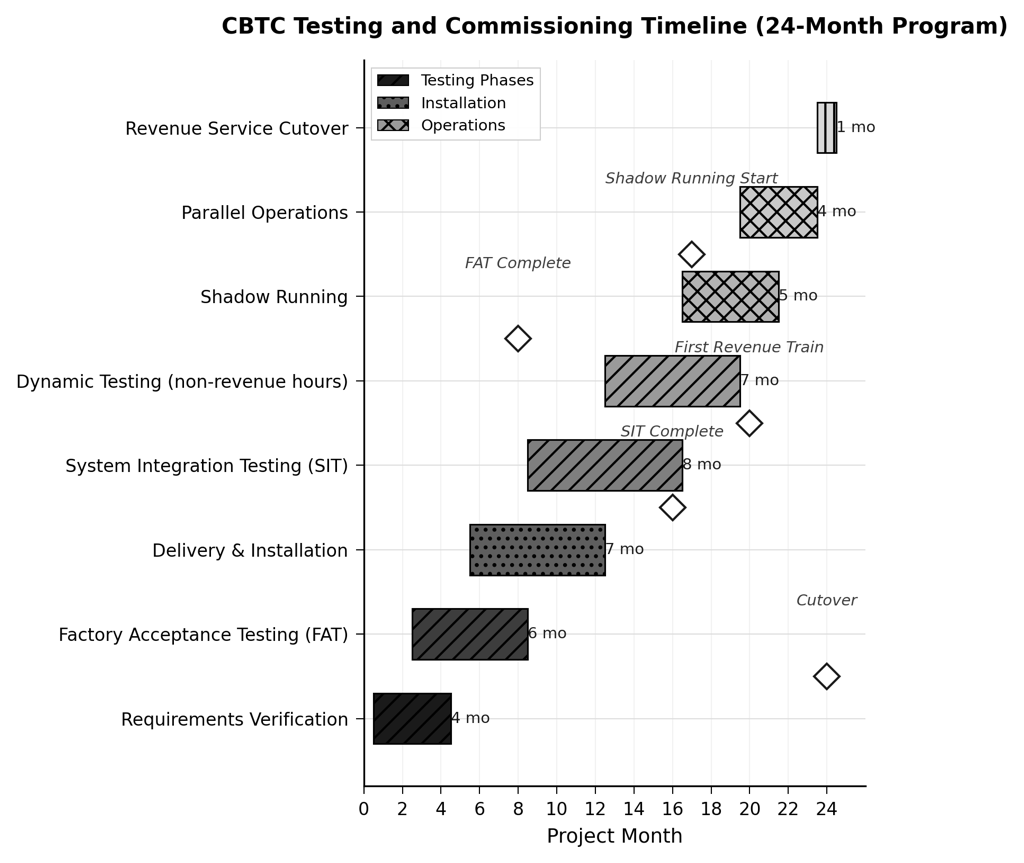 If a proposal’s master schedule is 25 percent shorter than the manuscript and US precedent suggest, the schedule is the red flag.
Red flag 3: Soft language on Buy America compliance
Build America, Buy America (BABA) requires at least 70 percent domestic content for manufactured products and 90 percent for steel and iron on federally funded transit capital. Manuscript Chapter 14 documents a 5 to 15 percent BABA premium over international market prices. A vendor that responds to the RFP’s BABA section with “Bidder will work in good faith to achieve compliance” or “Bidder anticipates compliance subject to FTA waiver process” is flagging that compliance is uncertain. FTA waivers for full CBTC systems are rare; FTA grants subcomponent waivers, not system-level exemptions.
What good BABA language looks like: a line-item domestic content percentage for every major subsystem, named US assembly sites, named domestic suppliers for each critical component, a compliance plan with delivery milestones, and an audit-rights clause. Soft language is the diagnostic. Agencies that accept a soft BABA response and discover compliance gaps in the second year of the contract face two bad options: pay for compliance retrofit or risk a federal grant clawback.
Red flag 4: Reference projects in different operational regimes
Proposals are evaluated heavily on past performance, with 20 to 25 percent of the typical evaluation weight on similar prior projects. A reference list dominated by airport people movers when the project is a heavy-rail brownfield retrofit, or by Asian metros without Davis-Bacon prevailing wage exposure when the project is in a major US union city, is a reference list that does not validate execution capacity for the work at hand.
The diagnostic during evaluation: do the reference projects share at least three of (a) brownfield retrofit (versus greenfield), (b) US transit jurisdiction (versus airport people-mover or non-US metro), (c) similar route-mile range, (d) similar fleet size and rolling stock heterogeneity, (e) similar Davis-Bacon and BABA cost structure? A reference list that hits four or five of these resembles the project. A reference list that hits one or two — a non-US driverless metro, a US airport people-mover — is irrelevant past-performance evidence dressed up as relevant.
Red flag 5: No named Independent Safety Assessor
Manuscript Chapter 12 documents Independent Safety Assessor (ISA) cost at typically 0.5 to 1.5 percent of contract value, with 60 percent of effort during design (months 6 to 18), 30 percent during pre-commissioning testing (months 24 to 30), and 10 percent during operations preparation. An ISA hired late, after design is locked, is nearly worthless. A proposal that does not name a candidate ISA, or that proposes “Owner to select ISA at later milestone,” is implicitly asking the agency to absorb the safety-case scheduling risk.
Better proposals name two to three candidate ISAs with short-form qualifications, propose a contractual mechanism for ISA approval, and commit to the ISA participating in design reviews from preliminary design through dynamic testing. The named-ISA test is also a sophistication test: bidders that know the US CBTC market name TÜV Rheinland, Ricardo Rail, Lloyd’s Register, Atkins, or comparable firms with US transit signaling experience. Bidders that gesture vaguely at “an independent safety assessor satisfactory to the Owner” do not have the relationships to deliver the ISA on the schedule the project needs.
Red flag 6: Interface Control Document language that retains vendor IP
The Interface Control Document (ICD) is the contract between two subsystems. Manuscript Chapter 12 and the companion procurement piece on How to Write a CBTC RFP That Doesn’t Lock You Into One Vendor cover why ICDs matter for vendor neutrality. The diagnostic in a proposal: read the bidder’s response to the ICD ownership clause. Three patterns are common.
The first pattern, acceptable: “Contractor shall develop, deliver, and maintain Interface Control Documents per Appendix X. ICDs shall become Owner property upon acceptance, subject to Contractor’s retained rights in proprietary algorithms not necessary to interface implementation.” This preserves Owner ownership of the interface specification while protecting the vendor’s underlying engineering investment.
The second pattern, marginal: “Contractor shall provide Interface Control Documents during the design phase. ICDs are confidential to Contractor and Owner and may not be disclosed to third parties without Contractor’s written consent.” This makes the ICD nondisclosure-bound, which preserves vendor lock-in by preventing third-party suppliers from referencing the document.
The third pattern, disqualifying: “Contractor shall provide system architecture documentation sufficient for Owner’s operational needs. Detailed interface specifications are Contractor’s proprietary information and not subject to disclosure.” This refuses to deliver ICDs altogether and locks the agency into the vendor for every adjacent subsystem on the line for the next 30 years.
Red flag 7: Contingency below 8 percent on a brownfield project
A modern US brownfield CBTC project carries integration risk on multiple fronts: legacy interlocking interface, mixed-fleet rolling stock, weekend-only track access, Davis-Bacon labor scheduling, BABA compliance, and FTA Project Management Oversight Contractor (PMOC) review gates. Manuscript Chapter 12 references how multiple US projects have absorbed 15 to 30 percent change-order growth against original contract value. A proposed total cost that includes less than 8 to 10 percent contingency is either an under-priced bid that will rebuild the contingency through change orders or a bid built around a shorter, simpler project than the agency actually has.
The diagnostic during evaluation: locate the contingency line in the cost narrative. Read its narrative justification. Compare against the integration risks the agency has specifically identified in the RFP. A proposal claiming 5 percent contingency on a brownfield retrofit with fleet retrofit complexity and weekend-only access is a proposal that has not allocated for the project’s actual risk profile. (For the systematic look at the cost drivers behind change-order growth, see CBTC Procurement: Cost Drivers Beyond the Sticker Price.)
Red flag 8: Performance guarantees only at 30 days, not 24 months
US CBTC contracts standardly include performance guarantees lasting 24 to 36 months post-Revenue Service Ready (RSR), with 3 to 5 percent of contract value held in retention pending availability and headway demonstration. A proposal offering performance guarantees only over a 30-day demonstration period, or one that conditions guarantees on Owner-provided maintainability infrastructure that is not actually contracted, is offering optical performance assurance rather than substantive performance assurance.
The diagnostic during evaluation: read the guarantee period, the retention percentage, the cure-period mechanics, and the liquidated damages cap. A standard structure looks like: 24 months availability and headway demonstration post-RSR; 3 to 5 percent retention; cure periods of 30 to 90 days for missed targets; $50,000 to $500,000 per day liquidated damages capped at 5 to 10 percent of contract value. A proposal that materially shortens any one of those parameters is shifting risk back to the agency.
 Two red flags in the same proposal predict a difficult contract. Three is grounds for an evaluation downgrade.
Practical takeaways
- Build the eight-flag checklist into the technical evaluation rubric before the proposal review window opens. Score each flag explicitly so that the evaluation panel has documented findings, not just impressions.
- Require bidders to substitute redlined alternatives for any specification exceptions. A specification exception without a redline is a deferred change order.
- Audit reference projects against the agency’s actual operational regime — brownfield versus greenfield, US versus non-US, transit versus airport. A long reference list is not a substitute for a relevant reference list.
- Treat the schedule, contingency, and performance-guarantee structures as evidence about how the bidder thinks about risk. Bidders who have priced and scheduled CBTC retrofits before do not propose 4-year schedules with 5 percent contingency.
- Read the ICD ownership clause carefully. The single sentence about who owns the Interface Control Documents at acceptance is the difference between a future second-vendor procurement and a 30-year sole-source relationship.
Where to go next
This post is a 9-minute checklist. The procurement framework that supports it lives in Chapter 12 (Project Lifecycle) and Chapter 15 (Vendor Landscape) of Communications-Based Train Control, Volume 2: Operations, Deployment & Economics (Buy on Amazon). Download Chapter 12 slides (free PDF) for the procurement structure and design-review framework.
For the 12-criterion evaluation rubric the eight flags slot into, see Evaluating CBTC Bids: The 12 Criteria That Matter. For the budget-overrun mechanics that the flags predict, see Why CBTC Projects Run 30%+ Over Budget — and How to Prevent It.
Sources
- Wang, C. (2026). Communications-Based Train Control, Volume 2: Operations, Deployment & Economics. Independent. ISBN 979-8-258-54295-3. — Chapter 12, “Project Lifecycle,” sections 12.2 and 12.4–12.5; Chapter 15, “Vendor Landscape.”
- IEEE Standards Association. IEEE Std 1474.1: Communications-Based Train Control (CBTC) Performance and Functional Requirements.
- Federal Transit Administration. Build America, Buy America Act Implementation Guidance. transit.dot.gov/BuyAmerica
- Federal Transit Administration. Project Management Oversight Program. transit.dot.gov/funding/grant-programs/capital-investments/project-management-oversight
- Bay Area Rapid Transit. Train Control Modernization Program. bart.gov/about/projects/cbtc
- MTA New York City Transit. Communications-Based Train Control Status Update. new.mta.info/project/communications-based-train-control-cbtc
- San Francisco Municipal Transportation Agency. Train Control Upgrade Project. sfmta.com/projects/train-control-upgrade-project
How this article was produced. Drafted with AI assistance, then reviewed and fact-checked by Chunjun (Francisco) Wang against Communications-Based Train Control (the author's two-volume reference) and primary sources — agency records, vendor documentation, and IEEE/IEC standards. Every date, vendor, and figure is traceable to a cited source. Spot a mistake? Corrections are welcome via the contact page.
Read the full treatment in the book
Chapter 12 of Communications-Based Train Control, Volume 2, covers this in depth.