international-benchmarks · Article
Riyadh Metro Driverless: The Gulf's Mega Greenfield Answer to US Brownfield CBTC
On 30 January 2025, Guinness World Records certified the Riyadh Metro driverless network — six lines, 176 kilometers, 85 stations, opened in phases across barely five weeks — as the longest fully automated metro on earth, taking a record Dubai had held. Two years earlier and a short flight down the Gulf, Doha had opened its own three-line driverless metro in time to move crowds for a World Cup. For a United States transit engineer accustomed to decade-long brownfield resignaling, these two systems are the cleanest available picture of what Communications-Based Train Control (CBTC) delivers when it is built greenfield, at national scale, on a compressed schedule.
Why two Gulf metros belong in a US engineer’s benchmark set
The United States usually benchmarks its train-control ambitions against London, Paris, and its own agencies, and those comparisons are covered elsewhere on this site. Riyadh and Doha belong in the set for a sharper reason: together they are the opposite of the American condition. Every US CBTC project of consequence is a brownfield retrofit — new equipment threaded into a signaling estate and an operating culture built over decades. Riyadh and Doha are mega greenfield: no legacy interlocking, no aging fleet to convert, no operating rules to preserve, and a decision structure that settled on unattended operation once, at the top. Studying them does not hand a US program manager a template to copy. It isolates the variables, and it makes the domestic obstacles easier to name.
Riyadh Metro: driverless at national scale, opened in five weeks
The Riyadh Metro is, by route length, the largest driverless system ever opened in a single program. The Royal Commission for Riyadh City brought the network into service in phases: Lines 1, 4, and 6 on 1 December 2024, Lines 2 and 5 on 15 December 2024, and Line 3 on 5 January 2025. Within roughly five weeks the city went from no metro to six fully automated lines. By late February 2025 the system had carried more than 18 million riders, against a planned steady-state demand near 1.2 million passengers per day.
Every line runs at Grade of Automation 4 (GoA 4) — unattended train operation, no driver and no attendant in the leading car — with full-height platform screen doors enforcing the platform-edge separation that GoA 4 requires. Trains operate at speeds up to 90 kilometers per hour on a service headway of roughly three to seven minutes, and the network spans 85 stations across 176 route-kilometers. The all-in program cost is commonly put at roughly $22.5 billion, with some official estimates closer to $25 billion. Those figures buy a point worth holding onto: the Riyadh Metro is not a pilot or a showcase line. It is a citywide GoA 4 system delivered as new construction, and it reached unattended operation on day one, which is exactly the milestone US brownfield programs spend years working toward.
Three consortiums, three CBTC platforms: who built which line
Riyadh is unusual not only for its scale but for how it was split. Rather than award one turnkey train-control contract, the city procured its six lines through three separate design-build consortiums, and the result is a single-city network running three different CBTC products behind a common fare and passenger interface. Getting the attribution right matters, because the vendor names have also shifted with industry consolidation since the 2013 awards.
Lines 1 (Blue) and 2 (Red) were delivered by the BACS consortium, which included Bechtel, Almabani, Consolidated Contractors Company, Siemens, and AECOM, under a package worth roughly $9.4 billion. Siemens supplied both the rolling stock — Inspiro trains — and the signaling, its Trainguard MT CBTC coupled with the Airlink radio and Digiloc train-location subsystems. Line 3 (Orange) came from the ANM consortium in a contract of about $5.2 billion, where Ansaldo STS provided the CBTC and Bombardier Transportation supplied 47 Innovia Metro 300 trainsets. Both of those names have since changed hands: Ansaldo STS is now part of Hitachi Rail, and Bombardier Transportation was absorbed by Alstom in 2021, so the Line 3 signaling and vehicles that were competitively distinct at award now sit inside two of the same corporate parents that hold the other four lines. Lines 4 (Yellow), 5 (Green), and 6 (Purple) were built by the FAST consortium — FCC, Samsung C&T, Alstom, Strukton, and others — with Alstom furnishing its Urbalis CBTC and 69 Metropolis trainsets.
For a US reader weighing a multi-line resignaling, Riyadh is a live demonstration that a city can run several incompatible CBTC platforms side by side, provided each line is a self-contained island and no train ever needs to cross a vendor boundary under automatic control. That is a genuine architectural choice with genuine costs: three sets of spares, three maintenance skill bases, three safety cases, and no interoperability between lines at the train-control layer. It is the mirror image of the interoperability problem that dominates US brownfield thinking, where the expensive boundary is between new and old equipment on the same line rather than between two clean new systems. The upside of the split is competitive tension and schedule parallelism — three consortiums building at once, rather than one supplier pacing the whole program — which is part of how the city compressed six lines into a single opening window.
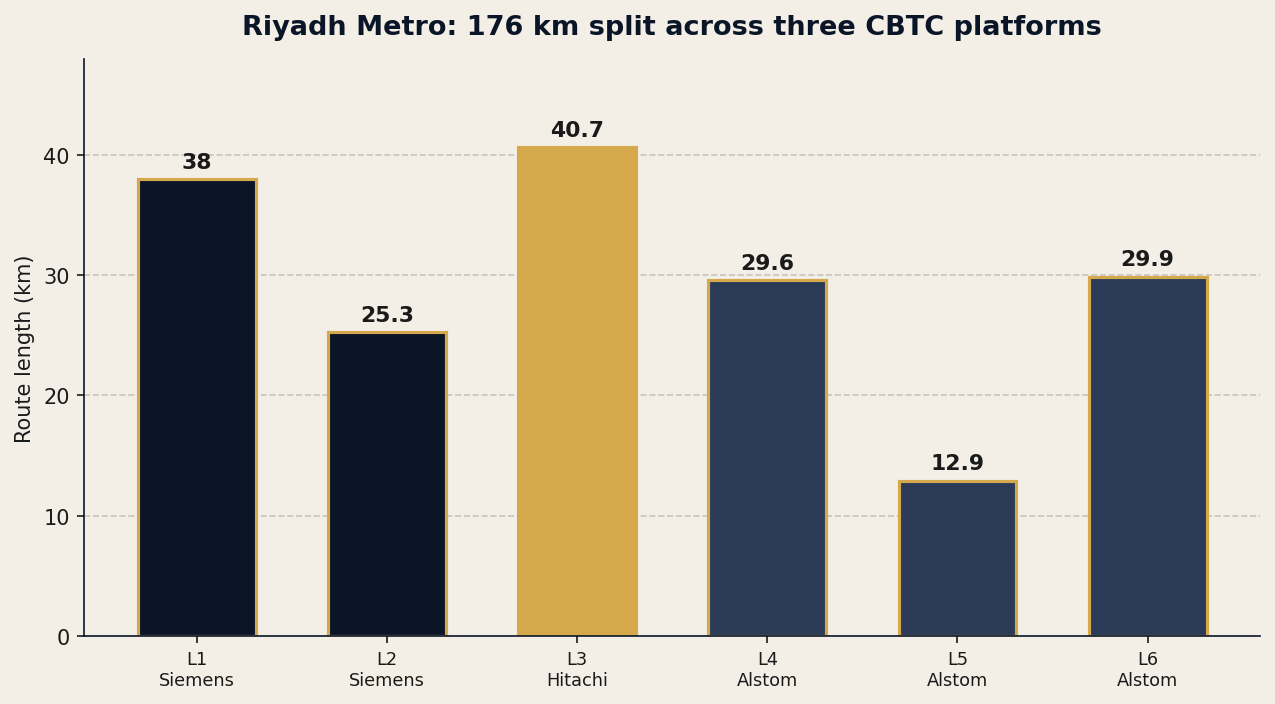 Riyadh’s 176 route-kilometers split across three CBTC platforms — Siemens (Lines 1-2), Ansaldo STS/Hitachi Rail (Line 3), and Alstom (Lines 4-6) — each line a self-contained automated island.
 The Gulf’s driverless metros split across four CBTC platforms and two cities.
Doha Metro CBTC: one Thales platform, opened for a World Cup
Doha took the opposite approach to Riyadh’s fragmentation. Qatar Rail built its three lines — Red, Gold, and Green — on a single supplier’s train control, the Thales SelTrac CBTC platform, the same product family that runs Vancouver, Dubai, and dozens of other automated networks. The Red Line entered preview service on 8 May 2019, the Gold Line followed on 21 November 2019, and the Green Line on 10 December 2019, giving Qatar a complete 76-kilometer, 37-station driverless network roughly three years before it hosted the 2022 World Cup.
Doha Metro CBTC runs at GoA 4 with full-height platform screen doors, and its trains are notable for speed: the fleet of 75 three-car Kinki Sharyo Al Faras trainsets, delivered with Mitsubishi Corporation, operate at up to roughly 100 kilometers per hour, which places Doha among the fastest driverless metros in service and reflects the longer interstation spacing of a network laid out on fresh alignment rather than a legacy urban grid. The homogeneity of the system is its defining engineering trait. One CBTC platform across all three lines means one safety argument, one spare-parts pool, and one maintenance discipline — the payoff Dubai captured on its own Thales network and that is examined in Dubai Metro: How CBTC Runs the World’s Longest Driverless Network, the article Riyadh displaced from the record books.
The other Doha detail a US engineer should register is the operating model. The network is owned by Qatar Rail but operated under a 20-year contract by RKH Qitarat, a joint venture of the local Hamad Group with Keolis and RATP Dev. Unattended train operation removed the driver; it did not remove the operator, the control-center staff, or the maintenance organization. GoA 4 is a statement about the train, not about the payroll.
Why the Gulf reached GoA 4 before the United States
The reason Riyadh and Doha opened fully driverless years before New York or San Francisco will place a single revenue train under unattended operation is not superior engineering. It is that their problem was structurally easier, and three conditions did most of the work.
First, there was no brownfield tax. Neither city had legacy signaling to overlay, a mixed fleet to retrofit, or accumulated operating rules to preserve — the constraints that turn US resignaling into the multiyear ordeal described in Why Madrid Has More CBTC Lines Than the Entire US. Second, the civil works, systems, and vehicles were procured together as turnkey packages under integrated consortiums, so the interface risk that US agencies carry across separate civil, systems, and rolling-stock contracts was internalized by the supplier. Third, the decision to build driverless was made once, centrally, and did not have to survive the public-comment periods, labor negotiations, and federal-funding cycles that shape every American capital program.
Strip those three frictions away and GoA 4 CBTC turns out to be a mature, buyable, on-schedule technology — which is precisely the point. The Gulf metros do not prove that unattended operation is unproven or exotic. They prove the opposite: the technology has not been the bottleneck for years. What the United States wrestles with is integration, contracting structure, and institutional cadence, and none of those is a signaling problem. Where a system genuinely sits on the automation ladder, as opposed to where its marketing claims, is the distinction drawn in Driverless Operations Worldwide: Who’s GoA 4, Who’s Faking It. Riyadh and Doha sit unambiguously in the genuine column.
What does not transfer to US brownfield
The trap is to read Riyadh’s five-week rollout or Doha’s tidy World Cup timeline and conclude that US agencies are simply slow. The comparison is false on its own terms. A US agency cannot buy the conditions that made those schedules possible. It cannot conjure a greenfield alignment through a built-out city, cannot suspend the funding and procurement rules that structure federal capital dollars, and cannot cut over a line carrying passengers today without a staged migration, temporary mixed-mode running, and a safety case that spans the boundary between new and legacy equipment for the duration.
What does transfer is narrower and more useful. Riyadh confirms that multiple CBTC platforms can coexist in one city when the lines are self-contained, which is relevant to any US system considering different vendors on different lines. Doha confirms that single-vendor homogeneity buys a simpler safety case and a leaner maintenance footprint, which is relevant to any agency standardizing a fleet-wide platform. And both confirm that platform screen doors, obstacle and derailment detection, and a control center staffed to talk to every train are not optional extras but the load-bearing substitutes for the driver’s eyes — capital and operating costs a US GoA 4 business case must carry from the first spreadsheet, not bolt on later.
What this means in practice
- The technology is not the constraint. Riyadh and Doha demonstrate mature, on-schedule GoA 4 CBTC at national scale. A US business case that treats unattended operation as unproven is arguing against fifteen combined years of Gulf revenue service.
- Greenfield schedules do not port to brownfield. Citing Riyadh’s five-week rollout or Doha’s timeline in a US capital plan invites a false comparison; the American cost is integration and cutover, which the Gulf systems never had to pay.
- Multi-vendor is viable when lines are islands. Riyadh runs Siemens, Ansaldo STS/Hitachi Rail, and Alstom CBTC in one city — proof that platform diversity works, at the price of no train-control interoperability between lines.
- Homogeneity has a real payoff. Doha’s single Thales SelTrac platform buys one safety case and one maintenance base; that simplicity is the argument for fleet-wide standardization on a US property.
- Platform screen doors are part of the price. Any US GoA 4 aspiration inherits the full-height platform-door and detection cost the Gulf built in from the start. It is a line item, not an afterthought.
Where to go next
This post is a 12-minute benchmark study. The full treatment of international CBTC case studies and their relevance to US deployment decisions lives in Chapter 11 (“International Benchmarks with US Relevance”) of Communications-Based Train Control, Volume 2: Operations, Deployment & Economics (Buy on Amazon). Download Chapter 11 slides (free PDF) for the comparative benchmark tables covering Riyadh, Doha, Dubai, and their US counterparts.
Sources
- Wang, C. (2026). Communications-Based Train Control, Volume 2: Operations, Deployment & Economics. Independent. ISBN 979-8-258-54528-2. — [Chapter 11, “International Benchmarks with US Relevance”]
- Royal Commission for Riyadh City. Riyadh Metro Earns Guinness World Record for the Longest Driverless Train Network. rcrc.gov.sa
- Guinness World Records. Longest driverless metro network. guinnessworldrecords.com
- Railway Gazette International. King inaugurates Riyadh Metro ahead of public opening. railwaygazette.com
- Railway Technology. Riyadh Metro, Saudi Arabia. railway-technology.com
- Siemens Mobility. Riyadh Metro (Trainguard MT CBTC, Lines 1 and 2). mobility.siemens.com
- Railway Gazette International. Doha Metro opened for preview service. railwaygazette.com
- Railway Technology. Doha Metro, Qatar. railway-technology.com
- Thales Group. Train control / CBTC (SelTrac). thalesgroup.com
- IEEE Standards Association. IEEE Std 1474.1: Standard for Communications-Based Train Control (CBTC) Performance and Functional Requirements.
How this article was produced. Drafted with AI assistance, then reviewed and fact-checked by Chunjun (Francisco) Wang against Communications-Based Train Control (the author's two-volume reference) and primary sources — agency records, vendor documentation, and IEEE/IEC standards. Every date, vendor, and figure is traceable to a cited source. Spot a mistake? Corrections are welcome via the contact page.
Read the full treatment in the book
Chapter 8 of Communications-Based Train Control, Volume 1, covers this in depth.