international-benchmarks · Article
Seoul Metro CBTC: How Korea Built a Driverless Layer Over a Legacy Subway
On 24 July 2009, four months after Dubai opened the driverless Red Line that this site has already examined, Seoul placed a very different kind of automated metro into service, and the honest story of Seoul Metro CBTC begins with it. Line 9 ran fast, express trains overtaking local trains on passing loops beneath the Han River, under a private concession rather than a public agency, with a French operator holding the majority stake and a Korean rolling-stock builder holding the rest. It quickly became the most crowded line in a city that already knew crowding, and within six years its peak load factor reached 240 percent. What Line 9 was not, and still is not, was driverless. Korea did not automate its subway by converting its flagship lines to unattended operation; it built a driverless layer of new lines around a legacy network that still, in large part, runs with a driver in the cab. For a US transit engineer, that pattern is the entire lesson.
Why Seoul belongs in the US benchmark set
American agencies usually benchmark train control against London, Paris, and their own slow domestic programs, and those comparisons are covered elsewhere on this site. Seoul earns a place in the set for a subtler reason than Dubai does. Dubai is the clean greenfield case; Seoul is the messy, realistic one. The Seoul Capital Area operates one of the busiest and most extensive urban rail networks on earth, assembled over four decades by multiple owners, multiple operators, and multiple signalling suppliers, and it has pursued driverless operation not by ripping out its legacy core but by adding fully automated lines at the edges and, only recently, by beginning to retrofit Communications-Based Train Control (CBTC) into the older network. That layered pattern — a driver-operated legacy spine, a driverless periphery, and a slow central retrofit — is far closer to the situation a New York, Chicago, or Washington engineer actually faces than any single-procurement Gulf metro will ever be.
The line that made automation famous ran with a driver
Line 9 is the natural entry point because it is the line most Americans hear about first, and because its signalling is widely misremembered. The line now runs 40.6 kilometers with 38 stations across three construction phases, the first opened in 2009, the second in March 2015, and the third in December 2018. Its opening section was procured and run as a public-private partnership: the operating company, Seoul Line9 Operation, was formed by RATP Dev Transdev Asia, holding roughly 80 percent, and Hyundai Rotem, holding the remainder, under a concession from the Seoul Metro Line 9 franchise. That concession structure, rare in the United States for heavy urban rail, is one of the two reasons a US program manager should study the line at all.
The other reason is the signalling itself. Line 9 does not run on radio moving-block CBTC. Alstom equipped the line with its Urbalis 200 automatic train control system, a track-circuit-based product that provides train protection, interlocking, and automatic train operation, but not the continuous train-to-wayside radio and virtual moving block that define CBTC in the IEEE 1474 sense described in our grades-of-automation primer. Trains run at Grade of Automation 2 (GoA 2): automatic acceleration and braking, supervised by a driver in the cab. The line’s famous express service — express trains overtaking locals roughly five times an hour in each direction — and its punishing crowding are operating achievements, not automation ones. Line 9 is a reminder that “advanced Korean metro” and “driverless CBTC” are not synonyms, and that a benchmark visit which conflates the two will draw the wrong conclusions.
The driverless network Korea actually built
Korea’s genuine unattended operation lives on newer, mostly Thales-signalled lines, and it arrived early. The Shinbundang Line, since rebranded the DX Line, opened in October 2011 as what its operator describes as Korea’s first driverless heavy-rail metro and, reportedly, the fifth subway in the world to run completely without an onboard driver. It now runs 33.4 kilometers with 16 stations under operator NeoTrans, on a Thales CBTC system at GoA 4 — full unattended train operation — with Hyundai Rotem trainsets and a maximum speed above 90 kilometers per hour, the fastest average speed of any subway line in the country. Where Line 9 optimizes throughput with drivers, the Shinbundang Line demonstrated that a Korean private operator could run genuine unattended service at intercity speeds a decade before most US agencies placed a single CBTC train in revenue service.
Incheon completed the picture on the mainline scale. Incheon Subway Line 2 opened on 30 July 2016 as a fully driverless line, 29.2 kilometers and 27 stations, on a Thales SelTrac CBTC system, with 37 two-car Hyundai Rotem trainsets built in 2013 running on a 750-volt third rail. The line reportedly holds peak headways in the range of four to five minutes, and every station was built to accommodate longer four-car trains as demand grows — a designed-in capacity margin that greenfield GoA 4 lines can afford and brownfield retrofits almost never can. Line 2 belongs squarely in the genuine-GoA-4 column discussed in Driverless Operations Worldwide: Who’s GoA 4, Who’s Faking It, and it did what Dubai did, at a KRW 2 trillion construction cost, without the Gulf’s blank-sheet advantage: it threaded a driverless metro through an existing Korean city.
Light metro at the edges, and the crowding paradox
The clearest lesson from Seoul is one its engineers learned the hard way: driverless does not mean high capacity. The two automated light-metro lines that fan out from the region’s airports prove the point. The Busan-Gimhae Light Rail Transit opened in September 2011, running 23.5 kilometers on continuous viaduct through Gimhae International Airport with 21 stations, signalled by Thales and worked by driverless two-car Hyundai Rotem sets — one of Korea’s earliest driverless light rail lines. The Gimpo Goldline followed on 28 September 2019, a driverless light metro of 23.67 kilometers and 10 stations feeding Gimpo airport and the dense new towns of its namesake city, run by 23 two-car Hyundai Rotem trainsets at up to 80 kilometers per hour, with onboard attendants rather than drivers.
Both lines were sized for airport-access demand and both were overwhelmed by commuter demand. The Gimpo Goldline in particular became a national crowding scandal: its two-car driverless trains have run at more than 200 percent of rated capacity, and in August 2024 the operator raised frequency from 24 to 26 trains an hour, close to the practical ceiling of the CBTC headway, without solving the problem. The constraint is not the signalling, which can pack trains tightly, but the train — two narrow cars cannot be lengthened on demand the way Incheon Line 2’s four-car-ready platforms can. For a US agency tempted to read “driverless” as “capacity solution,” Gimpo is the cautionary case: automation buys frequency and labor economics, not train length, and a line specified too small at the platform stays too small forever. This is the same platform-length discipline examined in the greenfield-design lessons of Singapore’s North East Line, applied here as a warning rather than a model.
Seoul Metro CBTC retrofits and the domestic signalling turn
The most instructive chapter for the United States is the one now unfolding on the legacy network, because it is the chapter that rhymes with New York and San Francisco. Seoul Metro’s older lines were built on the same track-circuit automatic train control family as Line 9, and the agency has begun converting them to Seoul Metro CBTC to wring more capacity out of fixed infrastructure. The Ui-Sinseol Line is the announced pilot, with full CBTC operation targeted around 2032 alongside a planned extension; the agency projects peak congestion on that line falling from roughly 165 percent toward 143 percent once shorter headways take effect, and it has signaled intent to extend CBTC conversion to the heavily loaded Line 2 and Line 9. Those are brownfield resignaling projects in every sense a US engineer would recognize, with the same interface, cutover, and re-certification burdens that dominate domestic schedules.
What makes the Korean version distinct is industrial policy. Rather than depend indefinitely on European suppliers, Korea funded a domestic CBTC platform: Hyundai Rotem’s KTCS-M, developed from a 2014 government program, uses the LTE-R 4G railway radio standard and Wi-Fi-band communication, carries SIL 4 safety certification, and is designed to support automation up to full unattended operation. It has been trialed on a 6.6-kilometer section of the Ilsan corridor on Line 3, including a train operated in driverless mode, as a proving ground before wider rollout. The strategic parallel for the United States is direct: a domestically developed, standards-based train control product reduces the single-vendor lock-in that raises US resignaling costs, an argument developed at length in the manuscript and echoed in why Madrid has more CBTC lines than the entire United States. Under Buy America and the Build America, Buy America (BABA) requirements now attached to Federal Transit Administration (FTA) funding, a home-grown CBTC supply base is not merely an economic preference; it is close to a procurement precondition, and Korea has quietly built one.
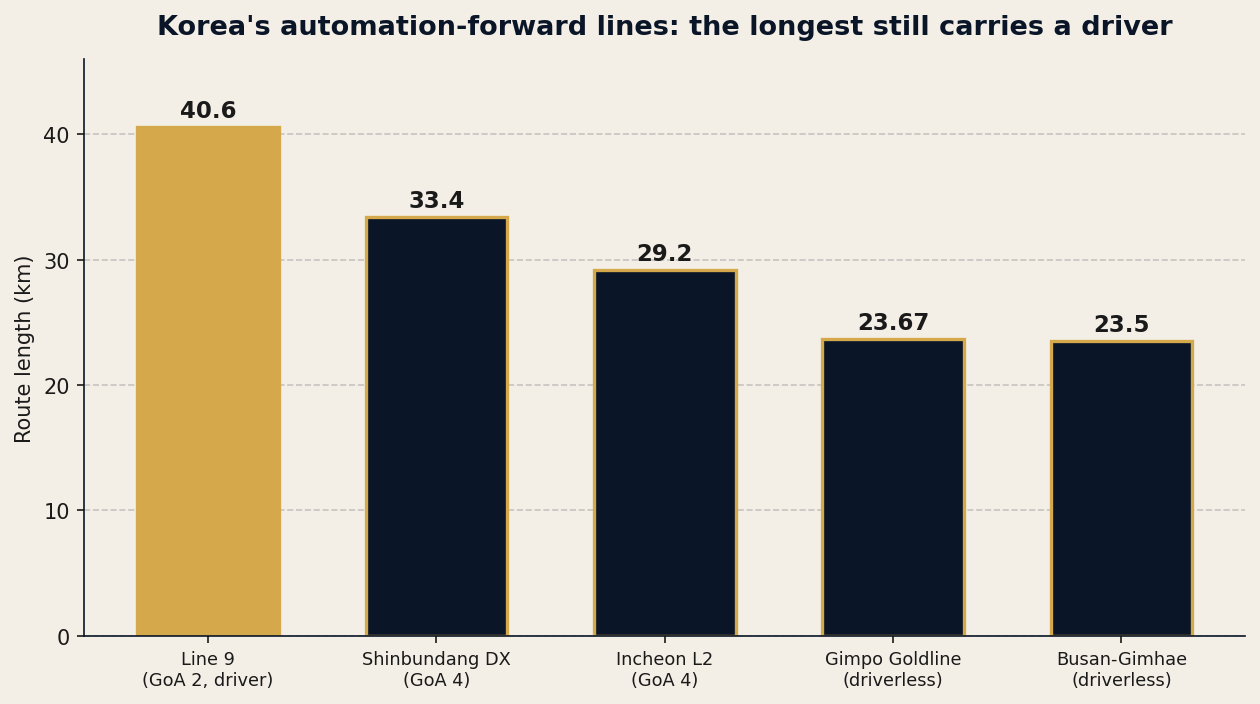 Korea’s longest automation-forward line, Line 9, is also the only one on this list that still carries a driver; the driverless network is built from shorter, newer lines.
 Seoul pairs a driver-operated Line 9 with several driverless GoA 4 lines from different suppliers.
What US agencies can and cannot learn from Seoul
Seoul’s value to an American program is that it separates several variables the Dubai case bundles together. Korea shows that driverless GoA 4 CBTC is mature and buyable — Shinbundang has run it since 2011, Incheon Line 2 since 2016 — while simultaneously showing that a large legacy network does not have to be converted wholesale to benefit, and that conversion, when it comes, carries the same brownfield tax the United States pays. It also shows two levers US agencies rarely pull: a genuine private concession model on Line 9, and a deliberate domestic-vendor industrial policy behind KTCS-M. The parts that transfer are the design disciplines — build platforms longer than today’s demand, treat platform screen doors and detection as inseparable from GoA 4, and keep the signalling architecture open enough to avoid lock-in. The parts that do not transfer are the ones rooted in Korea’s faster decision structure and its willingness to fund a national train control program, neither of which a US agency controls.
What this means in practice
- Do not confuse a famous metro with a driverless one. Line 9 is Korea’s showcase express line, but it runs Alstom track-circuit ATC at GoA 2 with a driver; citing it as a CBTC or driverless benchmark misstates the technology and invites a flawed business case.
- Korea proves driverless CBTC at genuine urban scale. The Shinbundang and Incheon Line 2 lines demonstrate mature GoA 4 operation on real, city-threading routes; the technology risk US agencies fear was retired abroad years ago.
- Automation is not a capacity fix. The Gimpo Goldline runs driverless at more than 200 percent load because two-car trains cannot grow; specify platform and train length for the demand you will have, not the demand you have today.
- The legacy retrofit is the real analog. Seoul’s Ui-Sinseol CBTC pilot, and its planned Line 2 and Line 9 conversions, are brownfield resignaling with the same cutover and re-certification costs that shape every US program.
- Domestic supply is strategy, not sentiment. KTCS-M gives Korea a home-grown CBTC option that eases vendor lock-in; under BABA, a comparable US supply base is close to a funding precondition rather than a preference.
Where to go next
This post is an 11-minute case study. The full treatment of international CBTC benchmarks and their relevance to US deployment decisions lives in Chapter 11 (“International Benchmarks with US Relevance”) of Communications-Based Train Control, Volume 2: Operations, Deployment & Economics (Buy on Amazon). Download Chapter 11 slides (free PDF) for the comparative benchmark tables.
Sources
- Wang, C. (2026). Communications-Based Train Control, Volume 2: Operations, Deployment & Economics. Independent. ISBN 979-8-258-54528-2. — [Chapter 11, “International Benchmarks with US Relevance”]
- Alstom. (2009). New Seoul metro Line 9 signalling under Alstom’s control. alstom.com
- International Railway Journal. (2016). Incheon opens metro Line 2. railjournal.com
- International Railway Journal. (2019). Seoul Gimpo Gold Line automated light metro opens. railjournal.com
- Railway Gazette International. (2011). Busan-Gimhae Light Rail Transit opens. railwaygazette.com
- Seoul Economic Daily. (2026). Seoul Launches Subway Congestion Fix, Begins CBTC Rollout on Ui-Sinseol Line. en.sedaily.com
- Hyundai Rotem. Signalling: KTCS-M and integrated train control. hyundai-rotem.com
- International Railway Journal. (2022). Seoul’s Shinbundang Line reaches Suwon. railjournal.com
- IEEE Standards Association. IEEE Std 1474.1: Standard for Communications-Based Train Control (CBTC) Performance and Functional Requirements.
How this article was produced. Drafted with AI assistance, then reviewed and fact-checked by Chunjun (Francisco) Wang against Communications-Based Train Control (the author's two-volume reference) and primary sources — agency records, vendor documentation, and IEEE/IEC standards. Every date, vendor, and figure is traceable to a cited source. Spot a mistake? Corrections are welcome via the contact page.
Read the full treatment in the book
Chapter 8 of Communications-Based Train Control, Volume 1, covers this in depth.