comparative · Article
Single-Vendor vs Multi-Vendor CBTC: NYC's Lessons Learned
When the New York City Metropolitan Transportation Authority awarded its first Communications-Based Train Control (CBTC) contract to Siemens Transportation Systems in 1999 for the L Line, the question of vendor diversification did not arise. There was one project, one corridor, and one vendor. By the time the second NYCT CBTC procurement landed in the early 2000s, the question was unavoidable. The 7 Line ultimately went to Thales (now Hitachi Rail SelTrac); Queens Boulevard, awarded later, returned to Siemens. The MTA’s strategic posture across the three contracts is deliberately multi-vendor: trade operational complexity for reduced exposure to any single vendor’s pricing power, support trajectory, or product roadmap. Two decades and three line deployments later, the NYC multi-vendor CBTC experience is the most-cited US data point for any agency facing the same decision. This article unpacks what that experience actually teaches, separating the durable lessons from the New York-specific contingencies.
The single-vendor vs multi-vendor question, in plain terms
A single-vendor CBTC strategy commits an agency to one supplier across multiple lines, multiple contracts, and multiple decades of procurement. The advantages are immediate and tangible: a unified safety case across the network, common training and procedures, a single spare-parts inventory, simplified maintenance, and fewer interfaces between supervisory systems. The disadvantages compound over time: the vendor’s pricing power on follow-on contracts grows, the agency’s operational dependence on the vendor’s support quality becomes existential, and the agency’s ability to adopt newer technology depends on the vendor’s product roadmap.
A multi-vendor CBTC strategy distributes the agency’s exposure across two or more suppliers, typically with one vendor per line or one vendor per contract package. The advantages are strategic: competitive pressure on follow-on procurements, reduced lock-in exposure, and the optionality to migrate technology generations on different timelines per line. The disadvantages are operational: dual training, dual logistics, redundant testing, and the integration friction that comes from running two different supervisory systems and two different spare-parts inventories.
Industry references put the lock-in premium of single-vendor procurement at 10 to 25 percent of total lifecycle cost. The operational complexity premium of multi-vendor procurement is harder to quantify but is real; the MTA estimates from internal program reviews put it in the high single digits to low double digits as a percentage of the operational budget for the affected lines.
What NYC actually did
The MTA’s three CBTC procurements, taken in sequence, illustrate a deliberate strategy:
The L Line was the original contract: Siemens Transportation Systems was awarded the design and deployment of the Trainguard MT CBTC system in 1999 with a contract value of approximately $340 million. The line achieved partial revenue service in April 2006 and full CBTC revenue service in April 2009, with continued tuning into the late 2010s. The L Line proved the architecture worked on a heavily used legacy US metro line. (For the headline capacity outcome, see How CBTC Lets the L Line Run a Train Every 110 Seconds.)
The 7 Line (Flushing) was the second major CBTC procurement. The award went to Thales Ground Transportation Systems for the SelTrac platform; the line entered full revenue service under CBTC in 2018. The 7 Line was deliberately a different vendor than the L Line, and the deployment represents the MTA’s first concrete commitment to multi-vendor architecture. The Hitachi Rail acquisition of Thales GTS in April 2024 means the 7 Line’s vendor is now part of the same global company that supplies BART; the platform itself remains SelTrac.
The Queens Boulevard project returned to Siemens for the Siemens Trainguard MT platform, with partial revenue service achieved in 2024. This contract is the third major CBTC deployment in the MTA portfolio; selecting Siemens again, after going to Thales for the 7 Line, completes the deliberate diversification pattern (Siemens → Thales → Siemens) rather than reinforcing single-vendor consolidation.
The pattern is not random. The MTA’s procurement strategy treats each line as an independent contract with its own competitive evaluation, rather than as a draw on an exclusive vendor agreement. The result is that the system carries Siemens Trainguard MT on the L Line and Queens Boulevard, and Hitachi Rail SelTrac (legacy Thales) on the 7 Line; the spares, training, and engineering capabilities for both platforms must be maintained.
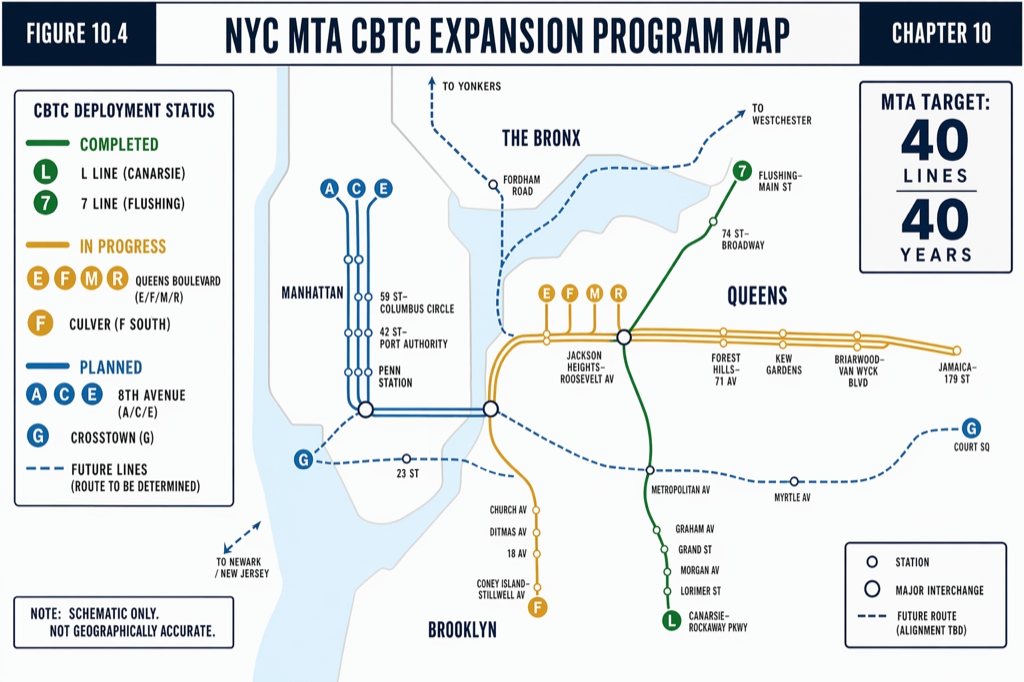 NYC’s three CBTC line procurements demonstrate a deliberate multi-vendor strategy across two decades.
What the multi-vendor strategy has actually delivered
The strategic outcomes of the NYC posture are visible in the procurement data over the last fifteen years. Three are worth naming explicitly.
First, competitive pressure on follow-on procurements. The Queens Boulevard contract was a competitive procurement; Siemens won it on the merits, but the existence of a credible second bidder (Thales/Hitachi, with the 7 Line as a reference) materially shaped the bid environment. Vendors who know the agency has demonstrated willingness to switch suppliers price more competitively than vendors who know the agency has no realistic alternative.
Second, technology insertion without single-vendor capture. As the CBTC industry has evolved (Wi-Fi handover improvements, integration with predictive maintenance, the emerging cellular-class radio question), the MTA has not been bound to a single vendor’s technology cadence. The 7 Line’s Thales SelTrac and the L Line’s Siemens Trainguard MT are at different points in their respective product lifecycles; the MTA can plan technology refresh on each line independently rather than synchronizing to a single vendor’s roadmap.
Third, support-quality bargaining power. When one vendor’s support performance falls short, the agency has the institutional memory of having worked with another vendor at scale. This creates real negotiating room in service-level discussions that single-vendor agencies do not have.
The three benefits are not theoretical; they are visible in the procurement track record and in the operational performance reports the MTA publishes. They are, however, only achievable for agencies with multiple lines undergoing CBTC deployment over a multi-decade horizon. An agency with a single line has no opportunity to play vendors against each other at the procurement level.
What the multi-vendor strategy has actually cost
The operational costs of the multi-vendor posture are equally real. Three are worth pricing explicitly.
First, dual training and operating procedures. The L Line and the 7 Line operate on different platforms with different driver-machine interfaces, different operating-mode taxonomies, and different procedures for degraded-mode operation. Train operators, controllers, and dispatchers who work both lines must be qualified on both systems. The MTA has institutional capacity to manage this, but it represents a permanent overhead that single-vendor agencies do not pay.
Second, dual logistics and spare-parts inventory. The Siemens Trainguard MT and Hitachi SelTrac platforms have different VOBC modules, different balises, different access points, and different cabinets. The MTA maintains two separate spare-parts inventories with associated warehousing, ordering, and obsolescence-management overhead. The cost is bounded but persistent.
Third, integration friction at the supervisory layer. The MTA’s Rail Control Center must integrate two different ATS systems, with translation layers between them and the agency’s enterprise infrastructure. The integration is feasible (the MTA’s experience demonstrates that), but it absorbs engineering effort that a single-vendor agency would not need to spend.
The cost-benefit math for the MTA, taken across two decades and three lines, has favored the multi-vendor strategy. The lock-in premium avoided over the lifetime of the assets is large enough to justify the operational overhead. For agencies with smaller scale or fewer lines undergoing CBTC, the math may not work out the same way. (For the broader vendor consolidation context, see Thales SelTrac vs Hitachi (Ansaldo) ATC: Procurement Implications.)
What changed with the 2024 Hitachi acquisition
The April 2024 Hitachi Rail acquisition of Thales Ground Transportation Systems materially changes the strategic landscape that the MTA’s decision was made within. The 7 Line’s vendor is now part of a global company that also operates the Ansaldo-heritage CBTC product on the BART TCMP. From a strategic-bargaining perspective, the MTA’s three-platform diversification has effectively become a two-and-a-half-platform diversification: Siemens for the L Line and Queens Boulevard, and Hitachi Rail (via the legacy Thales SelTrac product line) for the 7 Line.
The acquisition does not undo the strategic logic of the original procurement. The 7 Line’s spares still flow, the engineering team is largely the same, and the platform itself is unchanged. But the broader market context has shifted. An agency now contemplating a similar three-vendor strategy has fewer genuinely independent global vendors to choose from. The post-acquisition tier-1 CBTC vendor field includes Siemens, Alstom, and Hitachi Rail (with two product lines) for any procurement subject to Buy America requirements; CRSC remains effectively excluded from US procurement on Build America, Buy America (BABA) and supply-chain security grounds.
The implication for agencies considering the NYC pattern is that the multi-vendor strategy is now harder to execute. Two genuinely independent vendors plus one with two product lines is the practical limit for the next decade absent further consolidation, and the diversification benefit per additional vendor is correspondingly smaller.
What other US agencies should learn from NYC
The right lesson is contextual. The MTA’s strategy makes sense for an agency with a multi-decade CBTC program across multiple lines, with the engineering and operations capacity to absorb dual-platform overhead. Agencies whose context differs should not blindly copy the pattern.
For an agency with a single CBTC line (most US agencies), the multi-vendor question is moot at the procurement level. The strategic question is how to negotiate single-vendor procurement so that lock-in exposure is minimized over the asset lifecycle. The mechanisms that matter are the open-architecture levers covered in Open Architecture vs Proprietary CBTC: A Real-World Cost Analysis: Interface Control Documents, source-code escrow, royalty-free patent licensing, and open APIs for non-safety integrations.
For an agency with two or three CBTC lines under planning (BART after TCMP completes, WMATA contemplating Red, Green, and Blue line modernization, MBTA on the Green Line), the NYC strategy is directly relevant. The procurement specification and the timing of follow-on contracts should preserve the option to diversify, even if the initial line goes to a single vendor. The relevant procurement language is to make the second contract a competitive procurement rather than an extension of the first, and to specify that the second-line vendor’s safety case can be built without dependence on the first-line vendor’s proprietary interfaces.
For an agency anticipating GoA 4 (unattended train operation) on a future line, the multi-vendor question is more nuanced. The operational complexity of running multiple GoA 4 platforms is higher than the equivalent for GoA 2, and the safety case integration is harder. Agencies in this position should engage with both the New York multi-vendor experience and the more single-vendor patterns of Vancouver and Singapore before committing.
| Agency Context | Recommended Vendor Strategy | Key Considerations |
|---|---|---|
| Single Line | Single Vendor | Minimize lock-in exposure |
| Multi-Line | Multi-Vendor | Competitive pressure, technology insertion, support-quality bargaining |
| GoA 2 | — | — |
| GoA 4 | — | — |
| Large Scale Program | Multi-Vendor | Absorb dual-platform overhead |
| Small Scale Program | — | — |
What this means in practice
- The single-vendor vs multi-vendor decision is contextual, not universal. NYC’s deliberate multi-vendor strategy worked for the MTA because of scale; it does not generalize to single-line agencies.
- Multi-vendor strategy has real benefits (competitive pressure on follow-on procurements, reduced lock-in, technology-refresh flexibility) that compound over a multi-decade program.
- Multi-vendor strategy has real costs (dual training, dual logistics, supervisory-layer integration friction) that are bounded but persistent.
- The 2024 Hitachi acquisition of Thales Ground Transportation Systems materially narrows the multi-vendor option space for new procurements. Plan for two-and-a-half independent global vendors, not three.
- For agencies with a single CBTC line or modest program scale, the right strategy is single-vendor procurement with strong open-architecture levers (ICDs, escrow, patent licensing, open APIs).
- For agencies with multi-line, multi-decade programs, the NYC pattern is directly relevant and worth studying in depth.
Where to go next
This post is a strategic-procurement overview. The full treatment of CBTC vendor strategy, contract structure, and the NYC case study lives in Chapter 10 (“CBTC in the United States”), Chapter 12 (“Procurement and RFP Strategy”), and Chapter 15 (“Vendor Landscape and Technology Trends”) of Communications-Based Train Control (Volume 2 on Amazon). Download Chapter 12 slides (free PDF)
Sources
- Wang, C. (2026). Communications-Based Train Control, Volume 2: Deployment, Economics, and the Future. Independent. ISBN 979-8-258-54295-3. — Chapter 10, “CBTC in the United States”; Chapter 12, “Procurement and RFP Strategy”; Chapter 15, “Vendor Landscape and Technology Trends.”
- IEEE Standards Association. IEEE Std 1474.1: Standard for Communications-Based Train Control (CBTC) Performance and Functional Requirements.
- MTA New York City Transit. Communications-Based Train Control Status Update. new.mta.info/project/communications-based-train-control-cbtc
- Hitachi Rail. Acquisition of Thales Ground Transportation Systems. hitachirail.com/news
- Federal Transit Administration. Capital Investment Grants Program. transit.dot.gov/CIG
- Federal Transit Administration. Build America, Buy America Act Implementation Guidance. transit.dot.gov/buyamerica
How this article was produced. Drafted with AI assistance, then reviewed and fact-checked by Chunjun (Francisco) Wang against Communications-Based Train Control (the author's two-volume reference) and primary sources — agency records, vendor documentation, and IEEE/IEC standards. Every date, vendor, and figure is traceable to a cited source. Spot a mistake? Corrections are welcome via the contact page.
Read the full treatment in the book
Chapter 10 of Communications-Based Train Control, Volume 2, covers this in depth.