comparative · Article
Wi-Fi vs LTE-R for Train-to-Wayside: 2026 Update
The Data Communication System is the part of a Communications-Based Train Control (CBTC) deployment that any procurement specification eventually has to commit to and that any agency engineering team eventually has to defend. For roughly 25 years, the default answer has been IEEE 802.11 spread-spectrum radio, typically in the unlicensed 2.4 GHz and 5 GHz bands. Every major US CBTC deployment, from the L Line through Honolulu Skyline, runs on some flavor of Wi-Fi. The Wi-Fi vs LTE-R debate has been brewing for nearly a decade, accelerated by the European Future Railway Mobile Communication System (FRMCS) program and the maturation of private LTE and 5G networks. In 2026, the question is no longer “which radio technology is better” but “where on the migration curve does this specific procurement sit, and what should the specification commit to versus leave open for future technology insertion.” This article works through the comparative landscape and the practical procurement implications.
Where Wi-Fi-based CBTC is in 2026
Every revenue-service CBTC deployment in the United States runs on IEEE 802.11. The dominant configurations use 802.11n or 802.11ac (Wi-Fi 5) on 5 GHz as the primary control channel, with 2.4 GHz retained for backup or non-safety-critical traffic on some deployments. Access points are spaced at 200-to-400-meter intervals in tunnels and 300-to-500-meter intervals in elevated and at-grade sections, with overlapping coverage zones to support seamless handover.
The architecture has well-understood strengths. IEEE 802.11 is mature and well-documented; the equipment is commercial off-the-shelf, hardened for the rail environment, and competitively priced. Integration with the agency’s broader IT infrastructure (RADIUS authentication, SNMP monitoring, network management) is straightforward. Spectrum is unlicensed and globally available; an agency can deploy a new line without waiting for FCC coordination. Data rates are abundant compared to CBTC’s actual safety-critical bandwidth requirements (tens of kilobits per second per train); the link is rarely the bottleneck.
The architecture also has well-understood weaknesses. The 2.4 GHz band is heavily contested with passenger devices, neighboring networks, and consumer Wi-Fi; modern deployments use 5 GHz precisely because of this. Even at 5 GHz, the unlicensed bands are shared with non-rail users, and agencies cannot guarantee that future regulatory or commercial changes will not impair link performance. Handover latency in standard Wi-Fi (typically 200 to 600 milliseconds for consumer-grade roaming) exceeds the CBTC safety deadline of about 250 milliseconds; meeting the deadline requires fast-roaming techniques (IEEE 802.11r, key caching, predictive handover orchestration) that add engineering complexity. Coverage in deep tunnels and through structural steel demands dense access-point networks, with the corresponding capital and operational cost.
Despite these weaknesses, IEEE 802.11 remains the dominant US CBTC radio technology because the alternatives are not yet at deployment maturity for safety-critical applications. (For the broader DCS architecture, including inductive loops as a third option, see Radio-Based vs Inductive-Loop CBTC.)
What LTE-R and FRMCS bring to the table
LTE-R (Long-Term Evolution for Railways) and FRMCS (the 5G-based successor to GSM-R) are cellular-class radio technologies designed for safety-critical rail communication. LTE-R is anchored on 3GPP specifications adapted for rail, with deployments primarily in Korea, China, and selected European corridors. FRMCS is the European-led 5G program intended to replace GSM-R on mainline rail by the early 2030s, built on 3GPP Release 17 and later, incorporating 5G New Radio, network slicing, ultra-reliable low-latency communications (URLLC), and mission-critical push-to-talk.
The capabilities both technologies bring are substantial. Cellular-class radio operates on licensed or managed spectrum, with regulatory protection against interference. URLLC targets air-interface latency below one millisecond and reliability of 99.999 percent, a qualitative improvement over Wi-Fi handover behavior. Network slicing allows a single physical infrastructure to support multiple logical networks with isolated resource pools and Quality of Service guarantees; a CBTC deployment could run a mission-critical control slice, a non-safety operational slice, and a passenger connectivity slice on the same physical equipment without cross-talk. Massive MIMO and beam-forming improve spectral efficiency and propagation range; preliminary measurements suggest that 5G-NR coverage can extend several times the range of comparable Wi-Fi access points.
The capabilities cellular-class radio does not yet bring to US CBTC are equally important. There is no production-deployed 5G-R or FRMCS CBTC system in revenue service in the United States as of 2026; vendor product roadmaps target reference designs in the 2027-to-2029 window. The US lacks a dedicated frequency band equivalent to the European FRMCS allocation in the 1900 MHz range; transit agencies pursuing cellular-class CBTC must use Citizens Broadband Radio Service (CBRS) Priority Access Licenses, leased commercial spectrum, or partnerships with carrier networks. The safety case for cellular-class CBTC, including how to satisfy SIL 4 requirements with shared infrastructure, is still under development. (The FRMCS architecture and its US implications are explored further in CBTC vs ERTMS Hybrid Level 3.)
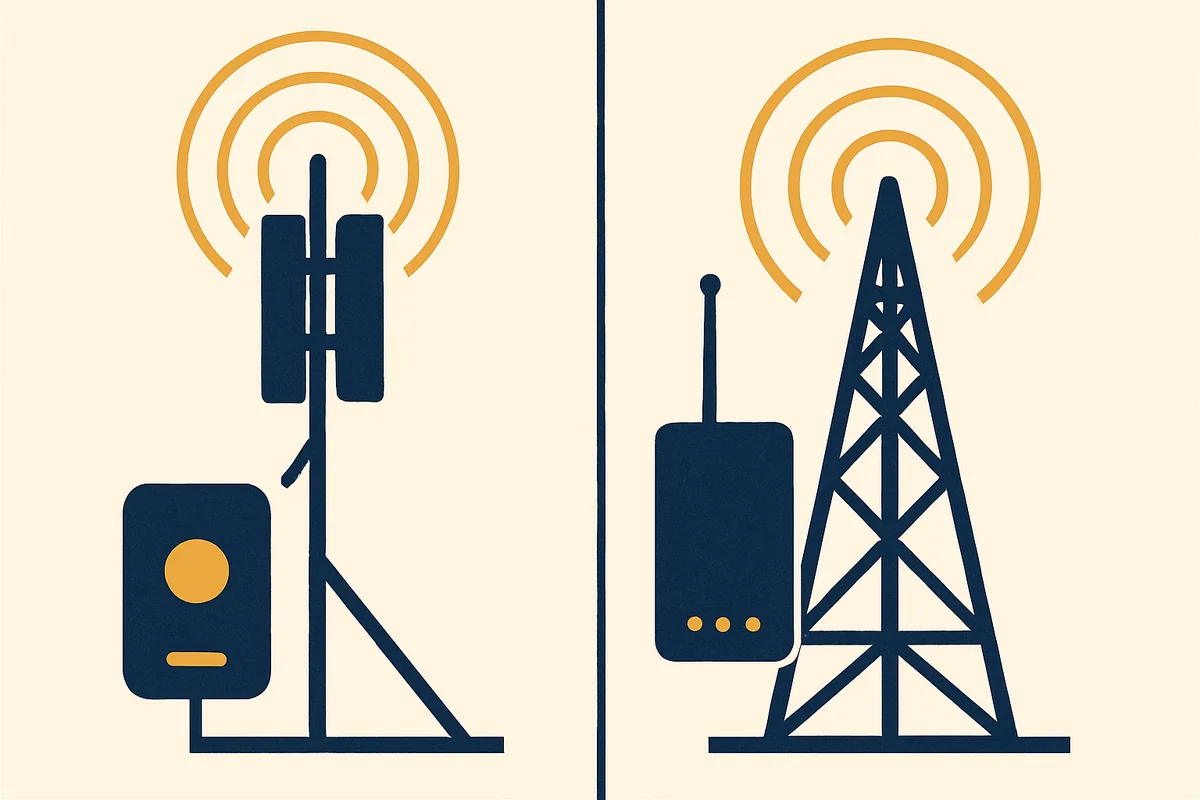
[FIGURE: Side-by-side comparison of Wi-Fi-based CBTC (IEEE 802.11ac on unlicensed 5 GHz, AP spacing 200 to 400 meters, fast roaming via 802.11r) and LTE-R/5G-R CBTC (licensed or managed spectrum, longer cell range, URLLC and network slicing, 100-to-150 millisecond handover targets) with annotations on US deployment status. Source: existing book figure fig_15_04_5g_migration.png. Caption: “Wi-Fi-based CBTC dominates US revenue service in 2026; cellular-class alternatives are emerging on parallel migration timelines.”]
US transit agencies on the migration path
Several US transit agencies have publicly committed to evaluating cellular-class CBTC for future deployments. WMATA, MTA, and BART have all obtained CBRS Priority Access Licenses and deployed private LTE networks for workforce communications, asset tracking, and command-and-control. These pilot deployments have demonstrated technical feasibility for extending CBRS into safety-critical applications. Migration paths from Wi-Fi to CBRS-based or licensed-spectrum CBTC remain under evaluation; the key open challenges are demonstrating that CBRS Quality of Service guarantees meet SIL 4 requirements, establishing fallback protocols for spectrum relinquishment if incumbent radar activates in a licensed area, and obtaining regulatory approval from both the FCC and FTA for CBRS-dependent safety functions.
The hybrid migration pattern that is emerging in 2026 has three layers. Primary CBTC safety channels remain on IEEE 802.11. Secondary backup channels, non-safety telemetry, video streams, and emerging advanced functions migrate to LTE or early-stage 5G. The hybrid configuration minimizes disruption, reduces migration risk, and allows agencies to build operational expertise before committing critical safety functions to new infrastructure. The next layer, an LTE-R or 5G-R overlay fully supporting CBTC signaling, is targeted for the 2028-to-2035 window for early-adopter agencies; major vendors (Siemens, Hitachi Rail) have announced product-development timelines that align with this window.
The full-replacement scenario, where greenfield automated people movers and new metro lines commission natively on 5G-NR or FRMCS, is unlikely before 2030 for the installed base but is expected to become standard for new builds after that horizon. Honolulu Skyline opened in 2023 on conventional Wi-Fi-based CBTC; the next greenfield US metro of comparable scale will face a different procurement environment.
Cybersecurity considerations differ across radio technologies
The cybersecurity surface of a Wi-Fi-based CBTC system is well-understood. The unlicensed band is reachable by any RF-equipped attacker; defense-in-depth (network segmentation through VLANs, encryption, mutual authentication, continuous monitoring) is mandatory. The Transportation Security Administration’s Security Directives 1580 and 1582, along with NIST Special Publication 800-82, define the regulatory expectations.
A cellular-class CBTC system has a different surface. The licensed or managed spectrum reduces some vectors (a non-rail attacker has fewer over-the-air options), but the broader integration with carrier networks, cloud platforms, and remote operations centers introduces new attack surfaces. Network slicing misconfiguration could allow cross-slice attacks; Software-Defined Networking and Network Function Virtualization components expand the surface that vendors and integrators must defend.
Procurement specifications should treat the cybersecurity dimension explicitly, requiring vendors to commit to defense-in-depth architectures regardless of the radio technology. The TSA directives apply to both Wi-Fi-based and cellular-class CBTC; the implementation differs but the requirement is the same.
What procurement specifications should commit to in 2026
For new CBTC procurements being written in 2026, the right posture on the radio question is layered.
First, specify IEEE 802.11 as the primary control channel for the initial deployment. This is the deployable, certified, well-understood option; specifying anything else for primary safety-critical traffic in 2026 means accepting integration risk that is not yet justified by operational benefit.
Second, require the vendor to commit to an upgrade path to LTE-R or 5G-R as a future technology-insertion option. The architecture should support the migration without requiring a full DCS replacement; the wayside cabinet, the onboard radio housing, and the network design should all anticipate the transition.
Third, demand open-interface protocols for non-safety-critical integrations regardless of radio technology. The cybersecurity, monitoring, and asset-management interfaces should be vendor-agnostic so that future migrations do not lock the agency into a single vendor’s roadmap.
Fourth, require demonstrated handover behavior under access-point failure scenarios, not just under nominal conditions. This applies to both Wi-Fi and any future cellular-class deployment.
Fifth, specify cybersecurity controls explicitly, with reference to TSA Directives 1580 and 1582 and NIST SP 800-82. These apply across radio technologies; the procurement should not treat them as optional.
 A 2026 CBTC procurement specification should commit to Wi-Fi for safety-critical traffic and design for cellular-class m.
What this means in practice
- Specify IEEE 802.11 as the primary CBTC control channel for new procurements being written in 2026. Specify 5 GHz as the default control band; treat 2.4 GHz as backup or non-safety-critical only.
- Require demonstrated handover performance under AP-failure scenarios. The fast-roaming numbers vendors quote come from well-tuned demonstration networks.
- Build the migration path to LTE-R or 5G-R into the procurement architecture. Wayside cabinets, onboard radio housings, and network design should anticipate the transition, even if initial deployment is on Wi-Fi.
- Watch the WMATA, MTA, and BART CBRS pilot deployments closely. The technical and regulatory lessons from those pilots will shape the specifications written 2027 onward.
- Treat cybersecurity as architecture-agnostic. Defense-in-depth, network segmentation, encryption, and continuous monitoring apply regardless of radio technology.
- Include post-quantum cryptographic readiness in any CBTC procurement written from 2026 onward. NIST FIPS 203, 204, and 205 (finalized in 2024) provide the standards for ML-KEM, ML-DSA, and SLH-DSA; firmware updates will need to incorporate them well before quantum computing poses an imminent threat.
Where to go next
This post is an architectural and procurement overview. The full treatment of CBTC communication systems, including network design, redundancy strategies, and the path to LTE-R and 5G-R, lives in Chapter 6 (“Communication Systems”) and Chapter 15 (“Vendor Landscape and Technology Trends”) of Communications-Based Train Control (Volume 1 on Amazon). Download Chapter 6 slides (free PDF)
Sources
- Wang, C. (2026). Communications-Based Train Control, Volume 1: Foundations & Technical Architecture. Independent. ISBN 979-8-258-54295-3. — Chapter 6, “Communication Systems”; Chapter 15, “Vendor Landscape and Technology Trends.”
- IEEE Standards Association. IEEE 802.11 Wireless LAN Standards.
- 3rd Generation Partnership Project. Release 17 Specifications for 5G NR. 3gpp.org
- International Union of Railways. Future Railway Mobile Communication System (FRMCS). uic.org/rail-system/frmcs
- Federal Communications Commission. Citizens Broadband Radio Service (CBRS) Rules and Procedures. fcc.gov/wireless/bureau-divisions/mobility-division/35-ghz-band/35-ghz-band-overview
- Transportation Security Administration. Surface Transportation Cybersecurity Directives 1580 and 1582. tsa.gov/foia/readingroom
- National Institute of Standards and Technology. Special Publication 800-82 Revision 3: Guide to Operational Technology Security. csrc.nist.gov/publications/sp
- National Institute of Standards and Technology. FIPS 203, 204, 205: Post-Quantum Cryptography Standards. csrc.nist.gov/projects/post-quantum-cryptography
How this article was produced. Drafted with AI assistance, then reviewed and fact-checked by Chunjun (Francisco) Wang against Communications-Based Train Control (the author's two-volume reference) and primary sources — agency records, vendor documentation, and IEEE/IEC standards. Every date, vendor, and figure is traceable to a cited source. Spot a mistake? Corrections are welcome via the contact page.
Read the full treatment in the book
Chapter 6 of Communications-Based Train Control, Volume 1, covers this in depth.