definitional · Article
CBTC vs Traditional Signaling: 8 Concrete Differences
The Pennsylvania Railroad began wiring track circuits onto its busiest corridors in the 1880s, less than two decades after William Robinson patented the device in 1872. By the time the first US revenue-service CBTC line went live on the L Line in April 2009, the Robinson architecture had been the operational backbone of American rapid transit for more than a century. Some MTA A Division track circuits still in service predate the moon landing. The shift from this paradigm to CBTC is not a software upgrade; it is a fundamentally different way of answering the question “where is the train, and how close can the next one get?” This post catalogs the eight differences that matter most when an agency, a state safety oversight reviewer, or a procurement consultant compares the two side by side.
Why these eight, and why now
Traditional fixed-block signaling is not a single technology. It is a family of designs that evolved across the late nineteenth and twentieth centuries: mechanical interlockings, relay-based interlockings, color-light wayside signals, audio-frequency cab signaling, and discrete-block automatic train control. CBTC, by contrast, is a tightly defined architecture set out in IEEE Std 1474.1. Comparing the two requires holding the family of legacy approaches to the standard CBTC reference. The differences below are the ones that drive agency decisions: capacity ceilings, capital and lifecycle cost, the shape of degraded operation, and the labor and supplier dependencies that follow each technology choice. They are not subjective. Each is grounded in deployed US systems, IEEE and IEC standards, and the empirical record of the past twenty-five years of revenue operation.
1. Separation logic: fixed sections versus computed buffers
A traditional fixed-block system divides the track into discrete sections. Each section is either occupied or clear, as reported by a track circuit. A train cannot enter a block until the preceding train has fully cleared it. The minimum operational headway therefore equals the time it takes a train to traverse one block plus the braking distance of the train behind, plus margins for signal cycle time and operator reaction. The system’s spatial precision is the block length: typically 200 to 500 meters.
CBTC abandons fixed sections entirely. The wayside Zone Controller knows each train’s position to within roughly one to two meters, knows its declared braking performance, and continuously computes a Movement Authority that ends at a safe distance behind the rear of the next train. The buffer is virtual, sized in real time, and it shrinks as the lead train accelerates and grows as it slows. (For the underlying mechanics, see Moving Block Explained: Why It Replaced Fixed Block.)
This single difference is the source of every other entry on this list.
2. Train detection: track circuit versus onboard report
Traditional signaling detects trains indirectly. The wheels and axles of a train short an electrical circuit running through the rails; the absence of voltage at the receiving end of a block tells the wayside that something occupies the block. The system never knows where in the block, only that the block is taken. It also has well-known failure modes: rusty rail in a lightly used yard can mask a train (a “loss of shunt”), and broken bond wires can produce phantom occupancies that strand service for hours.
CBTC reverses the architecture. The train, not the wayside, determines its position, using sensor fusion across a tachometer, a Doppler radar, and balise reads. The train then transmits that position to the wayside dozens of times per minute. The wayside trusts a cryptographically authenticated report rather than inferring presence from electrical state. Track circuits in CBTC territory, where they survive at all, exist as a fallback for non-equipped vehicles and broken-rail detection, not as the primary occupancy mechanism.
3. Capacity ceiling: 24 to 28 versus 30 trains per hour and beyond
The capacity advantage is the single most quantifiable benefit of CBTC and the most common item in any business case. On a busy fixed-block US metro line, the practical ceiling is roughly 24 to 28 trains per hour per direction, set by block length, station dwell variability, and operator reaction. The MTA’s A Division Lexington Avenue Line operates near this ceiling and uses skip-stop service to extract additional throughput.
A well-designed CBTC line lifts that ceiling by 20 to 40 percent. Paris Métro Line 1 increased peak throughput from roughly 20 to 27 trains per hour after its Siemens conversion. Hong Kong’s Tsuen Wan Line moved from 18 to 24. The L Line, the US flagship, sustains 24 to 29 trains per hour. The differences are not marginal; they are the difference between platform crowding and platform fluidity at peak.
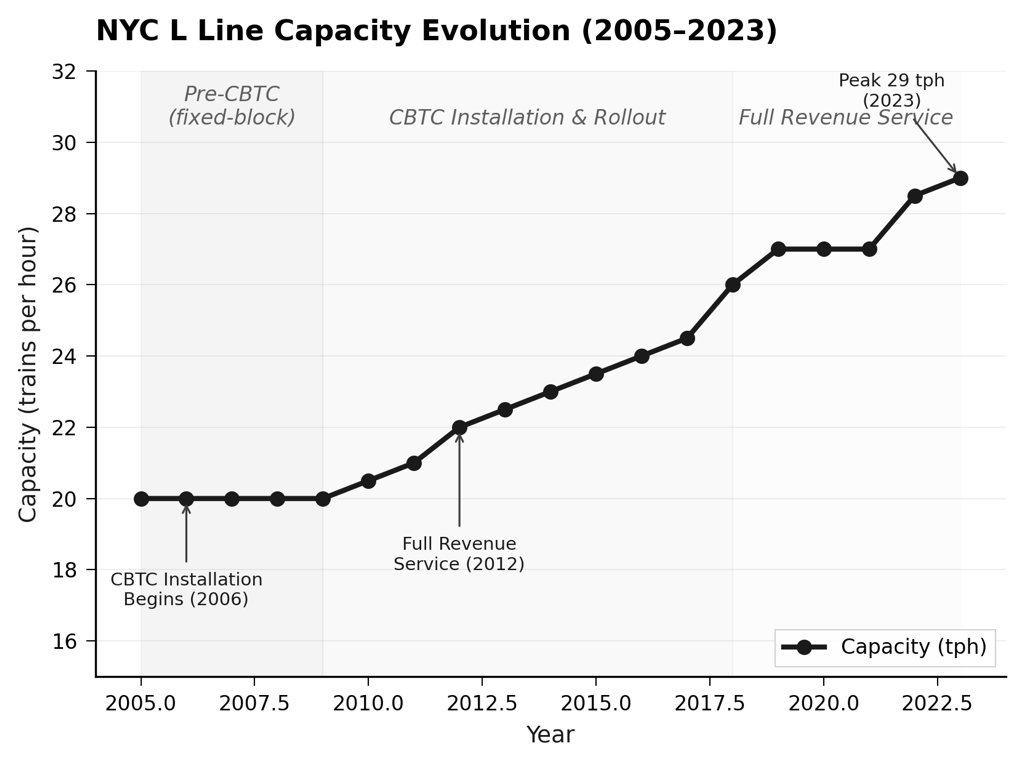 L Line capacity rose from approximately 20 to 29 trains per hour after CBTC commissioning, with no civil works.
4. Safety model: discrete signal compliance versus continuous supervision
Fixed-block signaling encodes safety in the operator. The operator sees a wayside aspect, interprets it, and slows or stops accordingly. Cab signaling improved on this by carrying the aspect into the cab, but the model still rests on the operator’s response. When the response fails, the system records a Signal Passed at Danger (SPAD) event. SPADs are tracked by every major US transit agency precisely because they are the leading indicator of how often the human-in-the-loop safety model breaks down.
CBTC moves enforcement into the system. Automatic Train Protection compares the train’s current speed against the speed permitted by the Movement Authority every cycle. If the train is faster than allowed, ATP commands the brake without consulting the driver. There is no SPAD because there is no aspect to pass; the train is supervised continuously, not at discrete points. Industry experience on mature CBTC lines documents SPAD-equivalent rates an order of magnitude lower than fixed-block baselines, with multiple lines reporting zero reportable signal-related safety events over operational decades.
5. Wayside infrastructure: dense versus consolidated
A 50-kilometer fixed-block metro line typically carries 150 to 200 wayside signal heads, a comparable number of track circuits, and four to six relay houses. Each component has a maintenance cycle, a spare-parts catalog, and a workforce trained to fix it. Much of the equipment outlives its design life by decades; some MTA relay logic predates transistors.
A CBTC line consolidates this into a small number of zone controllers (one per 2 to 5 kilometers of track) housed in equipment rooms, plus wayside access points (radio antennas) every 250 to 500 meters and balises every 200 meters or so. The total count of distributed safety-critical hardware drops sharply. The maintenance workforce shifts from electromechanical signal technicians to network and software specialists — itself a labor planning challenge worth its own article. (For the strategic implications, see The Onboard Side of CBTC: Inside the VOBC.)
6. Capital and lifecycle cost: front-loaded versus distributed
The capital cost ratio is the single most-misquoted number in CBTC procurement. A traditional resignaling project on a typical US metro line lands somewhere between $8 million and $15 million per 10 kilometers of track. A CBTC retrofit on the same line lands between $15 million and $25 million per 10 kilometers, before accounting for fleet equipment. The L Line retrofit cost approximately $48 million per kilometer for a complex 10.5-kilometer line in dense urban infrastructure.
But capital is roughly 5 to 8 percent of a metro line’s total development cost when civil works, stations, and rolling stock are included. Over a 30-year lifecycle, CBTC’s lower wayside maintenance, higher capacity, and energy savings recover the premium on most high-ridership lines within 12 to 18 years. The mistake agencies make is comparing capital alone. The right comparison is total cost of ownership across a 30-year planning horizon, accounting for capacity-driven revenue and avoided maintenance.
7. Degraded-mode behavior: blunt versus graduated
When a fixed-block system loses a track circuit or a signal head, the typical operational response is to drop to manual block working: a dispatcher issues verbal authorities, operators move at restricted speed, and capacity collapses by 50 to 60 percent. The blunt edge is a feature; without precise position, conservative assumptions are the only safe default.
CBTC degraded modes are graduated. If the radio link to a single train drops, that train applies service brakes within a configurable timeout (commonly three to five seconds) and the rest of the line continues at full performance. If a Zone Controller fails, its hot-standby takes over within roughly 500 milliseconds and trains never see a service interruption. If wider failures occur, the system can fall back to a defined “restricted manual” mode under ATP supervision while the wayside is repaired. Capacity drops 15 to 25 percent in degraded operation, not 50 to 60 percent. The shape of failure matters: a transit agency that runs through morning rush on a degraded CBTC line still moves passengers; one that runs morning rush on a manual-block fallback does not.
8. The vendor and supply chain: many versus few
US fixed-block signaling has a deep, fragmented supplier base. Track circuit modules, signal heads, switch machines, and relay logic come from a long list of US, Canadian, and European vendors, with substantial second-source availability and decades of installed-base spares.
The CBTC market is concentrated. Five suppliers — Siemens Mobility (Trainguard MT), Alstom (Urbalis, the rebrand of the former Bombardier CITYFLO 650 platform after the 2021 acquisition), Thales (SelTrac, now part of Hitachi Rail after the 2024 acquisition), Hitachi Rail STS (the former Ansaldo STS), and CRSC — hold the global market. Build America, Buy America (BABA) compliance, introduced in 2021 under FTA grant policy, adds a 5 to 15 percent premium and limits some suppliers’ ability to bid in the US without domestic content commitments. Vendor selection has more strategic weight in CBTC than in fixed-block signaling, and the consequences of vendor lock-in extend over the 30-year service life of the system.
| Aspect | Traditional Signaling | CBTC |
|---|---|---|
| Separation Logic | Fixed sections | Computed buffers |
| Train Detection | Track circuit | Onboard report |
| Capacity Ceiling | 24 to 28 trains/hour | 30 trains/hour and beyond |
| Safety Model | Discrete signal compliance | Continuous supervision |
| Wayside Infrastructure | Dense | Consolidated |
| Capital and Lifecycle Cost | Front-loaded | Distributed |
| Degraded-Mode Behavior | Blunt | Graduated |
| Vendor and Supply Chain | Many | Few |
What this means in practice
- Capacity is the headline benefit, but the safety model and degraded-mode behavior are what change the operational character of the railway.
- Compare lifecycle costs, not capital costs. The L Line numbers are the public reference point; ask vendors to model 30-year total cost of ownership, not five-year capital outlay.
- Track-circuit fallback is not optional in retrofit projects; specify it explicitly to handle non-equipped trains, broken-rail detection, and engineering moves.
- Vendor concentration is real and matters for procurement strategy. Single-vendor contracts are simpler; multi-vendor procurements impose interface burden but preserve competition.
- BABA compliance adds 5 to 15 percent to capital cost; build it into the budget envelope from the start, not as a contingency.
Where to go next
This post is a 10-minute summary. The full treatment lives in [Chapter 1 — The Evolution of Train Control] of Communications-Based Train Control (Volume 1 on Amazon). Download Chapter 1 slides (free PDF →)
Sources
- Wang, C. (2026). Communications-Based Train Control, Volume 1: Foundations & Technical Architecture. Independent. ISBN 979-8-258-54295-3. — Chapter 1, “The Evolution of Train Control.”
- IEEE Standards Association. IEEE Std 1474.1: Standard for Communications-Based Train Control (CBTC) Performance and Functional Requirements.
- MTA New York City Transit. Communications-Based Train Control Status Update. new.mta.info/project/communications-based-train-control-cbtc
- Federal Transit Administration. Build America, Buy America Implementation Guidance. transit.dot.gov/buyamerica
- RATP. Métro Line 1 Automation Project Overview. ratp.fr
- MTR Corporation. Tsuen Wan Line Resignaling Project Summary. mtr.com.hk
- UK Rail Safety and Standards Board. Annual Safety Performance Reports. rssb.co.uk
How this article was produced. Drafted with AI assistance, then reviewed and fact-checked by Chunjun (Francisco) Wang against Communications-Based Train Control (the author's two-volume reference) and primary sources — agency records, vendor documentation, and IEEE/IEC standards. Every date, vendor, and figure is traceable to a cited source. Spot a mistake? Corrections are welcome via the contact page.
Read the full treatment in the book
Chapter 1 of Communications-Based Train Control, Volume 1, covers this in depth.