definitional · Article
How CBTC Lets the L Line Run a Train Every 110 Seconds
For most of the twentieth century, the 14th Street–Canarsie Line of the New York City subway was a fixed-block railroad whose practical ceiling was about 15 trains per hour. Track circuits, color-light signals, and 1960s-era relay logic limited the spacing between successive trains to four-minute intervals at peak. Riders queued, the platforms compressed, and capacity stopped where the relays did. By the late 2010s, after a multi-decade Communications-Based Train Control (CBTC) project led by Siemens Transportation Systems, the same line was running well above 25 trains per hour with sustained peak headways near 110 to 120 seconds. The L Line CBTC headway is now the most-cited US data point in any board presentation that ends with the phrase “we should look at this.” This article explains the mechanics: how the L Line’s Siemens Trainguard MT system, paired with disciplined dwell-time management and a homogeneous fleet, drove that improvement, and what it does and does not generalize to.
What the L Line numbers actually say
Before unpacking the mechanics, it helps to fix the numbers. The Metropolitan Transportation Authority’s own performance reporting and the manuscript chapters that grew out of it describe the L Line’s transition this way: pre-CBTC peak service ran approximately 15 to 20 trains per hour, depending on which year and whether one counts the legacy fixed-block ceiling or the post-cab-signaling improvement on top of it. Post-CBTC, the line sustains 26 trains per hour in current revenue operation, and has demonstrated peak performance closer to 29 trains per hour under favorable conditions. That translates to a sustained headway in the 110-to-130-second band and observed best headways in the 75-to-80-second range during validation.
Two sentences are doing a lot of work here. The first is “sustained.” A line can clip a 75-second headway between two trains during a single peak window and still average 130 seconds across a service hour. The L Line’s value is that it holds the tighter number across a real revenue hour, not just on a single test pass. The second is “homogeneous.” The L Line operated R143 and R160 cars, both delivered factory-equipped with Siemens Trainguard MT VOBCs. There is no mixed-fleet penalty in the L Line case. Many of the lines that follow it on the MTA’s CBTC roadmap will not have that luxury. (The architectural reasons live in Moving Block Explained; the headline contrast lives in CBTC vs Traditional Signaling: 8 Concrete Differences.)
Why fixed block stopped at fifteen
To see why CBTC moved the number, look at what fixed block was doing first. In a fixed-block railroad, separation is enforced by track circuits that detect train presence in a section. Two trains cannot occupy the same section, and a successor train cannot enter a section the predecessor has not fully cleared. The minimum safe headway is therefore a function of section length, train length, train speed, and braking distance. Once the agency and the regulator have settled on a section length, the headway floor is fixed.
The L Line’s pre-CBTC infrastructure was built around 400-to-500-foot blocks with cab-signaling overlays and an automatic train control system that enforced speed codes. That gave the line a theoretical ceiling somewhere in the 25 to 30 trains-per-hour range and a practical ceiling around 15 to 20, with the gap explained by station dwell time, route conflicts at terminals, and the operational margin every dispatcher needs to absorb a single bad dwell without cascading into a service break. By the early 2000s, the line was carrying roughly 400,000 weekday riders and the practical capacity was no longer matching the demand profile. The MTA’s 1997 RFP and the 1999 award to Siemens Transportation Systems started from that operational fact, not from any abstract preference for newer technology.
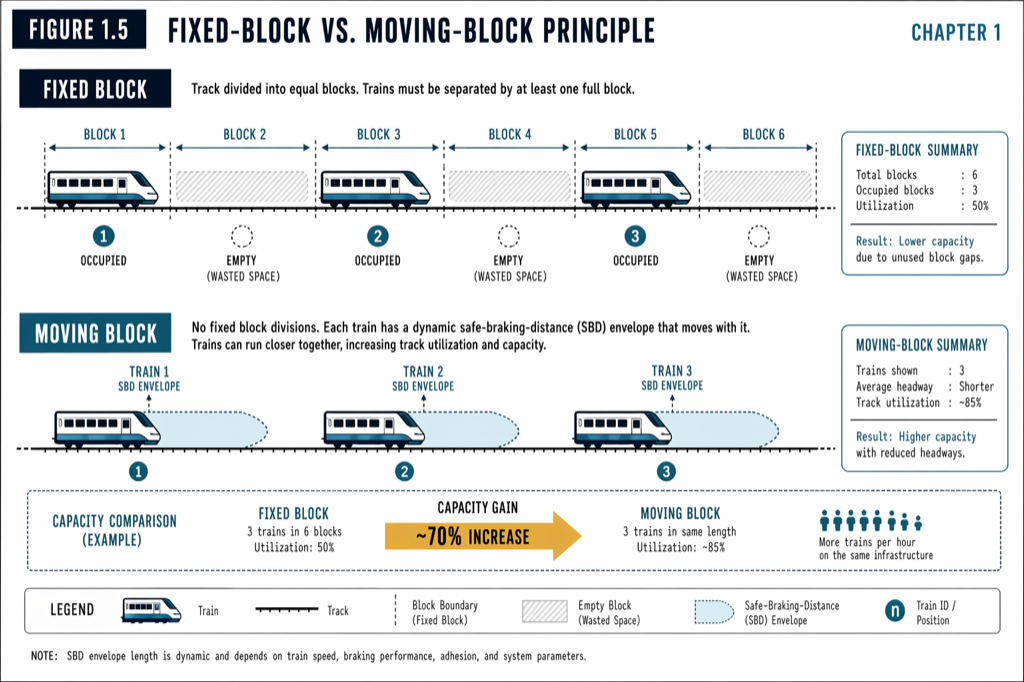 Fixed-block separation is bounded by section length; moving-block separation is bounded by physics.
What CBTC changed underneath the L Line
CBTC replaces the inferential, section-based view with three commitments. The first is high-resolution train location. Each L Line train knows its position to about one to two meters at all times, achieved by sensor fusion: tachometer odometry on the wheelsets, balise reads at trackside, and motion-state cross-checks. The second is continuous bidirectional communication over a 2.4 GHz IEEE 802.11 radio network, with redundant access points spaced through the Canarsie Tubes and along the line. The third is distributed vital processing: a Siemens VOBC onboard each car set, redundant Zone Controllers along the wayside, and an Automatic Train Supervision system in the Rail Control Center.
The combined effect on capacity is a moving block. Instead of holding the successor outside a fixed 400-foot section, the wayside Zone Controller continuously computes a safe-braking-distance buffer behind each train and issues a Movement Authority that ends just short of that buffer. As the lead train moves, the buffer moves with it. As the lead train slows for a station, the buffer shortens; the successor closes up. As the lead train accelerates out of the station, the buffer extends; the successor matches. The result, in the L Line’s geometry, is a sustainable peak headway in the 110-to-130-second range and a demonstrated capacity of 26 trains per hour, with peaks closer to 29 in observation.
Several specific design features amplify the effect on the L Line. Trainguard MT updates Movement Authorities every 200 to 500 milliseconds, fast enough that a successor’s protected buffer can close to within 200 feet of the lead train without violating safe-braking margins. The line’s fleet is homogeneous and modern, which means every train has the same braking characteristics and the wayside can use a single performance envelope rather than computing a worst case across mixed equipment. The line is largely four-track in the operationally critical sections and features only a handful of conflicting movements at terminals, which means dispatchers do not have to insert the schedule buffers that complicate capacity on more interlocked routes.
Why the headway holds on a real day
The harder question, and the one most useful for agencies weighing their own retrofits, is why the L Line holds the tighter number across an entire revenue hour rather than on isolated test runs. Three operational ingredients matter, and a CBTC RFP that ignores them will buy a system that demonstrates the headline capacity in commissioning and falls short in service.
First, dwell-time discipline. Even with a 100-second moving-block headway available from CBTC, the L Line cannot sustain it if station dwells run 35 to 50 seconds. Door operations, customer flow at peak stations, and platform crowding determine the floor. The MTA’s stabilization period after CBTC went live was substantially about driving median dwells down toward the high-twenties at the busiest stations and tightening the variance, so that one slow door cycle does not cascade into a 200-second hole behind it.
Second, terminal turnaround. A line that is line-haul-limited can sustain a 100-second headway only if the terminals can turn trains in less time than the line will absorb them. The L Line’s Eighth Avenue and Canarsie–Rockaway Parkway terminals were both engineered for short turnarounds; the modernization included pocket tracks, bumper-block dwell discipline, and dispatcher procedures that moved a single train through a turn in roughly two minutes. A line that takes three minutes to turn a train at one end will not see the headline headway in service no matter what the wayside computer is capable of authorizing.
Third, fleet homogeneity. The L Line’s trains were delivered with CBTC equipment installed at the factory, paired with two car classes that have nearly identical performance envelopes. The Zone Controller can compute one braking curve and apply it to every train. Lines that retrofit CBTC into mixed fleets, with two or three different car classes whose deceleration profiles differ by 5 to 10 percent, must compute the worst-case envelope and accept the resulting capacity penalty.
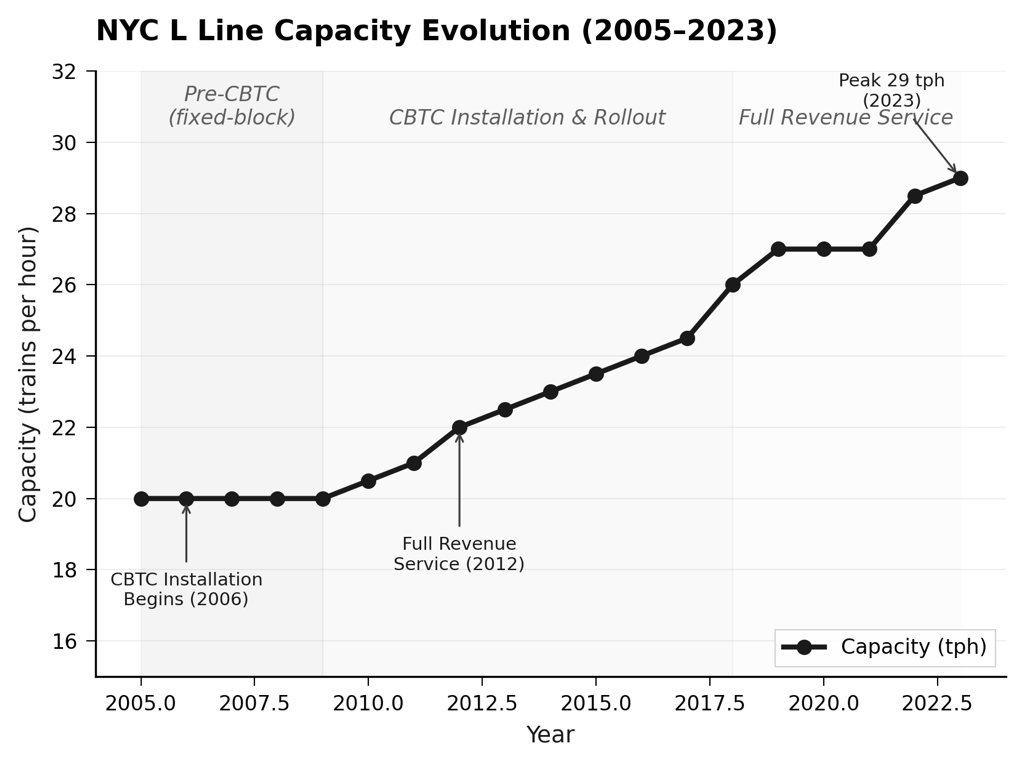 L Line capacity rose from 15-to-20 TPH (fixed block) to 26 sustained and 29 peak (CBTC).
What the L Line proves and what it does not
The L Line proves three things. CBTC retrofit on a heavily used legacy US metro line is feasible, even when the line cannot be closed for the duration of the project. A 30-to-50 percent capacity uplift is achievable in revenue service, not just on paper. And the safety case can be assembled from US institutional building blocks: IEEE 1474, the Federal Transit Administration (FTA) pathway, and a state safety oversight (SSO) review. These three demonstrated facts unlocked every subsequent US transit-modernization business case from the 7 Line through Queens Boulevard.
What the L Line does not prove is that the same headway is reachable on every line. The L Line had a friendly geometry: largely linear, four-track in the right places, modern homogeneous fleet, and a revenue-service environment whose interactions with other lines were modest. The MTA’s A Division and B Division have older, more heterogeneous fleets, more complex interlocking, and operationally significant cross-line transfers that constrain headway in ways the L Line does not. Lines outside New York with different ridership profiles, terminal geometries, and labor contexts will see different floors. The right way to read the L Line headline is as a proof of concept and a procurement reference point, not as a universal target.
What this means in practice
- Quote the L Line capacity as 26 trains per hour sustained with peaks near 29, not as a single “30 TPHPD” figure that ignores the dwell floor.
- Treat the headline headway as one of three coupled outputs: line-haul moving-block separation, dwell discipline, and terminal turnaround. A capacity case that ignores any of the three is incomplete.
- Specify the worst-case fleet braking envelope explicitly in any procurement; a mixed-fleet retrofit will not see the L Line’s homogeneous-fleet number.
- Use the L Line as an existence proof in board materials. Use Paris Line 14, Singapore NEL, or London 4LM if a higher number is needed; do not inflate the L Line.
- Plan the cutover stabilization period at 12 to 18 months at minimum. The L Line did not reach its sustained headway on day one; it reached it after operations and engineering had jointly tuned the system.
Where to go next
This post is a 10-minute summary. The full treatment lives in Chapter 1 (“The Evolution of Train Control”) and Chapter 10 (“CBTC in the United States”) of Communications-Based Train Control (Volume 1 on Amazon). Download Chapter 10 slides (free PDF)
Sources
- Wang, C. (2026). Communications-Based Train Control, Volume 1: Foundations & Technical Architecture. Independent. ISBN 979-8-258-54295-3. — Chapter 1, “The Evolution of Train Control”; Chapter 10, “CBTC in the United States.”
- MTA New York City Transit. Communications-Based Train Control Status Update. new.mta.info/project/communications-based-train-control-cbtc
- IEEE Standards Association. IEEE Std 1474.1: Standard for Communications-Based Train Control (CBTC) Performance and Functional Requirements.
- International Electrotechnical Commission. IEC 62290-1: Railway applications — Urban guided transport management and command/control systems.
- Federal Transit Administration. State Safety Oversight Program. transit.dot.gov/regulations-and-guidance/safety/state-safety-oversight
- Siemens Mobility. Trainguard MT CBTC Overview. siemens.com/global/en/products/mobility/rail-solutions/rail-automation.html
Read the full treatment in the book
Chapter 1 of Communications-Based Train Control, Volume 1, covers this in depth.