agency-case-studies · Article
NYC 7 Line, Queens Boulevard, and Beyond: The MTA Roadmap
The Metropolitan Transportation Authority’s original CBTC vision, articulated during the 2005–2009 capital planning cycle and codified in the 2010–2014 Capital Program, projected systemwide deployment of Communications-Based Train Control (CBTC) across most of the 248-mile NYC subway by 2025 to 2030, at total program cost between $15 billion and $30 billion in nominal dollars. By 2026, with the L Line and the 7 Line in full revenue service, partial revenue on Queens Boulevard, and Culver still in early construction, the realistic projection for systemwide CBTC has slipped into the 2040s. This article walks the MTA roadmap line by line — what is operating, what is in deployment, what is in planning — and argues that the slip is structural rather than scandalous: the 24/7 service constraint, the 110 years of incremental infrastructure, and the multi-vendor-multi-fleet integration burden are doing exactly what the L Line lessons predicted they would do.
Why the MTA roadmap matters beyond New York
The MTA program is the largest CBTC capital deployment in United States history, and is therefore the single most consequential US procurement laboratory. Every other US transit agency considering brownfield CBTC retrofit — Washington Metropolitan Area Transit Authority (WMATA), Southeastern Pennsylvania Transportation Authority (SEPTA), Chicago Transit Authority (CTA), the Bay Area Rapid Transit (BART) Train Control Modernization Program — pays close attention to the MTA’s contract structures, vendor selections, schedule slips, and labor agreements. (For the L Line foundation that anchors the rest of the program, see NYC MTA L Line CBTC: 25 Years of Lessons.) The roadmap is also the central exhibit in any board conversation about whether multi-decade CBTC programs deliver on their original cost and schedule projections. The honest answer is: not on the original schedule, not on the original cost, but with the operational and reliability gains that justified the program in the first place.
This post is for transit program managers, FTA reviewers, board members, and consultants who need to communicate a realistic version of the MTA’s progress without either celebrating delay or dismissing genuine accomplishment.
7 Line (Flushing): the second deployment, the cleanest validation
The 7 Line is the second full CBTC deployment in North America and the first large-scale success after the L Line. It runs 13.7 miles from Flushing-Main Street in Queens to Hudson Yards in Manhattan, serving 22 stations. The procurement was a Thales (now Hitachi Rail) prime-integrator role with Siemens as a subcontractor for communications and platform screen door equipment, awarded for approximately $560 million in 2010. Design and procurement ran 2010 to 2013; construction and testing 2013 to 2018; full revenue service November 1, 2018.
What the 7 Line proved was that CBTC retrofit could be repeated by a different prime integrator on a different MTA division and still deliver. The line achieved the MTA’s target capacity of 29 trains per hour upon transition, integrated platform screen doors at the new Hudson Yards station, and demonstrated approximately 11 percent energy savings versus pre-CBTC baseline. The project also validated the MTA’s two-vendor strategy. Operating two CBTC platforms — Siemens Trainguard MT on the L Line and Thales SelTrac on the 7 Line — imposes integration overhead the agency accepted in exchange for reduced vendor lock-in. The trade-off has been argued both ways for over a decade and is still argued today.
The 7 Line cost story was less escalated than the L Line’s, partly because Siemens-on-7-Line subcontracted communications work benefited from L Line institutional knowledge. The line’s geometry was also somewhat friendlier than what would follow on Queens Boulevard. As a procurement reference point for other agencies, the 7 Line is the cleanest single data point in the MTA portfolio.
Queens Boulevard: the line that exposed the limits
The Queens Boulevard Line is the most operationally complex CBTC retrofit in the MTA portfolio and arguably in North America. The four-track express-and-local line carries the E, F, M, and R services through Queens and Brooklyn across 41 stations, with branch interactions, complex interlockings, and a mixed fleet that includes equipment shared with adjacent lines. Siemens Mobility was selected through competitive procurement in 2013, with an initial Phase 1 contract of approximately $205 million that grew above $300 million by 2022 through scope additions.
The deployment strategy was sectional rather than line-wide. Phase 1 covers the E and F lines on the Manhattan-and-initial-Queens segment, targeting partial revenue service in 2024. Phase 2 covers the M line and additional E/F segments, in design with a 2027–2029 target. Phase 3 covers the R line and express track segments, in early planning for 2030 and beyond.
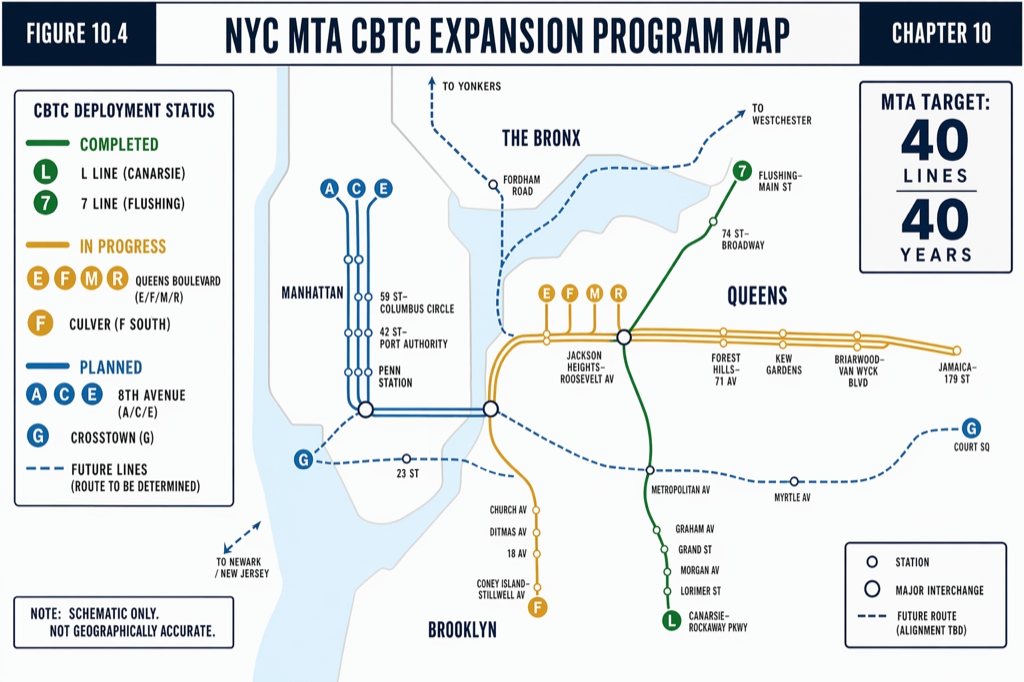 MTA CBTC expansion line-by-line status as of 2024–2026.
Queens Boulevard Phase 1 encountered cost overruns of approximately 40-to-50 percent above initial estimates by 2023, driven by scope creep around new ATO platforms and platform screen door retrofit, track-access constraints on a 24/7 line with complex branch operations, legacy interface engineering on the segments still operating fixed-block, and extensive operator-and-maintainer retraining. As of late 2024, portions of the E and F lines operate under CBTC in revenue service, with phased completion extending well past the original timeline. Full Queens Boulevard CBTC deployment is not realistically expected until 2030 or beyond.
The lesson Queens Boulevard reinforces is that line complexity dominates project cost and schedule far more than vendor selection or technology choice. A line with three branches, four tracks, mixed fleet, and 24/7 service cannot be retrofit on the same schedule as a homogeneous-fleet linear line. (For the procurement-side mitigations, see How to Write a CBTC RFP That Doesn’t Lock You Into One Vendor.)
Culver Line and 8th Avenue: the next two waves
The Culver Line — F and G service across 11.8 miles and 17 stations in Brooklyn — was designated for CBTC during the 2015–2019 capital planning cycle and contracted to Siemens Mobility for approximately $300 million-plus including platform extensions and related infrastructure. As of 2024, the line remains in design and early construction. Unlike the 7 Line or early Queens Boulevard work, the Culver Line has not yet entered revenue CBTC service. The next milestone of consequence is initial revenue commissioning, currently targeted for the late 2020s.
The 8th Avenue Line — the A, C, and E service complex across 61 stations — represents the next major deployment wave. With substantial ridership and three interleaved services, the technical challenges are comparable to Queens Boulevard. As of 2024, the 8th Avenue Line remains in planning and early design phases, with procurement expected within the 2025–2029 capital cycle. Vendor competition on this procurement will be substantial: Siemens, Thales/Hitachi Rail, Alstom (after the 2021 Bombardier acquisition), and possibly other entrants will all engage.
Beyond 8th Avenue, the MTA’s planning documents include the B-D-F-M complex and the N-Q-R-W complex. None of these has a contracted vendor as of 2026. Realistic deployment is post-2030, in some cases substantially post-2030.
Vendor landscape inside the MTA portfolio
The MTA has deliberately maintained a multi-vendor strategy. Siemens Mobility has been the dominant vendor by line count after the L Line success, winning Queens Boulevard and Culver. Thales (now part of Hitachi Rail) leads the 7 Line. Hitachi Rail STS and Alstom continue to compete actively on future procurements; Alstom’s North American manufacturing footprint in Hornell, Plattsburgh, and Rochester is a Buy America advantage on future bids.
The trade-off in the multi-vendor strategy is well documented. Operating multiple CBTC platforms requires duplicate spare parts inventory, parallel training pipelines, separate software update streams, and Interface Control Documents (ICDs) sharp enough to keep the platforms from interfering at boundaries. Single-vendor agencies — Baltimore Metro and Honolulu Skyline are the cleanest US examples — avoid these costs. The MTA has accepted them in exchange for a 10-to-25 percent estimated lifecycle premium that single-vendor procurement would otherwise impose through reduced competitive pressure on future contracts.
Why the original 2025–2030 vision slipped
The original MTA vision projected systemwide CBTC by 2025-to-2030. That was always optimistic, and three structural factors are responsible for the slip into the 2040s.
The first is the 24/7 service operations constraint. NYCT operates portions of its network continuously, 24 hours per day, 7 days per week. CBTC commissioning, testing, and integration require maintenance access windows. The agency cannot easily provide such windows without service suspensions affecting millions of riders. The standard mitigation — compressed testing timelines, parallel-zone testing, more sophisticated factory acceptance and simulation — recovers some schedule but not all. Schedule delays of 6 to 18 months on major lines have become the operating norm.
The second is the legacy infrastructure burden. The NYCT subway represents over 110 years of incremental development. Tunnel geometry constrains antenna placement; legacy 600 V DC traction power must coexist with modern CBTC communications; track access must occur in 2-to-6-hour windows. None of these problems are unsolvable; all of them slow every individual line.
The third is workforce and training scale. The MTA employs approximately 2,300 signals and controls maintenance personnel and over 13,000 train operators. CBTC deployment requires retraining across both populations and across multiple departments. The agency established a CBTC Training Academy in 2015 to standardize curriculum, but the throughput of the academy is itself a constraint on the deployment schedule.
These three factors compound. The cumulative effect is that full-system CBTC deployment is now projected to extend into the 2040s rather than the early 2030s. Cost projections have followed similar trajectories: original $15-to-$30 billion program estimates were nominal-dollar 2005–2010 figures. Inflation-adjusted, the actual program is substantially larger, though no MTA document publishes a single revised total in current dollars.
What other US agencies should take from the roadmap
The MTA roadmap is a hard test case, not a cautionary tale. It is the test case that proved revenue-line CBTC retrofit at scale is possible in the United States. It is also the test case that proved multi-decade public capital programs slip when they collide with 24/7 service operations and 110-year-old infrastructure.
For agencies entering CBTC procurement now — WMATA, SEPTA, CTA, and the next generation of mid-sized agencies — the actionable observations are these.
 MTA CBTC program: original vision versus realistic trajectory.
Plan for 25-year deployment horizons on systemwide programs, not 10. Carry 30-to-50 percent contingency on every line and accept that a line in revenue service is not a finished project until 12-to-18 months of stabilization have elapsed. Engage labor before the RFP, not after. Use Interface Control Documents to manage multi-vendor risk if the agency is large enough to want second-source competition; accept single-vendor lifecycle simplicity if the agency is smaller and integration capacity is limited.
Practical takeaways
- Treat the MTA roadmap as the most informative US data set on multi-line CBTC retrofit at scale. No other US program has comparable line count or operational complexity.
- Plan for 5-to-8-year project durations from procurement to revenue service per line, with 12-to-18-month stabilization after first revenue.
- Carry 30-to-50 percent cost contingency. The MTA’s 40-to-50 percent escalation on Queens Boulevard Phase 1 is not an outlier.
- Decide on multi-vendor versus single-vendor strategy before the first procurement, not after the second contract is in flight. The MTA chose multi-vendor; Baltimore and Honolulu chose single. Both are defensible. Choose deliberately.
- Accept that 24/7 operating environments constrain schedule far more than vendor selection. Compressed testing, parallel-zone validation, and stronger factory acceptance are partial mitigations, not solutions.
Where to go next
This post is a 12-minute summary. The full treatment lives in Chapter 10 (“CBTC in the United States”) and Chapter 12 (“Project Lifecycle”) of Communications-Based Train Control (Volume 2). Buy on Amazon. Download Chapter 10 slides (free PDF).
Sources
- Wang, C. (2026). Communications-Based Train Control, Volume 2: US Deployment, Procurement & Future Directions. Independent. ISBN 979-8-258-54295-3. — Chapter 10, “CBTC in the United States” (Sections 10.1, 10.2); Chapter 15, “Vendor Landscape and Technology Trends.”
- MTA New York City Transit. Communications-Based Train Control Status Update. new.mta.info/project/communications-based-train-control-cbtc
- MTA. 2020–2024 Capital Program. new.mta.info/transparency/board-and-committee-meetings
- MTA Office of the Inspector General. Reports on Capital Project Performance. mtaig.ny.gov
- Federal Transit Administration. Capital Investment Grants Program. transit.dot.gov/CIG
- IEEE Standards Association. IEEE Std 1474.1: Standard for Communications-Based Train Control (CBTC) Performance and Functional Requirements.
Read the full treatment in the book
Chapter 10 of Communications-Based Train Control, Volume 2, covers this in depth.