agency-case-studies · Article
NYC MTA L Line CBTC: 25 Years of Lessons (2001–2026)
In 1997, the Metropolitan Transportation Authority (MTA) issued a Request for Proposal (RFP) for the resignaling of a single Brooklyn-to-Manhattan subway line — the 14th Street–Canarsie Line, or L Line — using a then-novel technology called Communications-Based Train Control (CBTC). Two years later, in 1999, the MTA awarded the contract to Siemens Transportation Systems for approximately $340 million. The first trains operated under CBTC in partial revenue service in April 2006. Full revenue CBTC operation followed in April 2009. Hurricane Sandy flooded the Canarsie Tubes in October 2012, set in motion a multi-year tunnel reconstruction program, and forced a second round of CBTC equipment replacement that finished in April 2020. By 2026 the L Line is the most studied CBTC retrofit in North America: 25 years from RFP to its current operating profile, billions in capacity benefit unlocked across the rest of the MTA roadmap, and a record of decisions — some good, some painful — that every other US transit agency now references.
Why the L Line still matters
The L Line is not the largest US CBTC deployment, the newest, or the highest-Grade-of-Automation. The 7 Line is longer, the BART Train Control Modernization Program is more ambitious, and the Honolulu Skyline is the country’s only operational GoA 4 metro. Yet the L Line is still the reference project for any agency contemplating a brownfield CBTC retrofit on a heavily used legacy line. Three reasons. First, it is the oldest US revenue-line CBTC retrofit — by 2026, more than two decades of continuous operation. Second, it is the cleanest test case: largely linear geometry, homogeneous fleet, modest cross-line interaction. Third, the institutional residue of the project — labor agreements with TWU Local 100, the State Safety Oversight (SSO) review framework, the Federal Transit Administration (FTA) approval pathway, the Siemens vendor relationship that has now extended to Queens Boulevard and Culver — set the template for everything the MTA and its peers have done since.
This post is a practitioner’s chronological walk through the project. The aim is not to celebrate it; the aim is to extract what the next agency considering CBTC retrofit on a brownfield revenue line can usefully learn.
1997–2006: From RFP to first revenue trains
The Canarsie Line entered the late 1990s with a fixed-block signal system whose practical capacity was approximately 15 trains per hour at peak. Track circuits, color-light signals, and 1960s-era relay logic put a hard ceiling on how close two trains could follow one another. Pre-pandemic L Line ridership was approaching 400,000 weekday passengers, a load that the existing infrastructure could no longer comfortably absorb. The 1997 RFP and the 1999 award to Siemens Transportation Systems flowed directly from that operational fact, not from any abstract enthusiasm for newer technology.
The technology selection was deliberate. Siemens Trainguard MT — Medium Range Transmission — was selected on the strength of three attributes: vendor maturity (the platform had deployed on the Jubilee Line extension in London), a 2.4 GHz IEEE 802.11 radio architecture that did not require exclusive frequency licensing in the US, and an explicit overlay design that could ride on top of NYCT’s existing fixed-block infrastructure. The overlay design was not a luxury; it was a requirement. NYCT could not close the L Line for a multi-year cutover. The CBTC system had to coexist with the legacy track circuits and signal infrastructure for years, and trains had to be able to operate in CBTC mode or in fixed-block mode under operator control depending on equipment availability.
Design and engineering ran from 1999 through 2001. Installation and hardware deployment ran from 2001 through 2006: zone controllers placed along the 10.5-mile route, wayside radio infrastructure through the Canarsie Tubes, track-circuit modifications, and onboard equipment installation on the R143 fleet (which had been delivered factory-equipped with Siemens VOBCs starting in 2001). First partial revenue service began in April 2006 with operators in the cab and fixed-block fallback always available. The next three years were continuous validation: thousands of test runs across light load, peak load, and emergency conditions, mixed-fleet integration testing, dwell-time tuning, and station-by-station commissioning.
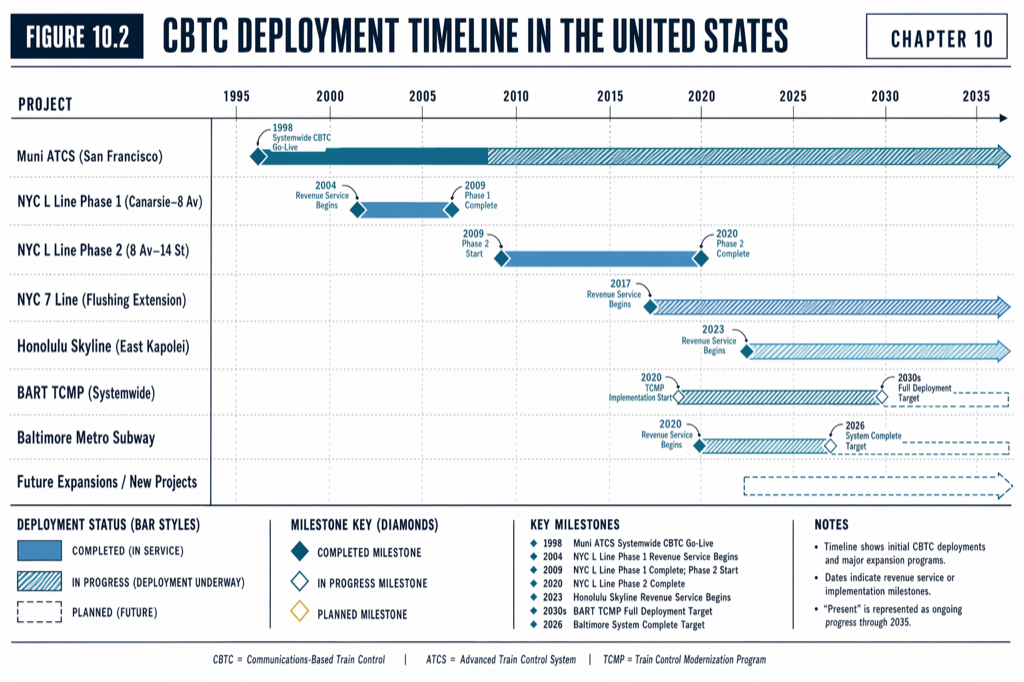 The L Line CBTC project spans nearly three decades from procurement to mature operations.
2009: Full revenue and the first quantified gains
Full CBTC revenue service was declared in April 2009. The R160 fleet, delivered starting in 2006 and fully CBTC-equipped, was now the dominant rolling stock; the R143 cars formed the remainder. Both classes shared the same Siemens VOBC architecture, so the wayside zone controllers could compute a single braking envelope and apply it to every train. The L Line’s homogeneous-fleet luxury, unavailable on most peer retrofits, translated directly into achievable headway.
The capacity numbers reset the agenda for US transit. Pre-CBTC scheduled peak service was 15 trains per hour at four-minute headways. Post-CBTC scheduled service rose to 30 trains per hour at two-minute scheduled headways. Realized capacity in revenue operation settled in the 26-to-29-trains-per-hour band — somewhat below theoretical maxima because of station dwell, schedule buffers, and cross-platform interactions, but a 70-to-90-percent net operational gain over the fixed-block ceiling. (For the mechanics of how the line holds the tighter number across an entire revenue hour, see How CBTC Lets the L Line Run a Train Every 110 Seconds.) On-time performance moved from approximately 85 percent pre-CBTC to a sustained 93-to-95 percent post-CBTC. Signal-system unplanned downtime fell from approximately 200-to-300 hours per year to under 50 hours per year. Energy consumption fell roughly 12-to-15 percent at the line level due to optimized acceleration and braking under Automatic Train Operation (ATO).
The cost story was less flattering, and remains the most honestly cited number in US CBTC procurement. The original $340 million contract is widely reported to have grown to approximately $500 million by completion — a roughly 47 percent escalation over baseline driven by extended testing, scope changes, contingency work for unforeseen technical issues, and integration labor. This figure is not exceptional for North American transit projects of the period, but it framed every subsequent MTA capital plan and every peer agency’s procurement contingency.
2012–2020: Hurricane Sandy and the second cutover
On October 29 and 30, 2012, Hurricane Sandy made landfall in New York. Storm surge inundated the Canarsie Tubes — the twin tunnels under the East River that carry the L Line — with saltwater to depths of 12 to 15 feet in sections. Traction power vaults, signal and CBTC equipment both wayside and embedded, ballast and roadbed, and station equipment in flood zones all suffered severe damage. The line continued to operate after initial repairs, but the long-term integrity of the tubes was a structural question the MTA could not defer.
In 2019 the agency committed to a comprehensive tunnel rehabilitation program. The plan ran from April 2019 through April 2020 (12 months), used weekend and night closures rather than a full shutdown, and included complete replacement of wayside CBTC controllers, cabling, and communication infrastructure inside the tubes. Service operated at reduced frequency — approximately 10 trains per hour during the work, down from the 30 tph peak — but continued throughout. Full service capability resumed in April 2020, three weeks before the COVID-19 pandemic remade transit ridership across New York.
The Hurricane Sandy episode is its own lesson. CBTC equipment is not less vulnerable to seawater than legacy relay rooms; the modular design of the L Line system did, however, make staged rip-and-replace tractable in a way the original mechanical infrastructure would not have permitted. The 2019–2020 reconstruction also produced the second institutional iteration of the Siemens-NYCT relationship, which by then had run nearly 20 years and had accumulated the kind of operational knowledge that no fresh vendor could replicate.
What worked: five durable lessons
The L Line proves five things that the rest of the US transit industry now relies on, and that the relevant manuscript chapters and the MTA’s own performance reporting both document.
First, overlay deployment on legacy fixed-block infrastructure is operationally feasible. The L Line ran continuously through more than a decade of installation and validation; fallback to fixed-block remained available throughout. Site-specific integration work — radio coverage, track circuit compatibility, signal interaction — was substantial, but it was not a blocker.
Second, a three-year validation period for a revenue line is realistic, not a delay. The 2006-to-2009 testing window produced thousands of test records and uncovered scenarios no factory acceptance test would have surfaced. Subsequent US CBTC projects that tried to compress this window either extended in flight (Queens Boulevard) or accepted higher commissioning risk.
Third, labor partnership is essential, not optional. The 2005 agreement with TWU Local 100 was the institutional precondition for everything that followed. Agencies that have entered CBTC procurement without an early labor agreement — including some that are still in procurement today — have spent years recovering ground.
Fourth, homogeneous fleet matters more than capacity calculation suggests. The L Line’s R143 and R160 cars share a common braking envelope, which lets the wayside compute one performance curve. Lines with mixed fleets pay a real capacity penalty that no amount of clever wayside engineering recovers.
Fifth, vendor partnership sustainability is more important than vendor selection. The Siemens relationship has now run nearly 25 years. Spare parts availability, software update strategy, and engineering continuity have all benefited from that duration. Subsequent agency procurements that optimized for low initial bid without weighting long-term support have not fared as well.
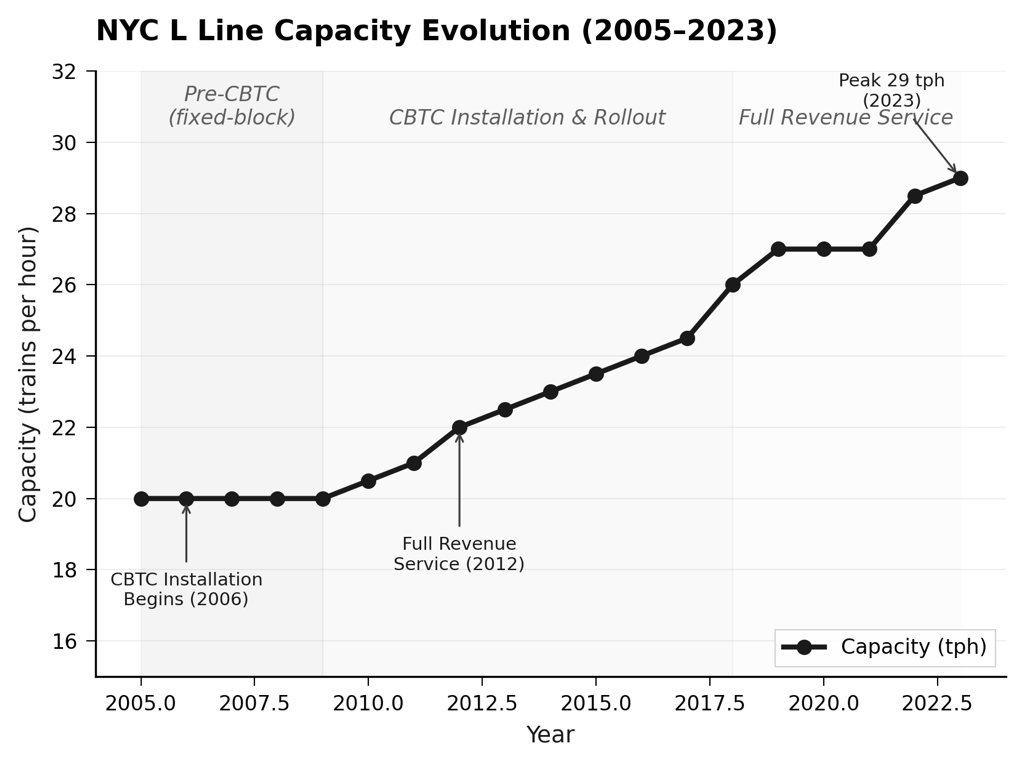 Quantified L Line operational gains, pre-CBTC versus post-CBTC.
What did not work: three persistent costs
The L Line also accumulated three categories of cost that the next agency should price in deliberately.
The first is the cost overrun pattern itself. The roughly 47 percent escalation from $340 million to approximately $500 million is not a one-line failure; it reflects a procurement structure that under-budgeted contingency for testing duration, scope evolution during installation, and the labor cost of extended commissioning. Every MTA CBTC project since has carried larger contingency reserves and, in several cases, has still exceeded them.
The second is the testing-window scarcity tax. NYCT operates 24/7. The L Line did not have the luxury of long maintenance windows, and testing had to be compressed into nights, weekends, and outages. The result was that uncovered issues had to be re-staged across multiple short windows rather than resolved in a single concentrated push. This raises every subsequent test cost on every NYCT line.
The third is the fixed-block fallback maintenance burden. Because the legacy signaling was retained for fallback, the MTA has now been maintaining two parallel signal systems on the L Line for two decades. The cost of that parallel maintenance is real and is rarely captured in the headline CBTC business case. (The wider procurement and lifecycle pattern is discussed in the MTA roadmap article.)
Practical takeaways for US transit agencies
- Treat the L Line as an existence proof for revenue-line CBTC retrofit, not as a guarantee of identical results. Geometry, fleet mix, and labor environment vary; expect floor effects.
- Budget the cutover stabilization period at 12 to 18 months minimum after first revenue service. The L Line did not reach 26-to-29 trains per hour on day one; it reached it after operations and engineering jointly tuned the system.
- Carry contingency at 30 to 50 percent over baseline contract value for any brownfield retrofit on a 24/7 operating line. The L Line’s roughly 47 percent escalation is not an outlier.
- Engage the operator labor union early and explicitly. The 2005 TWU Local 100 agreement is the model.
- Specify long-term vendor support — spare parts, software updates, engineering continuity — in the procurement, not in a separate maintenance contract. Twenty years of shared ownership is the actual unit of analysis.
Where to go next
This post is a 12-minute summary. The full treatment lives in Chapter 10 (“CBTC in the United States”) of Communications-Based Train Control (Volume 2). Buy on Amazon. Download Chapter 10 slides (free PDF).
Sources
- Wang, C. (2026). Communications-Based Train Control, Volume 2: US Deployment, Procurement & Future Directions. Independent. ISBN 979-8-258-54295-3. — Chapter 10, “CBTC in the United States” (Section 10.1, NYC L Line).
- MTA New York City Transit. Communications-Based Train Control Status Update. new.mta.info/project/communications-based-train-control-cbtc
- MTA. L Train Canarsie Tunnel Reconstruction Project Updates. new.mta.info
- Federal Transit Administration. State Safety Oversight Program. transit.dot.gov/regulations-and-guidance/safety/state-safety-oversight
- IEEE Standards Association. IEEE Std 1474.1: Standard for Communications-Based Train Control (CBTC) Performance and Functional Requirements.
- Siemens Mobility. Trainguard MT CBTC Overview. siemens.com/global/en/products/mobility/rail-solutions/rail-automation.html
- New York City Office of the Comptroller. Audit Reports on MTA Capital Program. comptroller.nyc.gov
Read the full treatment in the book
Chapter 1 of Communications-Based Train Control, Volume 1, covers this in depth.