standards · Article
SIL 4 in Rail Signaling: What It Actually Means

When IEC 61508 was first published in 1998, it was written for industrial process safety — chemical plants, power generation, hazardous-machinery shutdowns. Within a few years, the rail industry had adopted its Safety Integrity Level framework as the foundation of rail safety assurance, and within a decade, “SIL 4” had become the shorthand US transit engineers, suppliers, and regulators use for the safety target of any CBTC Automatic Train Protection function. The number that defines SIL 4 — a tolerable hazard rate of 10⁻⁹ to 10⁻⁸ per hour — is one of the most cited and least understood quantities in rail signaling. This post explains what that number actually means, what it costs in engineering effort, where it applies in a CBTC system, and why the entire safety case structure of CBTC depends on getting SIL allocation right early.
Why this matters for procurement
SIL allocation is the single most consequential safety decision in a CBTC project. Pushing functions into SIL 4 that do not need to be there inflates engineering cost without improving safety. Pulling functions out of SIL 4 that should be there compromises the safety case and the State Safety Oversight approval pathway. The SIL allocation decision cascades through architecture, software, hardware, testing, and Independent Safety Assessment effort. This post is for the program manager evaluating supplier proposals, the systems engineer drawing the SIL boundary, and the consulting engineer reviewing a safety case for an agency client.
What SIL actually quantifies
IEC 61508 defines four Safety Integrity Levels, each corresponding to a target probability of dangerous failure per hour for continuous-mode systems and per demand for low-demand systems. The continuous-mode targets — the relevant ones for CBTC, where ATP runs continuously while the train is in service — are:
- SIL 1: 10⁻⁶ to 10⁻⁵ dangerous failures per hour.
- SIL 2: 10⁻⁷ to 10⁻⁶.
- SIL 3: 10⁻⁸ to 10⁻⁷.
- SIL 4: 10⁻⁹ to 10⁻⁸.
Each level is a tenfold reduction in tolerable failure probability. This is not a linear cost curve. Each tenfold reduction requires substantially more rigorous engineering, testing, and oversight, with cost multipliers that compound at higher levels.
The 10⁻⁹ target deserves a moment of consideration. If a CBTC ATP function were to operate 16 hours per day, 365 days per year — a reasonable approximation for revenue service — the 10⁻⁹ per hour target translates to roughly one undetected dangerous failure per 170 to 1,700 years of operation per train. For a fleet of 100 trains, that is one undetected dangerous failure per 1.7 to 17 years across the fleet. In practice, the CBTC industry has done substantially better than the target on this dimension, but the target itself sets the engineering rigor required to be confident in the claim.
Why CBTC ATP requires SIL 4
The mapping from hazards to SIL targets follows the rail industry’s standard logic. An undetected failure in ATP — for example, a Movement Authority calculation that exceeds the safe braking distance, or a brake intervention that fails to apply when commanded — could result in a collision. The consequence class is catastrophic: multiple fatalities, regulatory and political consequences, fleet-wide service suspension. The SIL allocation is correspondingly the highest the framework offers.
Other CBTC functions sit at lower SILs by design. ATO is typically SIL 0 to SIL 2 because ATO failure cannot directly cause a collision: ATP catches every safety violation. A train under failed ATO operates manually, or stops and waits, or fails over to a backup ATO module. ATS, the central operations control, is typically SIL 0: ATS failure causes a scheduling event, not a safety event, because ATP enforces safety regardless of what ATS commands. (For the architectural separation that makes this possible, see ATP, ATO, ATS: The Three-Layer Triad of Modern Train Control.)
The multi-layer assurance that produces SIL 4
Achieving SIL 4 is not a single design decision. It is a stack of overlapping engineering practices, each of which catches what the others might miss:
Architecture. Safety-critical functions run on redundant hardware channels, typically 2-out-of-2 voting (2oo2) or 2-out-of-3 voting (2oo3). 2oo2 systems require both channels to agree; if they disagree, the system enters a safe state. 2oo3 systems take a majority vote, allowing operation to continue with a single channel failed. Modern Vehicle On-Board Controllers and Zone Controllers use one or the other depending on availability requirements.
Diverse software. Critical safety functions are typically implemented twice, in independent code bases derived from the same specification, often in different programming languages. The diversity is what protects against systematic software defects: a bug in one implementation is unlikely to be present in the other.
Formal verification. Safety-critical algorithms are specified in formal notation (Z, VDM, B-Method, or temporal logic) and verified mathematically rather than only tested. The B-Method has been used extensively in Paris Métro Line 14 and other major CBTC deployments.
Component qualification. Safety-grade electronic components with known failure modes are used in the safety-critical paths. Pre-certified COTS components are acceptable; uncertified COTS is not.
Software lifecycle. EN 50128 prescribes the development practices: formal specification, formal code review, automated static analysis, comprehensive unit and integration testing with traceability, and runtime monitoring. The standard requires different rigor for different SILs; SIL 4 demands the most.
Test coverage. SIL 4 software typically achieves greater than 90 percent code coverage through testing, with safety-critical execution paths exercised at 100 percent.
Independent Safety Assessment. An external assessor — TÜV, Ricardo, Mott MacDonald, Bureau Veritas, Intertek, or a comparable firm — reviews the design, audits the development process, witnesses key tests, and certifies that the system meets its SIL claim. (For the safety case the ISA reviews, see The Safety Case Document: What’s Inside, How It’s Reviewed.)
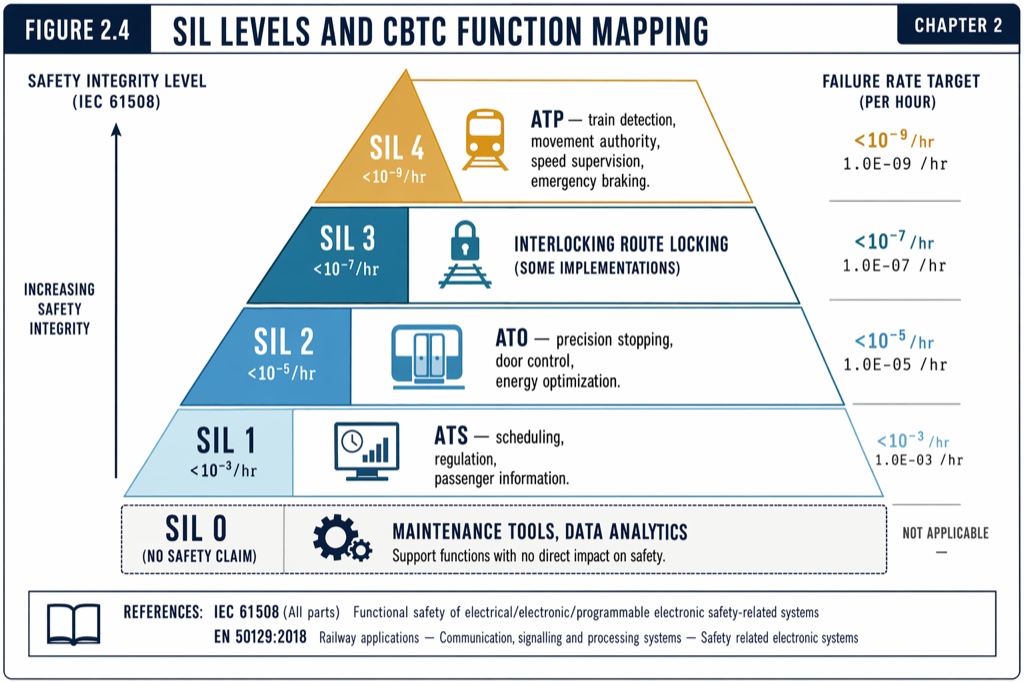 Each SIL is a tenfold reduction in tolerable failure rate, with engineering rigor compounding upward.
What SIL 4 costs
The engineering effort multiplier from SIL 2 to SIL 4 is typically in the range of 2 to 3 times. Industry reference figures for a SIL 4 ATP subsystem versus an equivalent SIL 2 implementation suggest:
- Requirements and specification effort: roughly 2 times. Formal methods discipline takes longer than narrative requirements.
- Design and review effort: roughly 2.5 times. Multi-stage review and formal architecture documentation take longer.
- Code development effort: roughly 1.2 times. Coding is not the dominant cost; the surrounding rigor is.
- Testing effort: roughly 3 times. Exhaustive coverage and traceability matrices add substantial work.
- Documentation and safety case effort: roughly 3 times. The safety case is the largest single SIL 4 deliverable.
Direct costs add to that. Formal methods tools, certified development environments, automated static analysis platforms, and Independent Safety Assessor services all add to the SIL 4 budget. A reasonable industry assumption for the SIL 4 engineering and certification cost on a CBTC ATP subsystem is in the low single millions of dollars, depending on system complexity and the supplier’s existing CBTC platform maturity. (For the V-model lifecycle that organizes this effort, see The V-Model Lifecycle for Safety-Critical Train Control.)
SIL 4 versus PTC
A common point of confusion: Positive Train Control on US mainline freight and commuter rail is generally not certified to SIL 4 in the formal IEC 61508 sense. PTC is regulated by the Federal Railroad Administration under 49 CFR Part 236 Subpart I, with its own functional and safety requirements. PTC’s I-ETMS architecture (the dominant US PTC implementation, primarily Wabtec) achieves a comparable level of safety through a different framework. The two are not directly comparable on the SIL scale; they are two different regulatory and safety-case structures aimed at adjacent operational contexts.
For CBTC procurement, the SIL 4 claim is the relevant one. For PTC procurement, the relevant claim is FRA 49 CFR Part 236 Subpart I compliance, demonstrated through the FRA’s PTC certification process.
The SIL allocation decision
The most common SIL allocation mistake is to specify “the entire CBTC system shall be SIL 4.” This statement is technically meaningless and commercially wasteful. SIL is allocated to functions, not to systems. A CBTC system has dozens of functions; only a subset are SIL 4 candidates.
The right approach is to conduct a Preliminary Hazard Analysis early in the project, identify each safety-related function, and assign the SIL each function actually requires based on the consequence of its failure. The result is typically:
- SIL 4: Movement Authority calculation, brake intervention enforcement, train position validation, on-board safety logic.
- SIL 3: Wayside communication integrity, backup safety layers, certain interlocking functions.
- SIL 1 to SIL 2: Driver advisory functions, non-critical alarms.
- Non-vital: Passenger information, energy optimization, scheduling, ATS dispatcher tools.
This stratification is what allows a CBTC project to keep its certification budget bounded while still achieving the required safety. A single misallocated function does not break the project; a systematically over-conservative allocation does.
Where SIL 4 does and does not apply
SIL 4 applies to the safety-critical core: the ATP function and its supporting infrastructure. It does not apply to:
- The schedule optimizer in ATS.
- The energy efficiency module in ATO.
- The platform information display.
- The fare collection system.
- The maintenance management dashboard.
- The customer mobile app.
A vendor that proposes “SIL 4 throughout” is either misunderstanding the framework or pricing for a margin the agency does not need to pay. A vendor that proposes “SIL 0 throughout” is offering a system that cannot be certified for revenue service. The procurement specification should name the SIL target per function, not per system.
Practical takeaways
- SIL 4 is the highest Safety Integrity Level under IEC 61508, defined as 10⁻⁹ to 10⁻⁸ dangerous failures per hour. It is required for CBTC ATP functions.
- SIL 4 is achieved through layered engineering practices: redundant architecture, diverse software, formal verification, component qualification, EN 50128 lifecycle, exhaustive testing, and Independent Safety Assessment.
- Engineering effort at SIL 4 is roughly 2 to 3 times the equivalent SIL 2 effort, with the safety case and testing burdens dominating the multiplier.
- SIL is allocated to functions, not to systems. A CBTC system has SIL 4 ATP, SIL 0 to SIL 2 ATO, and SIL 0 ATS in most modern deployments.
- Push functions into the right layer. Over-allocating to SIL 4 inflates cost; under-allocating compromises the safety case.
- PTC and CBTC are governed by different safety frameworks. SIL 4 is the relevant claim for CBTC; FRA 49 CFR Part 236 Subpart I compliance is the relevant claim for PTC.
Where to go next
This post is a brief summary. The full treatment lives in Chapter 2 of Communications-Based Train Control (Volume 1 on Amazon). Download Chapter 2 slides (free PDF)
Sources
- Wang, C. (2026). Communications-Based Train Control, Volume 1: Foundations & Technical Architecture. Independent. ISBN 979-8-258-54295-3. — Chapter 2, “Standards, Regulations, and the US Framework.”
- International Electrotechnical Commission. IEC 61508: Functional Safety of Electrical/Electronic/Programmable Electronic Safety-related Systems.
- CENELEC. EN 50126: Railway Applications — RAMS.
- CENELEC. EN 50128: Railway Applications — Software for Railway Control and Protection Systems.
- CENELEC. EN 50129: Railway Applications — Safety Related Electronic Systems for Signalling.
- Federal Railroad Administration. Positive Train Control (PTC) Overview. railroads.dot.gov
- IEEE Standards Association. IEEE Std 1474.3: Standard for Safety Assurance in Communications-Based Train Control (CBTC) Systems.
How this article was produced. Drafted with AI assistance, then reviewed and fact-checked by Chunjun (Francisco) Wang against Communications-Based Train Control (the author's two-volume reference) and primary sources — agency records, vendor documentation, and IEEE/IEC standards. Every date, vendor, and figure is traceable to a cited source. Spot a mistake? Corrections are welcome via the contact page.
Read the full treatment in the book
Chapter 2 of Communications-Based Train Control, Volume 1, covers this in depth.