agency-case-studies · Article
NYCT Mainline vs Branch Lines: Why the Pace Differs

In 2009, after a roughly twelve-year program from 1997 Request for Proposal (RFP) issuance to full revenue service, the Metropolitan Transportation Authority (MTA) declared full Communications-Based Train Control (CBTC) operation on the L Line — a single, largely linear Brooklyn-to-Manhattan subway line of 10.5 miles, 24 stations, and homogeneous rolling stock. In 2018, after roughly an eight-year program from 2010 procurement to revenue, the MTA delivered CBTC on the 7 Line. By 2024, on the Queens Boulevard Line (E, F, M, R), the MTA had reached partial CBTC revenue service — but only on a fraction of the corridor, and only after roughly eleven years of installation work since the 2013 contract award. Full Queens Boulevard CBTC is not now expected before 2030. The 8th Avenue Line (A, C, E) remains in early planning. The pace difference between branch and mainline is not a story of technical regression at the MTA. It is the product of operational arithmetic that every US transit agency contemplating a multi-line CBTC program needs to understand.
The two-tier deployment pattern
The MTA’s New York City Transit subway is not a single network with a single CBTC schedule. It is a federation of corridors with very different signal modernization difficulty, and the difference is structural rather than political. The L Line and the 7 Line are, in the strict topological sense, branch lines: each connects to the rest of the network at one or two points, but otherwise operates on its own track, with its own fleet, its own dispatcher territory, and its own performance envelope. The Queens Boulevard, 8th Avenue, and Lexington Avenue trunks are different. They carry multiple services on shared track, they interlock with branch lines and other trunks at every other station, they share fleet across services, and they do not have a single homogeneous performance envelope.
For a CBTC project, that distinction shows up in five places at once: the contract scope, the cutover staging, the test window availability, the fleet retrofit logistics, and the operating concept that the wayside zone controllers have to enforce. The L Line and 7 Line could be specified, procured, installed, tested, and cut over as discrete programs. Queens Boulevard cannot. (For the L Line’s cutover discipline, see NYC MTA L Line CBTC: 25 Years of Lessons.)
This article walks through why that is, what the consequences look like in budget and schedule, and what the lesson is for any other US agency planning a multi-corridor program.
Why the L Line was tractable
Three structural facts made the L Line a defensible first US CBTC retrofit. First, geometry. The L Line runs from 8th Avenue–14th Street in Manhattan to Canarsie–Rockaway Parkway in Brooklyn on a largely linear, two-track right-of-way. Apart from the 8th Avenue terminal complex and the merge points at Broadway Junction, the line operates without service-level interaction with other subway services. A zone controller computing Movement Authority for a train on the L Line does not need to coordinate with a controller on a different service competing for the same track. Second, fleet. By 2009, the L Line was operated by R143 (delivered 2001) and R160 (delivered from 2006) cars, both factory-equipped with Siemens Vehicle On-Board Controllers (VOBCs) and both sharing one braking-performance envelope. The wayside computed one curve and applied it to every train. Third, audience. Pre-CBTC scheduled service was 15 trains per hour at four-minute headways. The capacity case for moving block was decisive: doubling the theoretical ceiling. Stakeholder skepticism collapsed quickly when the first revenue trains in 2006 ran on time.
The Siemens Trainguard MT contract was approximately $340 million at award, ultimately delivered at approximately $500 million — a roughly 47 percent escalation, but on a defined scope. The thing that made the L Line program finishable in twelve years was that everybody — Siemens, the MTA, TWU Local 100, the Federal Transit Administration (FTA) review, the New York State Public Transportation Safety Board — was operating on a single, continuous, identifiable line. The conversation about scope did not have to renegotiate every six months because somebody on a connected service had a different idea.
Why the 7 Line repeated the trick
The 7 Line was the second US CBTC retrofit, delivered to full revenue service on November 1, 2018, against a 2010 contract award to Thales (with Siemens as a subcontractor) for approximately $560 million. The 7 Line is 13.7 miles, 22 stations, branch-line topology in the same operational sense as the L Line, and again equipped with a homogeneous fleet purpose-built for CBTC. The 7 Line program took about eight years to complete from contract award to revenue service — faster than the L Line because the agency had now been through the full lifecycle once, the labor agreement framework was already in place, and the testing methodology had been validated.
The 7 Line is the cleanest existence proof in the US for the proposition that, given a branch-line corridor with a homogeneous fleet, an agency that has already shipped one CBTC line can ship the next in roughly half the calendar time. (See NYC 7 Line, Queens Boulevard, and Beyond for the broader MTA CBTC roadmap.)
 The branch-versus-trunk distinction is topological, and it determines CBTC pace.
Why Queens Boulevard is harder than two L Lines
Queens Boulevard breaks every assumption that made the L Line and 7 Line tractable.
First, four services run on the same track. The E and F operate the express tracks; the M and R operate the local tracks. A zone controller along Queens Boulevard cannot compute one Movement Authority and apply it to every train, because two different services may be in the same zone at the same time on different tracks, with different stopping patterns and different upcoming junctions. The wayside has to compute and supervise multiple authority streams simultaneously, and the operating concept has to define how trains hand off when a service crosses from express to local or vice versa.
Second, fleet is mixed and not all factory-CBTC. The Queens Boulevard fleet has historically blended R160s (CBTC-compatible) with R46s and R68s (legacy, requiring retrofit kits) and now the new R211 cars (factory-equipped). The CBTC system has to support trains with different VOBC versions, different performance envelopes, and different commissioning histories on the same track. Headway is paced by the slowest fleet variant in the consist, which means that the capacity gain visible on the L Line cannot be fully realized on Queens Boulevard until fleet rationalization completes — a multi-year program in itself.
Third, branch interactions matter. Queens Boulevard interlocks with the 63rd Street tunnel, the 53rd Street tunnel, the Archer Avenue extension, the Forest Hills terminal, and the connection to 8th Avenue at 50th Street. Each junction is an interface with a non-CBTC service or with a different CBTC project on a different schedule. Cutover from legacy signaling to CBTC at a junction is not a unilateral decision; it is a negotiated event with the rest of the system.
Fourth, test windows are scarce and short. NYCT operates 24/7. The L Line and 7 Line had legitimate weekend and overnight closures available because each line has shuttle alternatives. Queens Boulevard cannot be closed without disrupting four services and the connections that depend on them. The result is that test cycles that on the L Line could be staged in a single 8-hour window have to be staged across multiple short windows, with re-staging cost every time. (For the broader budget consequence, see Why CBTC Projects Run 30%+ Over Budget.)
Fifth, the cost story reflects all of the above. The Queens Boulevard Phase 1 contract, originally approximately $205 million for Siemens, has grown to over $300 million, with cost overruns of roughly 40 to 50 percent above initial estimates by 2023. Phase 2 is in design. Phase 3 is in planning. Full Queens Boulevard CBTC operation is now projected beyond 2030.
Why 8th Avenue and Lexington are harder still
The 8th Avenue Line (A, C, E) and the eventual Lexington Avenue Line (4, 5, 6) compound everything that makes Queens Boulevard difficult. The 8th Avenue trunk runs three services across 61 stations through Manhattan, Queens, and Brooklyn, with branch interactions at Broadway-Nassau, World Trade Center, 50th Street, 168th Street, and the Far Rockaway and Lefferts Boulevard divisions. Lexington Avenue is the busiest single-line corridor in the United States, carries three services, has the longest interlocking complex in the system at 149th Street, and connects to half of the rest of the network. Neither corridor can be cut over as a single program; both have to be staged in segments, with mixed-mode operation across the boundary for years.
The MTA’s published timeline puts 8th Avenue procurement in the 2025–2029 capital cycle. Realistic full-line CBTC operation is therefore a 2040s event. Lexington Avenue is even further out. This is not pessimism. It is the calendar arithmetic that follows from the trunk-line operating concept.
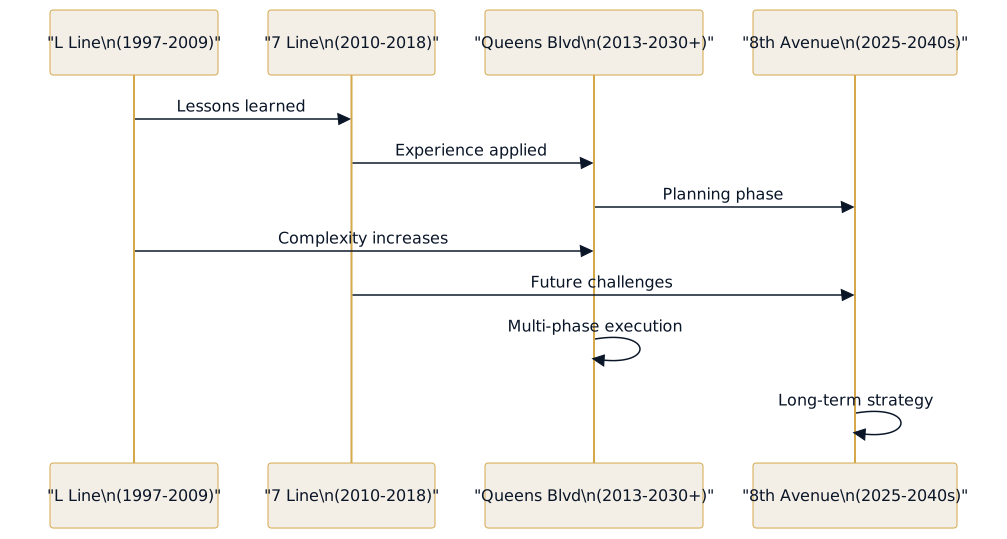 Branch-line CBTC ships in roughly a decade. Trunk-line CBTC takes two.
What this means for US transit agencies
Five things follow from the NYCT branch-versus-trunk pattern that other US agencies should price into their own CBTC programs.
First, start with a branch line if the network has one. The L Line was the right first project for NYCT because it was the cleanest available test of the technology and the institutional relationships. Bay Area Rapid Transit (BART), Washington Metropolitan Area Transit Authority (WMATA), and the Massachusetts Bay Transportation Authority (MBTA) face the harder problem of not having a true branch-line equivalent, and their CBTC programs have correspondingly heavier institutional lift in the first segment.
Second, fleet rationalization is a CBTC milestone, not an adjacent activity. The L Line and 7 Line shipped on time because the fleet was already CBTC-compatible. Queens Boulevard’s pace has been gated in part by the R211 procurement and the legacy fleet retirement schedule. Agencies planning trunk-line CBTC should price fleet replacement into the CBTC schedule, not next to it.
Third, operating concept lockdown is the highest-impact early decision. International experience cited in Chapter 11 of Communications-Based Train Control (Volume 2) shows that the agencies that wrote a finalized Operating Concept (OpCon) before issuing the RFP — Paris Lines 1 and 14, Copenhagen, Dubai, Singapore — shipped on schedule. The agencies that allowed the operating concept to evolve during procurement — including, in places, NYCT itself on the harder corridors — paid the cost in extended testing and scope evolution. (See How to Write a CBTC RFP That Doesn’t Lock You Into One Vendor for the procurement implication.)
Fourth, trunk-line CBTC is a programmatic exercise, not a project. Any trunk corridor with multiple services, mixed fleet, and branch interactions is necessarily multi-phase, multi-decade, and multi-vendor over its lifecycle. Treating it as a single project — one contract, one vendor, one cutover — is the most common single-source schedule failure in US CBTC.
Fifth, pace differences are normal and should not be read as agency dysfunction. The L Line shipped fast because it was a tractable problem. Queens Boulevard is shipping slowly because it is a harder problem. The L Line did not become hard; the agency did not become slow. The question for other agencies is not “why isn’t NYCT going faster” but “what does my own corridor look like, and which of these patterns does it match.” Phoenix, Seattle, and Denver light rail — for distinct reasons, see Phoenix, Seattle, Denver: Why Their LRTs Avoided CBTC — face yet another version of the same arithmetic: their networks do not justify CBTC capital. WMATA and BART, by contrast, face the trunk-line version of the NYCT problem.
Practical takeaways for US transit agencies
- Treat branch-line CBTC as an existence proof for the technology and the institutional relationships, not as a guarantee that the next corridor will follow the same calendar.
- Price trunk-line CBTC in two-decade units. The first phase is unlikely to deliver before year ten; full corridor cutover is unlikely to deliver before year twenty.
- Synchronize fleet replacement with CBTC milestones explicitly in the capital plan. Mixed-fleet operation paces every gain.
- Lock down the operating concept — including service interactions at every junction — before the RFP, not during design.
- Carry contingency at 30 to 50 percent over baseline contract value on any trunk-line CBTC retrofit. The Queens Boulevard 40-to-50 percent escalation is the realistic floor, not the ceiling.
Where to go next
This post is an 11-minute summary. The full treatment of US CBTC deployment patterns lives in Chapter 10 (“CBTC in the United States”) of Communications-Based Train Control (Volume 2). Buy on Amazon. Download Chapter 10 slides (free PDF).
Sources
- Wang, C. (2026). Communications-Based Train Control, Volume 2: US Deployment, Procurement & Future Directions. Independent. ISBN 979-8-258-54295-3. — Chapter 10, “CBTC in the United States” (Sections 10.1–10.2 on NYC L Line and Queens Boulevard).
- MTA New York City Transit. Communications-Based Train Control Status Update. new.mta.info/project/communications-based-train-control-cbtc
- MTA. 2020–2024 Capital Program. new.mta.info/transparency/capital-program-dashboard
- Federal Transit Administration. Capital Investment Grants Program. transit.dot.gov/CIG
- Office of the New York State Comptroller. MTA Capital Program Audit Reports. osc.state.ny.us
- IEEE Standards Association. IEEE Std 1474.1: Standard for Communications-Based Train Control (CBTC) Performance and Functional Requirements.
- New York City Office of the Comptroller. Audit Reports on MTA Capital Program. comptroller.nyc.gov
How this article was produced. Drafted with AI assistance, then reviewed and fact-checked by Chunjun (Francisco) Wang against Communications-Based Train Control (the author's two-volume reference) and primary sources — agency records, vendor documentation, and IEEE/IEC standards. Every date, vendor, and figure is traceable to a cited source. Spot a mistake? Corrections are welcome via the contact page.
Read the full treatment in the book
Chapter 10 of Communications-Based Train Control, Volume 2, covers this in depth.